On this page · 8 sections6 min read
What a barre instructor does
A barre instructor leads an exercise class using the movement vocabulary and teaching approach of the chosen method. The broader O*NET fitness-instructor profile describes demonstrating exercises, observing participants, and adapting instruction. For barre, teaching skill includes clear cues, manageable transitions, and attention to the people in the room rather than only performing the choreography.
Decide where you want to teach before choosing a course. An independent studio, a gym, and a branded operation may have different expectations about choreography, training, and auditions. A general credential can establish one kind of preparation while a studio still expects you to learn its specific class format.
A useful first teaching exercise is a simple sequence that you can explain without continuously looking at notes. Ask an observer to watch whether participants understand the setup and know what options are available. Clarity is a more useful early goal than making the sequence unusually difficult.
Do you need a license or certification?
The cited fitness and IBBFA sources do not establish a nationwide government license specifically for barre instruction. Private certification and employer requirements are the central credential distinctions for these courses. A barre certificate is not a medical or physical-therapy license and should not be advertised as one.
IBBFA describes its examination as a foundation assessment distinct from branded method certifications. It offers preparation pathways leading to its own written and practical evaluation. That is the association’s credential framework, not proof that every US studio legally requires an IBBFA credential. IBBFA examination overview
Ask the studio which exact training it accepts and whether an additional audition or internal course is required. If the studio names Barre Intensity or another method, determine whether it wants that method’s training specifically. Do not assume that similarly worded certificates are interchangeable.
Check emergency-response and insurance requirements with the employer, venue, and credential issuer. Those conditions can be separate from the barre course itself. Confirm the CPR requirement for the particular studio or venue where you want to teach; a general barre certificate does not settle that question.
For specialized populations or clinical concerns, understand the limits of your preparation. A short prenatal or other specialty module is not a substitute for a healthcare license. Ask how the curriculum handles referral and participant choice rather than treating a specialty title as authority to manage every condition.
Step-by-step: how to become a barre instructor
- Take classes with attention to teaching. Notice how instructors establish positions, pace transitions, and offer options. Write down what helps you understand the sequence so that your course comparison focuses on teaching methods as well as exercise content.
- Identify your target studio’s requirements. Ask about accepted certificates, method training, auditions, and emergency-response qualifications. Resolve these details before paying for a course whose credential may not match the employer’s expectations.
- Choose foundation or method training deliberately. Read the curriculum and assessment rather than assuming every barre course has the same purpose. Ask what prior fitness knowledge is expected and whether a beginner needs additional instruction.
- Practice cueing with observation. Lead a simple sequence for consenting practice participants and request feedback. Evaluate whether your words, demonstration, and pacing agree, especially when you are watching the class instead of performing every movement.
- Learn appropriate alternatives and limits. Ask the instructor how the method handles varied ability levels and requests outside scope. Do not improvise rehabilitation advice when a participant describes pain or a medical concern.
- Complete the actual assessment. Find out whether graduation requires a written test, recorded teaching, live evaluation, or another demonstration. Keep the credential name and issuer accurate on your resume and studio application.
- Prepare a class and operational plan. Rehearse setup, equipment checks, music arrangements, introduction, and closing. For online teaching, test the camera view and explain the limitations of what you can observe remotely.
For an audition rehearsal, ask a reviewer to focus on transitions. Many teaching problems occur between exercises, when participants are changing position or equipment while listening to the next instruction. Write the transition cues into your plan and practice them as deliberately as the movements.
Also rehearse losing your place. A prepared instructor should be able to pause, simplify, and resume without pushing participants through a confusing sequence. That ability is more useful than memorizing a complicated routine that works only when nothing interrupts it.
How long it takes and what it costs
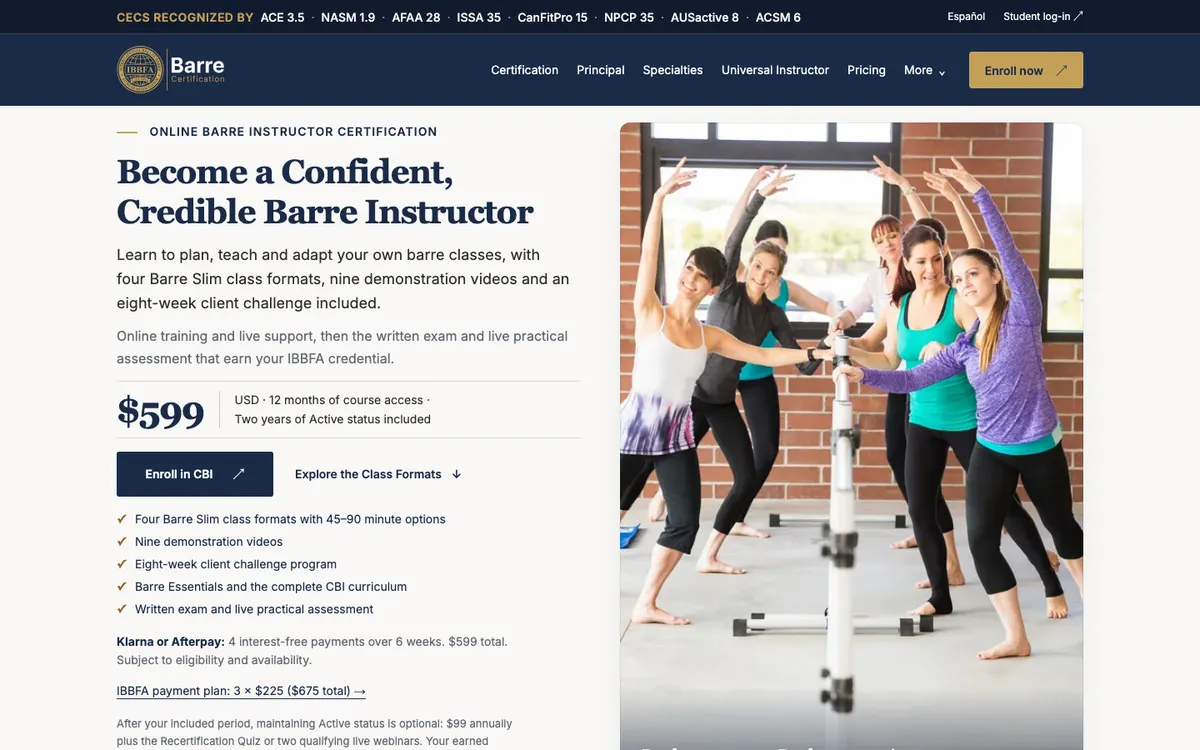
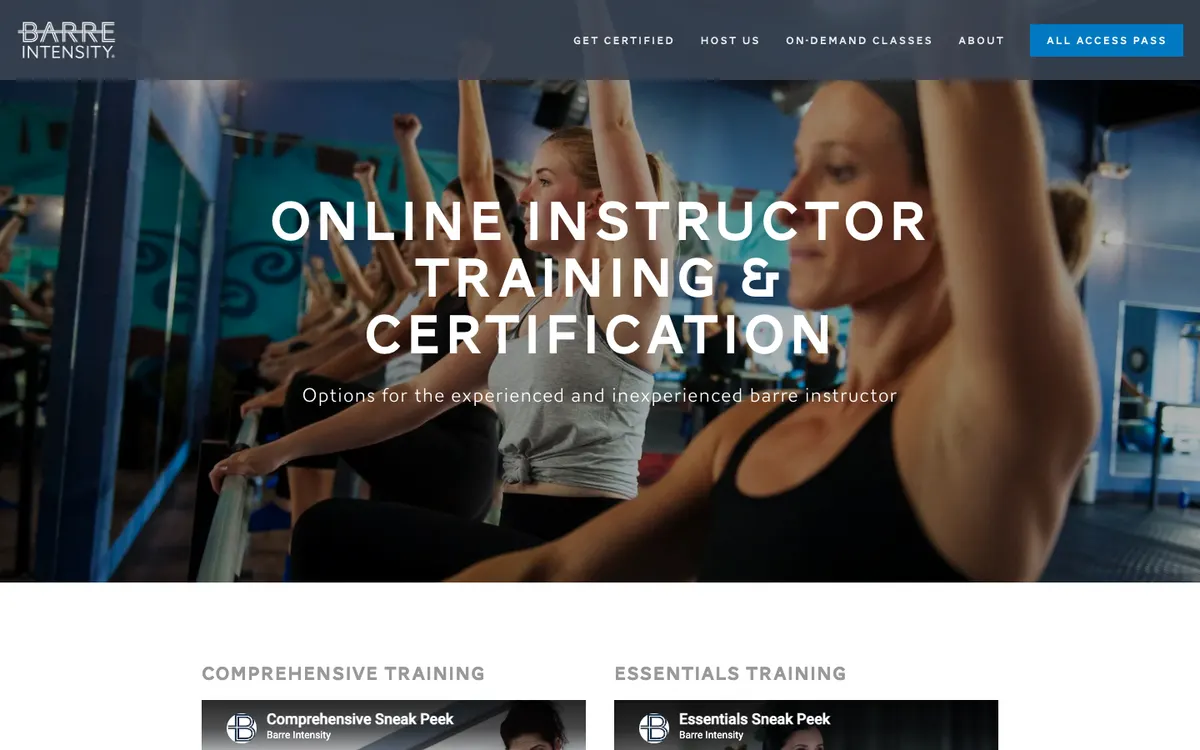
Entry-course prices here include $199 for Barre Intensity Essentials, $395 for its Comprehensive Training, and $599 for IBBFA’s CBI. The curriculum scope differs at each price. Keep advanced tracks, specialty modules, and recurring choreography access separate when choosing your initial preparation.
IBBFA Certified Barre Instructor (CBI) and Principal Track charges $599 for CBI certification, $1,297 for direct Principal Instructor Track enrollment, or $898 for a CBI-holder upgrade. Both are self-paced: CBI includes 12 months of course access and Principal includes 24 months.
Barre Intensity Online Instructor Training & Certification prices Comprehensive Training at $395, Essentials and BIIT at $199 each, Prenatal/Postnatal at $175, and Advanced Cueing at $99. Its online courses are self-paced; examples include a 7.5-hour prenatal course and 3.5-hour advanced-cueing course. Choreography membership is a separate $14.99/month or $119.99/year purchase.
IBBFA’s twelve-month CBI access term is not a claim that the course requires a year to finish. Likewise, short hour counts attached to specialty modules do not describe a complete beginner pathway. Ask for the expected study and teaching-practice workload of the exact course you plan to buy.
Budget separately for any assessment, retake, renewal, or required supporting credential after verifying the package. If you want ongoing choreography access, check whether that subscription is optional and what happens when it ends. Your right to use branded material may depend on terms beyond the initial course certificate.
Best online programs for aspiring barre instructors
There are two providers in this ranked selection. Compare the foundation credential with method-specific instruction, and ask your intended studio which training and practical assessment it accepts before choosing a package.
- IBBFA Certified Barre Instructor (CBI) and Principal Track offers CBI preparation and its own foundation-credential examination framework.
- Barre Intensity Online Instructor Training & Certification offers distinct Essentials, Comprehensive, and specialty courses rather than one interchangeable package.
Consult the Barre Instructor Certification comparison for reviews covering the foundation, comprehensive, and specialty choices.
Top programs compared
The 2 highest-scored online barre instructor certification programs in our ranking, side by side.
| Criterion | ||
|---|---|---|
| Our score | 8.8/10 | 8.6/10 |
| Price | $599 – $1,297 | $99 – $395 |
| Format | Self-paced | Self-paced |
| Duration | Self-paced; CBI includes 12 months of course access, Principal 24… | Self-paced online courses (e.g. 7.5-hour prenatal course, 3.5-hour… |
| Accreditation | CECs recognized by ACE (3.5), NASM (1.9), AFAA (28), ISSA (35), CanFitPro (15), NPCP (35)… | Courses approved for ACE and AFAA/NASM CEUs (e.g. Comprehensive: 1.3 AFAA/NASM, 1.4 ACE) |
| Free trial | — | 7-day free trial of the choreography membership |
| Best for | Fitness instructors who want a self-paced barre certification with a live practical exam… | Fitness instructors who want an affordable barre certification that also earns ACE and… |
| Full review | IBBFA (International Barre Body Fitness Association) review | Barre Intensity review |

Scores from our editorial method. See the full ranking of 2 programs.
Common mistakes to avoid
Do not buy a specialty module as your only preparation if it assumes existing teaching skills. A prenatal or advanced-cueing course may deepen a foundation without supplying it. Check prerequisites and the intended learner before using price or duration to compare it with comprehensive training.
Avoid assuming that personal dance experience automatically translates into group-fitness teaching. Demonstrating a position and helping a mixed-ability class understand it are different tasks. Seek feedback on cueing, observation, and alternatives rather than relying only on your own movement quality.
Do not repeat an association’s claim of industry recognition as a universal legal requirement. Ask the studio or employer what it accepts and document the answer. A credential can be useful without being mandatory everywhere.
When comparing online options, inspect the practical assessment carefully. A course can offer excellent explanations but still require you to arrange practice participants and a suitable recording space. Put those requirements into the schedule before the access period begins.
FAQ
Is IBBFA certification required by law for every barre class?
The IBBFA page describes a private credential, not a nationwide government licensing rule. Confirm employer and local requirements for your intended setting.
Are foundation and method credentials identical?
No. IBBFA explicitly distinguishes its foundation assessment from method-specific training. Ask the studio which preparation it expects.
Does the cheapest Barre Intensity course cover everything?
Not necessarily. The Barre Intensity listing includes Essentials, Comprehensive Training, and specialty products with different purposes. Compare the exact syllabus.
Is twelve months the required time to finish CBI?
The IBBFA review specifies twelve months of course access. That is an access window, not a universal completion duration.