On this page · 8 sections6 min read
What a breathwork facilitator does
A breathwork facilitator guides a defined breathing practice, explains participation choices, and manages the session setting. The International Breathwork Foundation’s ethics guidance frames breathwork as a nonmedical practice and emphasizes professional conduct. A provider’s use of words such as healing or transformation should not be treated as proof of clinical authority or guaranteed benefit.
Different courses may teach substantially different methods. Ask the school to describe the actual practices, the intended participants, and the level of intensity before comparing credentials. A quiet awareness exercise and an intensive facilitated session should not be assumed to require identical preparation simply because both are labeled breathwork.
A useful first learning goal is explaining a session accurately. A participant should understand what they are being invited to do, how to decline or stop, and what support is available. Training should assess those communication skills as well as the facilitator’s familiarity with the method.

Do you need a license or certification?
The IBF guidance cited here do not establish a single nationwide government breathwork-facilitator license. Private certificates and professional-association standards are different from state medical or mental health licenses. Before offering services, check the rules relevant to the actual activities and claims you intend to make.
IBF explicitly states that breathwork is not a medical practice and that listed professionals are not offering diagnosis or treatment of disease. Its ethical framework is useful for evaluating a school, but it is not a government authorization. A private course should not be marketed as a substitute for clinical training. IBF ethics and standards
Ask the provider which organization issues the credential, whether an outside body recognizes it, and what that recognition means. Some training may certify use of a particular method or commercial system. That is different from an independently assessed professional qualification and may come with separate rules about branding, music, or ongoing access.
For work with participants who have health concerns, obtain appropriate qualified guidance rather than relying on a generic checklist copied from another method. This guide does not establish a universal screening protocol or list of contraindications. A serious training program should explain its own screening, referral, supervision, and emergency procedures clearly enough for you to evaluate them before paying.
Also check the setting’s requirements. A studio, employer, insurer, or healthcare organization may have conditions beyond a school certificate. If you plan to teach remotely, ask how the method is adapted when you cannot directly observe or assist a participant.
Step-by-step: how to become a breathwork facilitator
- Understand the method as a participant and learner. Ask for a plain-language explanation of the practice and its intended purpose. Do not choose a training solely from dramatic promotional footage that gives little information about the session process.
- Investigate scope and evidence. Separate claims about relaxation or personal experience from claims about treating a condition. Ask the school which claims graduates are permitted to make and what evidence supports them, without assuming that provider confidence resolves uncertainty.
- Compare supervised learning. Find out whether an instructor observes you leading sessions, how feedback is delivered, and whether competence is required for graduation. Watching demonstrations does not reveal how you will respond when someone declines an instruction or becomes uncomfortable.
- Learn consent and participant communication. Practice explaining choices without pressuring people to continue. Your introduction should make opting out ordinary, and your advertising should match the actual experience rather than promising a specific emotional response.
- Clarify screening and escalation procedures. Ask who develops the protocol, how uncertain cases are handled, and when another professional should be consulted. Rehearse the procedure under supervision instead of inventing a response during a real session.
- Lead practice sessions within the training arrangement. Keep the audience and method within your current competence, collect feedback with consent, and review the session with a qualified supervisor. Distinguish learning practice from independent professional experience.
- Prepare the operational details. Confirm venue arrangements, participant information, sound or equipment needs, and the support available during the session. If a branded system is involved, understand the permissions and recurring costs before offering it commercially.
For a useful rehearsal, ask an observer to interrupt your introduction with ordinary questions: whether a participant may keep their eyes open, stop early, or avoid a particular element. Assess whether you can respond without shaming the person or making a medical judgment. This tests the participant experience more directly than reciting the method’s terminology.
Review the end of the session as carefully as the beginning. Explain what feedback you are inviting and how a participant can raise a concern afterward. Do not reinterpret a negative experience as proof of progress merely because the training uses a transformation narrative.
How long it takes and what it costs
Flow provides a tuition figure, while 9D’s price needs confirmation. Flow’s $4,200 standard tuition and $3,200 early-bird offer give you two prices within one program, not a category-wide range. Obtain the exact 9D package quote before deciding which training is more affordable.
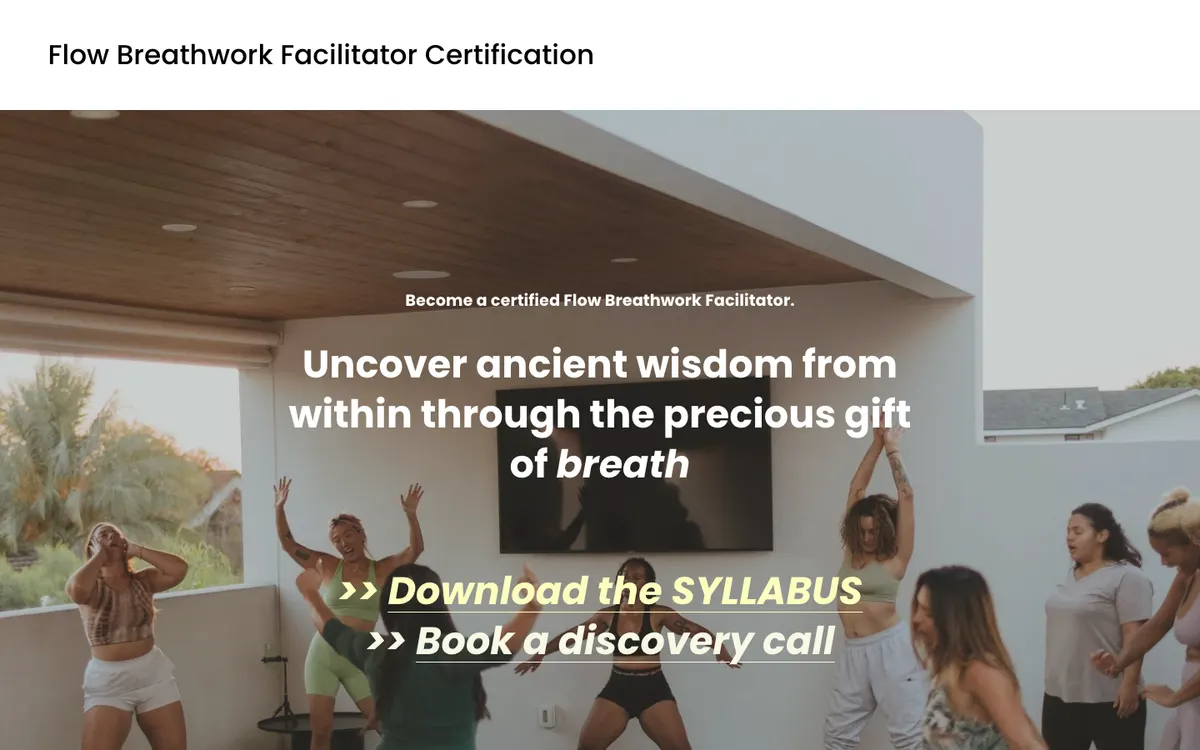
Flow Breathwork Facilitator Certification costs $4,200, with early-bird enrollment at $3,200. Allow about 12 weeks at roughly 7 hours per week; the program also specifies 3 months of mentorship.
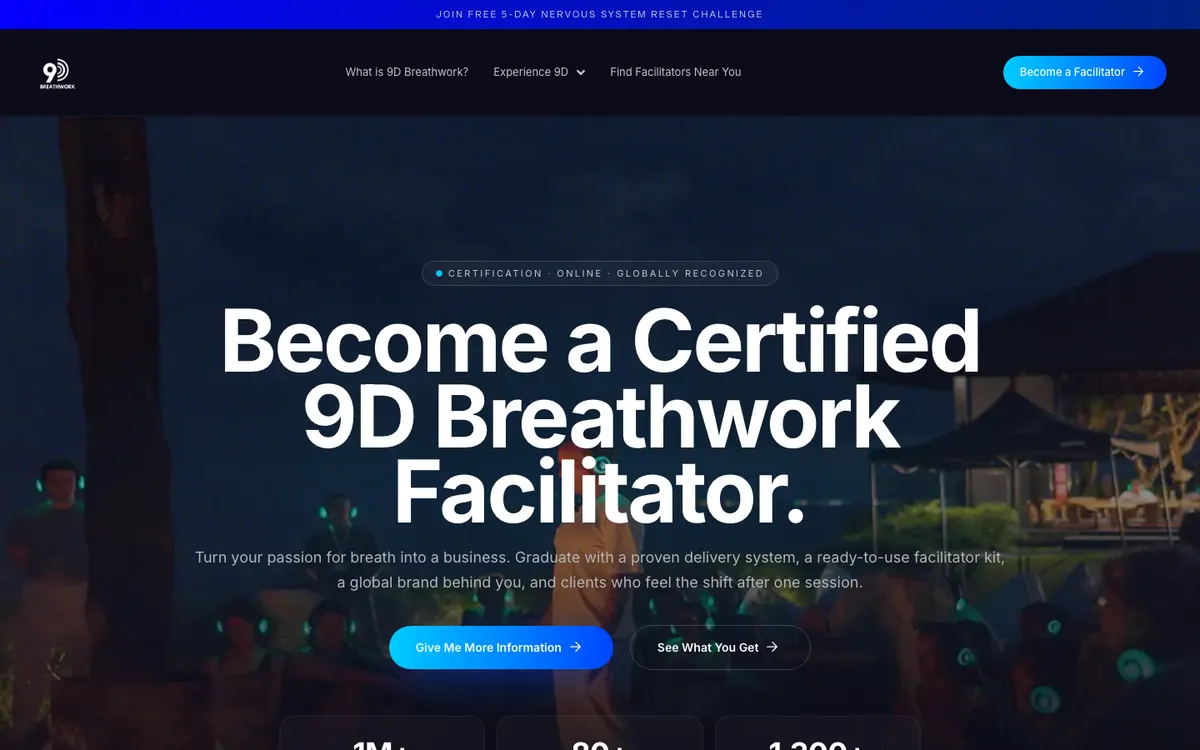
9D Breathwork Facilitator Certification is self-paced online, and the site says most learners finish in a few months. Tuition is not confirmed here, so request a written quote for the precise course and commercial-use package you are considering.
Flow’s training schedule is about twelve weeks with a weekly workload estimate and mentorship. The 9D entry describes self-paced study and a provider claim that many learners finish in a few months. Neither description establishes that every graduate is ready for every population or session format at that point.
Ask for the full commercial-use budget if you plan to run paid sessions. Equipment, music permissions, platform access, supervision, and method licensing may be relevant, but no amount should be assumed without a quote. Determine which costs are optional and which are necessary to deliver the exact service you intend to advertise.
Best online programs for aspiring breathwork facilitators
This category has two training options, shown in rank order. Compare the method, supervised facilitation, participant screening, and commercial-use terms alongside the delivery format; those details matter more than the shared certification label.
- Flow Breathwork Facilitator Certification uses a hybrid format.
- 9D Breathwork Facilitator Certification uses a self-paced format.
Read both reviews through the Breathwork Certification comparison to examine Flow’s hybrid approach and 9D’s self-paced offer.
Top programs compared
The 2 highest-scored online breathwork certification programs in our ranking, side by side.
| Criterion | ||
|---|---|---|
| Our score | 8.1/10 | 7.9/10 |
| Price | $3,200 – $4,200 | — |
| Format | Hybrid | Self-paced |
| Duration | About 12 weeks at roughly 7 hours per week; 3 months of mentorship | Self-paced online; the site says most finish in a few months |
| Free trial | — | 7-day free trial of the 9D Breathwork app (consumer… |
| Best for | Aspiring breathwork facilitators who want a structured 12-week certification with live… | People who want a turnkey breathwork facilitation system with a ready-made audio method… |
| Full review | Flow Breathwork Facilitator Training (AlwaysPlay Studios) review | 9D Breathwork review |
Scores from our editorial method. See the full ranking of 2 programs.
Common mistakes to avoid
Do not confuse an emotionally intense session with evidence of a beneficial outcome. A facilitator’s role includes respecting individual responses and limits. Choose training that welcomes critical questions and participant choice rather than requiring one interpretation of every experience.
Avoid buying a branded system before understanding its continuing obligations. Ask what happens to your permission to use its materials if a subscription ends. A training certificate and access to commercial assets may be governed by different agreements.
Do not copy another facilitator’s intake or health screening without understanding the method it was designed for. Obtain the training’s current protocol and appropriate professional guidance. If a school cannot explain who is responsible for uncertain cases, resolve that gap before practicing independently.
FAQ
Is a breathwork certificate a medical qualification?
No such equivalence is established. IBF describes breathwork as nonmedical and distinguishes it from diagnosis or disease treatment.
Can I compare Flow and 9D by total tuition?
Not without a current quote from 9D. The Flow listing has a tuition quote, while the 9D listing lacks a usable price.
Does self-paced mean there is no practical assessment?
Not necessarily; it describes scheduling, not assessment. Ask the provider what teaching demonstrations and feedback are required, using the category comparison as the starting point.
What should I ask before paying?
Request the method, intended audience, assessment, supervision, scope, and commercial-use terms. Compare those answers with the professional boundaries described by IBF’s ethics guidance.