On this page · 8 sections6 min read
What a digital marketer does
A digital marketer helps an organization reach an audience, communicate an offer, and evaluate what happens afterward. O*NET’s Search Marketing Strategists profile includes campaign tracking, web-metric analysis, search optimization, and coordination with developers. That profile covers a search-oriented part of a broader field that also includes email, social channels, and e-commerce. O*NET.
The practical task is to connect an audience and objective to a measurable action. Writing social posts, configuring an email sequence, or improving a product page can all be useful, but only when you understand what they are intended to accomplish. Begin with a specific channel or entry-level role rather than trying to master every marketing platform at once.

Do you need a license or certification?
A provider certificate is not a general government digital-marketing license. The cited occupational profile does not establish a mandatory national credential for ordinary marketing work. Employers and clients may still ask for platform knowledge, a portfolio, prior results, or particular educational experience.
Google’s course certificate and any separate advertising-platform certification should be identified by their exact names. Do not imply that a broad career certificate means Google endorses your agency or guarantees a client’s campaign outcome. Check what assessment the credential actually represents and whether it has any maintenance conditions.
Marketing also involves permissions, claims, and client data. Before running a real campaign, confirm authority to use the account, spend the budget, contact the audience, and publish the creative. A training exercise should not quietly become an unauthorized live campaign, and a course cannot substitute for checking the rules that apply to a specific industry or promotion.
Step-by-step: how to become a digital marketer
- Choose a target role and channel. Decide whether you want a broad entry-level foundation or a specialized service such as Pinterest management. Match the curriculum to that decision rather than assuming a niche course covers the entire field.
- Learn the path from message to action. Identify the audience, offer, landing page, and intended response. Understand what a metric represents before building reports around it.
- Create a bounded practice campaign. Use an owned or explicitly authorized project and define the goal, assets, budget if any, and approval process. Label simulations honestly if you do not have a live audience or spending authority.
- Set up measurement before launch. Document how results will be observed and what the data cannot tell you. Check that you are not confusing visits, inquiries, purchases, and revenue as interchangeable outcomes.
- Review and revise with evidence. Compare the observed result with the original hypothesis and explain the next change. Avoid claiming causation from a small or poorly controlled example.
- Build a clear portfolio case study. Show the brief, your contribution, creative or technical work, measurement limits, and lessons learned. Remove private customer information and obtain permission before sharing a client’s figures.
Create an honest campaign case study
Start with a written hypothesis, such as whether clearer product information will help visitors understand an offer. Identify the change you can make and the metric you can observe. If you cannot isolate the change from other activity, state that limitation instead of reporting a precise causal lift.
Save the original assets and the revised version so a reviewer can see what you actually contributed. Explain why a headline, image, audience choice, or page structure was changed. A portfolio with transparent reasoning can be useful even when the project is small.
For a specialized Pinterest service, map the workflow from client assets through publishing and reporting. Ask whether the course teaches account access, content planning, client approvals, and interpretation of analytics. A niche certificate is more useful when it supports a repeatable service process rather than only platform tips.
Choose between broad foundations and a niche service
Compare your target work with the syllabus before deciding that a shorter course is more efficient. A general marketing role may require familiarity with search, email, analytics, and e-commerce, while a Pinterest-management service needs a more focused workflow. The best fit depends on the responsibilities you intend to take on.
Ask whether the course includes feedback on your own campaign plan or only demonstrations. If you will sell a service, practice writing a scope that defines publishing, creative work, reporting, and client approvals. Clear boundaries help prevent a small channel-management assignment from expanding into responsibility for every marketing result.
For any practice report, distinguish measured outcomes from observations and assumptions. Explain the tracking limitations next to the result so a reviewer can assess the claim fairly.
How long it takes and what it costs
The Google certificate’s US and Canada price is $49 per month after its trial, with a provider-estimated six months at ten hours per week. That is a study estimate and subscription model, not a guaranteed total for every learner. Meagan Williamson’s catalog entry includes a $197 essentials course and a separate coaching program with installment payments.
These are different scopes: broad foundational marketing and a Pinterest-focused service path. Compare the full product, support, and billing terms. Add any authorized advertising budget or specialist software separately, and do not describe ad spend as course tuition or assume a course requires a particular live spend without checking.
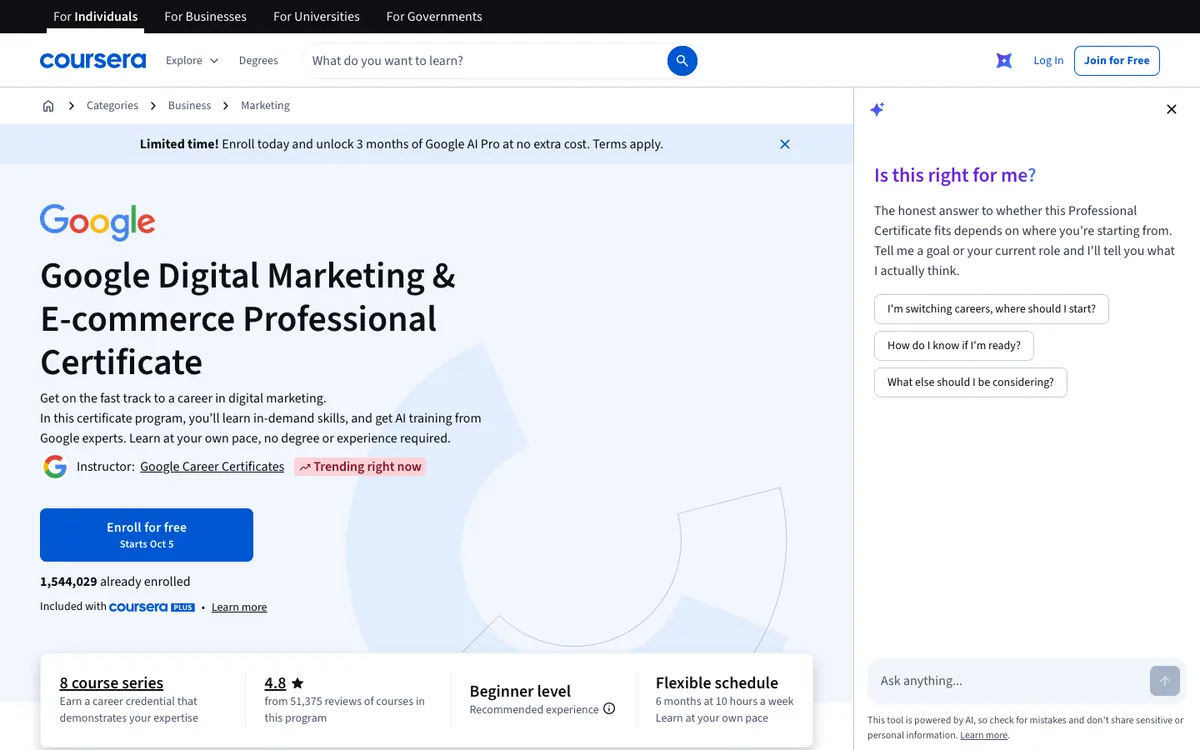
Google Digital Marketing & E-commerce Professional Certificate (Coursera). In the US and Canada, the certificate costs $49 per month after a seven-day free trial. It is also included in Coursera Plus, priced at $59 per month or $399 per year. The series contains eight courses, with an estimated six months of study at 10 hours per week; your subscription cost depends on how long you remain enrolled.
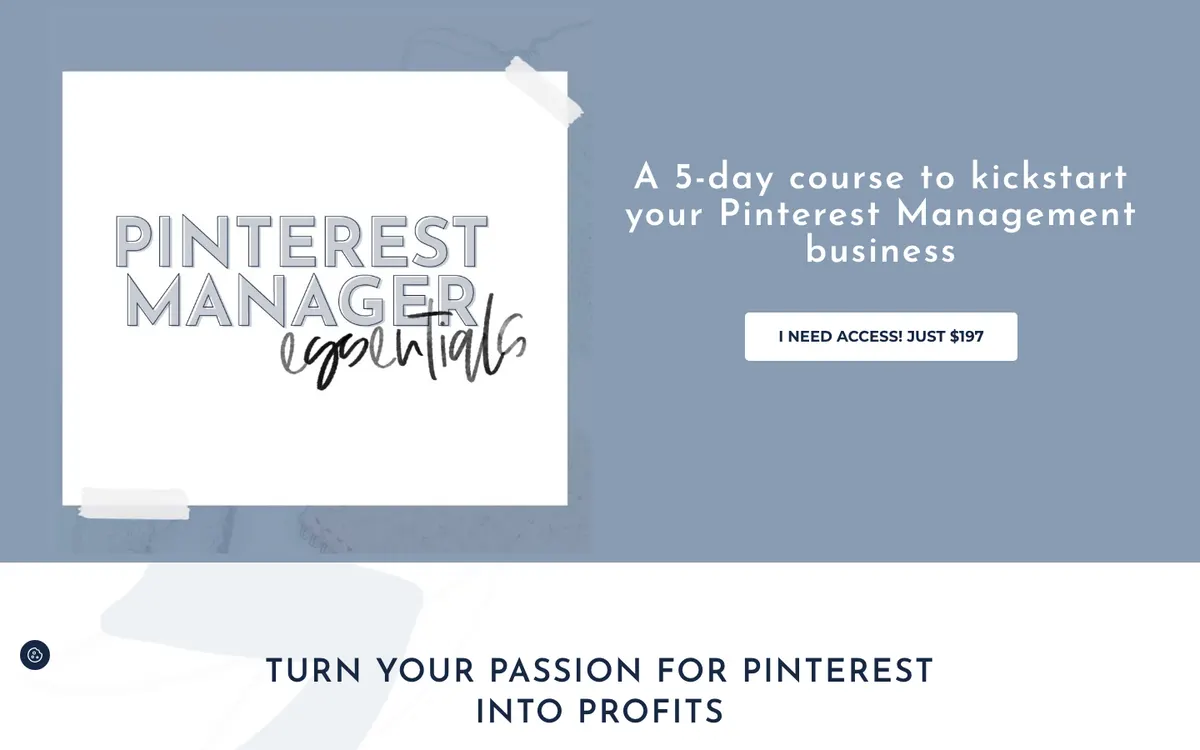
Meagan Williamson Pinterest Manager Courses (Pin Potential, Pinterest VA Accelerator). Pinterest Manager Essentials is a five-day course costing $197 in one payment. The six-week Pinterest VA Accelerator coaching program offers a payment plan of three installments of $525. A price for the separate Pin Potential membership is not shown. Confirm which product provides the service training and support you want.
Best online programs for aspiring digital marketers
The two options differ in breadth. Google provides a foundational marketing and e-commerce curriculum, while Meagan Williamson focuses on Pinterest-related services.
- Google Digital Marketing & E-commerce Professional Certificate (Coursera) gives beginners a budget-conscious foundation for entry-level digital-marketing and e-commerce roles.
- Meagan Williamson Pinterest Manager Courses (Pin Potential, Pinterest VA Accelerator) focuses on a practical, specialized route for aspiring Pinterest managers and virtual assistants who want to sell Pinterest-management services.
The Digital Marketing comparison links to both reviews so you can compare a broad foundation with specialized Pinterest instruction.
Top programs compared
The 2 highest-scored online digital marketing programs in our ranking, side by side.
| Criterion | ||
|---|---|---|
| Our score | 9.1/10 | 8.2/10 |
| Price | $49 – $399 | $197 |
| Format | Self-paced | Self-paced |
| Duration | 8-course series; about 6 months at 10 hours a week. | 5-day essentials course; 6-week VA Accelerator coaching program |
| Free trial | 7-day free trial. | — |
| Best for | Beginners targeting entry-level digital marketing or e-commerce roles on a small budget. | Aspiring Pinterest managers and VAs who want a niche, practical path to selling Pinterest… |
| Full review | Coursera (Google Digital Marketing & E-commerce) review | Meagan Williamson review |


Scores from our editorial method. See the full ranking of 2 programs.
Common mistakes to avoid
Do not treat course completion as a promise of employment or campaign results. A certificate can structure learning while still leaving practical implementation and judgment to be demonstrated.
Avoid presenting simulated metrics as live client results or using a client’s account without explicit authorization. Also avoid buying a narrow platform course when your target role requires broader analytics, email, or e-commerce knowledge. Compare the actual syllabus with the work you want to do.
FAQ
Does the Google certificate require prior experience?
The official course page describes it as beginner-level with no degree or experience required.
Is six months a guaranteed completion time?
No. It is the provider's estimate at its stated weekly study pace. See the Google certificate review.
Is Pinterest training a complete marketing qualification?
The Meagan Williamson review describes a specialized Pinterest-management path. Compare it with the broader skills your intended role requires.
What should I show besides a certificate?
Campaign reasoning and measurement are relevant to ONET's search-marketing duties. Use real, authorized work or clearly labeled simulations.