On this page · 8 sections6 min read
What a drone pilot does
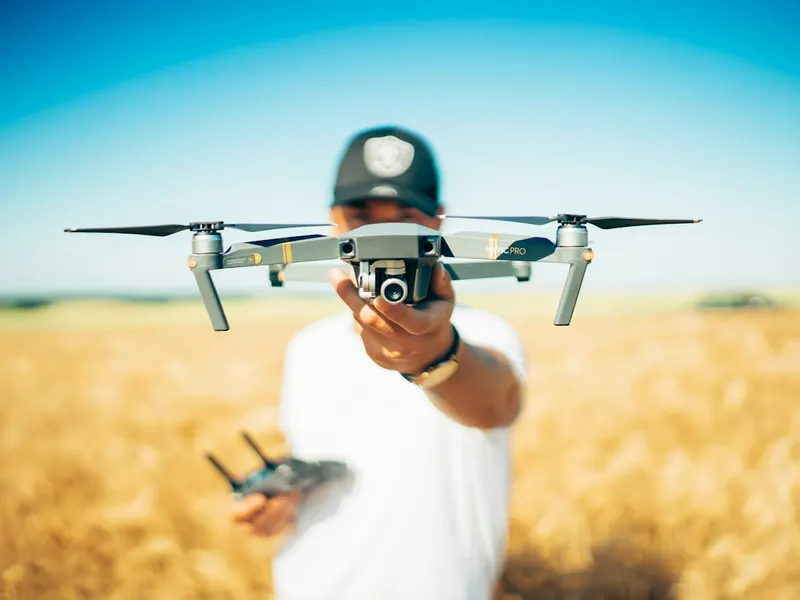
A drone pilot plans and conducts flights for a defined purpose, such as capturing imagery or collecting information for a client. The FAA’s remote-pilot pathway focuses on aviation knowledge, operating requirements, and safe procedures. Buying an aircraft and learning its controls is therefore only part of preparing for work. FAA.
The client deliverable also matters. A pilot supplying edited property images needs different production skills from someone supporting an inspection team. Decide what output you want to provide before buying specialized sensors or assuming that the remote-pilot credential establishes expertise in surveying, engineering, or another profession.
Do you need a license or certification?
For operations under the FAA’s Small UAS Rule, Part 107, the remote pilot must follow the FAA’s certification requirements. First-time candidates must be at least 16, meet the English-language and safe-operation conditions, and pass the initial UAG knowledge exam. The FAA also describes a separate route for qualifying existing Part 61 certificate holders. FAA certification instructions.
A commercial test-prep course is optional study support; its completion certificate is not the FAA Remote Pilot Certificate. Follow the FAA application process and carry the required certificate during operations. Aeronautical knowledge recency requires recurrent training within the preceding 24 calendar months; the FAA identifies no-cost online recurrent options.
The credential is not blanket approval for every flight. Check the operating rules and permissions applicable to your aircraft, airspace, location, and mission. If a client requests an operation outside your authority or capability, change the plan or decline it rather than assuming the certificate overrides the remaining restrictions.
Step-by-step: how to become a drone pilot
- Identify the correct operating route. Read the FAA guidance for the type of flying you intend to do. If you already hold a Part 61 certificate, confirm whether you meet the conditions for that pathway instead of purchasing a first-time course automatically.
- Use the official knowledge requirements to plan study. Review airspace, weather, operating rules, and decision-making topics. Choose paid preparation for its teaching and practice support, not because a school implies its course is the license itself.
- Complete the FAA testing and application sequence. Follow the instructions for obtaining an FAA Tracking Number, scheduling the relevant test, and using IACRA. Keep your identifying information consistent across your application and testing accounts to avoid avoidable administrative problems.
- Practice aircraft handling separately. Learn the specific model’s controls, status indications, limitations, and emergency procedures in a lawful, suitable environment. Knowledge-test preparation and practical flight competence are related but different learning tasks.
- Create a mission checklist. Plan the location, conditions, permissions, equipment, takeoff area, and expected deliverables before arriving. Include a clear decision to postpone when conditions or information are unsuitable.
- Build a relevant work sample. Produce a deliverable in your intended specialty and document the limits of what it demonstrates. Keep recurrent-training documentation and continue checking operating requirements as your missions become more complex.
Build a mission file before a client assignment
Write the client’s requested output in practical terms: image coverage, file format, timing, and any location constraints. Then separate the aviation plan from the production plan. A legally feasible flight can still fail the assignment if you do not understand what the client needs to receive.
Prepare a preflight log that documents the information you checked and any limits that would stop the mission. Rehearse how you would communicate a postponement without promising that a more expensive course or a better aircraft can remove the restriction. Good planning includes the possibility of not flying.
After practice flights, review both aircraft handling and the resulting data. Blurred images, inconsistent framing, missing coverage, or disorganized files indicate a production problem that another knowledge-test quiz may not solve. Select additional instruction according to that gap rather than repeatedly buying similar exam preparation.
Compare support rather than pass claims alone
Ask how a provider answers questions about material you do not understand and how it updates lessons when official requirements change. Read the conditions of any pass guarantee and identify exactly what reimbursement is offered. A useful support arrangement should help you correct a knowledge gap; it should not encourage treating a high practice score as proof that every proposed operation is lawful or safe.
How long it takes and what it costs
The catalog’s dedicated one-time Part 107 preparation offerings range in price from $97 to $299, with sale prices noted for some providers. Aviation Test Prep instead uses subscription terms. These are study-product prices, not a complete cost of certification, aircraft ownership, or operating a drone business.
The listed instruction or study estimates around 15 to 20 hours are provider-specific preparation descriptions. They do not include every learner’s revision needs, test scheduling, FAA processing, or flight practice. Budget separately for the official initial test, suitable equipment, replacement items, and any specialist software, obtaining current prices for each rather than inventing an all-in total.
Drone Pilot Ground School (UAV Coach). The regular price is $299, with a $159 sale displayed when checked on October 5, 2026. Access is for life. UAV Coach says most learners prepare after 15–20 hours of study; allow additional time if practice questions reveal gaps.
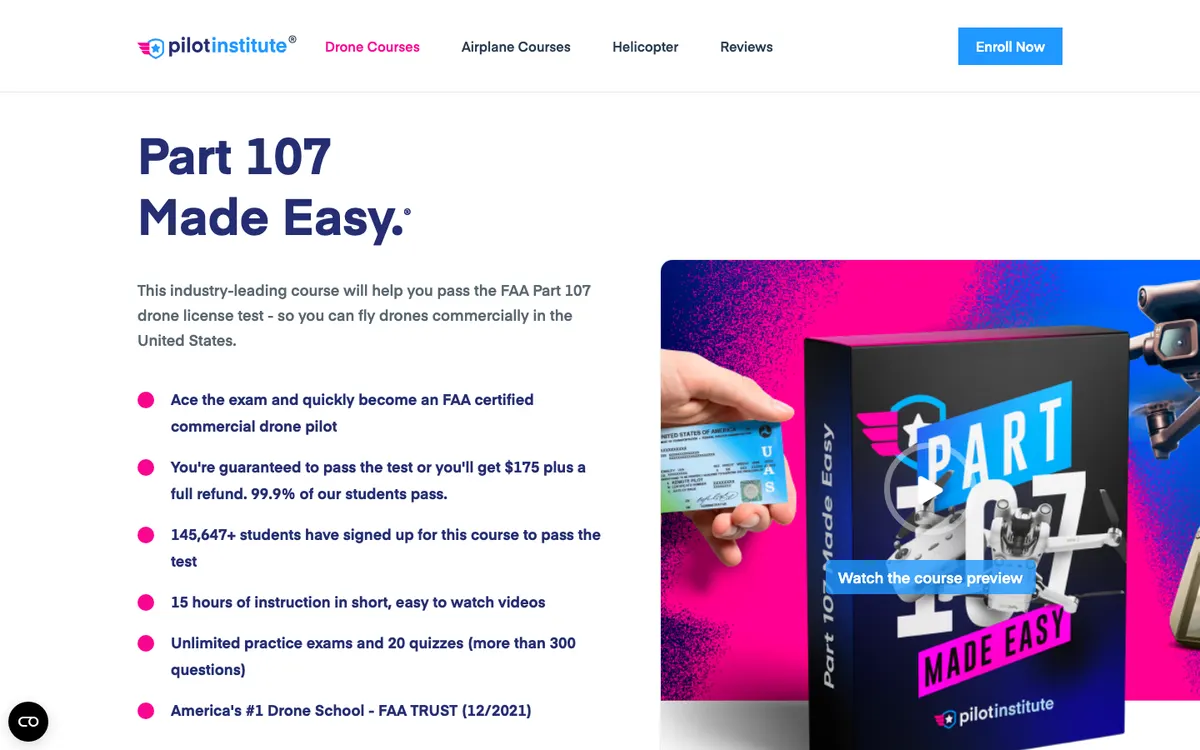
Pilot Institute Part 107 Commercial Drone License Course. The course costs $159 against a $249 list price and includes lifetime access plus a free drone-maneuvers bonus course. Its 15 hours of instruction are divided into short videos, which you can revisit during revision.
Altitude University Part 107 Test Prep Course. A one-time $97 payment buys lifetime access to this self-paced course. Its study guidance cites an FAA estimate of about 15–20 hours; treat that as a preparation estimate rather than a fixed completion requirement.
Aviation Test Prep (FAA Written Exam Prep). Subscription choices are $19.99 per month, $49.99 every three months, or $179.99 per year. Select an access period that fits your testing plan after confirming the question bank covers your specific FAA examination.
Best online programs for aspiring drone pilots
- Drone Pilot Ground School (UAV Coach) supports Part 107 candidates with live webinars and a pass guarantee.
- Pilot Institute Part 107 Commercial Drone License Course organizes Part 107 study for aspiring commercial pilots and advertises a pass guarantee with provider-specific conditions.
- Altitude University Part 107 Test Prep Course offers budget-conscious pilots inexpensive Part 107 preparation with lifetime access.
- Aviation Test Prep (FAA Written Exam Prep) provides student pilots with a current question bank and study plan for FAA knowledge tests.
The Drone Pilot (Part 107) comparison brings together the course reviews so you can compare study support and payment terms.
Top programs compared
The 4 highest-scored online drone pilot (part 107) programs in our ranking, side by side.
Swipe sideways to compare all 4 programs →
| Criterion | ||||
|---|---|---|---|---|
| Our score | 9.2/10 | 9.2/10 | 8.4/10 | 8.4/10 |
| Price | $159 – $299 | $159 – $249 | $97 | $19.99 – $180 |
| Format | Self-paced | Self-paced | Self-paced | Subscription |
| Duration | Prepares most learners after 15-20 hours of study; lifetime access. | 15 hours of instruction in short videos; lifetime access. | Self-paced; FAA estimates about 15-20 hours of study. | Subscription. |
| Free trial | Free preview. | — | — | Free learning library and free start with the AI assistant. |
| Best for | Part 107 candidates who want live webinar support and a pass guarantee. | Aspiring commercial drone pilots who want a well-structured Part 107 course with a strong… | Budget-conscious drone pilots who want an inexpensive Part 107 prep course with lifetime… | Student pilots preparing for FAA knowledge tests who want a current question bank and… |
| Full review | Drone Pilot Ground School (UAV Coach) review | Pilot Institute review | Altitude University review | Aviation Test Prep review |


Scores from our editorial method. See the full ranking of 4 programs.
Common mistakes to avoid
Do not advertise yourself as FAA-certified merely because you finished a school’s videos. Confirm issuance of the actual credential and maintain knowledge recency. Likewise, do not describe a provider’s pass guarantee as a guarantee that the FAA will approve your application or that you will obtain work.
Avoid buying a subscription question bank without checking that it covers the correct examination. The broader aviation category can include products for other pilot tests. Finally, distinguish operating a drone from providing a licensed professional service using its output.
FAQ
Is a paid Part 107 prep course mandatory?
The FAA's pathway requires the applicable testing and certification process, not purchase of a particular commercial school course.
What is the minimum age for a first-time remote pilot?
The FAA lists 16 among the requirements. See its eligibility instructions for the complete conditions.
Is exam preparation the full startup cost?
No. The drone program comparison lists study products. Aircraft, official testing, and operating expenses need separate budgets.
How do I maintain knowledge recency?
The FAA specifies recurrent training within the previous 24 calendar months and lists free online options. Follow its current recency instructions.