On this page · 8 sections6 min read
What a makeup artist does
A makeup artist plans and applies a look that fits the client, lighting, and occasion. In theatrical and performance work, O*NET includes cleaning brushes, studying scripts, maintaining continuity, and adjusting makeup during production. That profile describes a specialized setting; bridal, retail, and personal-event work should not automatically be assumed to have identical routines. O*NET.
For a beginner, the practical challenge is making a repeatable result on faces other than your own. Skin preparation, product selection, shade matching, sanitation, timing, and client communication all matter. A portfolio should demonstrate those decisions under realistic lighting rather than relying on heavy retouching to hide application problems.
Do you need a license or certification?
Check the state board before assuming that a private makeup certificate permits paid services. Makeup can fall within cosmetology or esthetics rules, and the treatment of particular services or settings varies. The exact work matters: makeup application, lash services, skin treatments, and other beauty services should not be bundled under one informal title when asking about licensing.
California’s Board of Barbering and Cosmetology explains its licensed scopes and school approval process, including makeup within services described for relevant licensees. It also states that performing regulated barbering and cosmetology services for a fee requires issuance of a license. This is a state example, not proof that every makeup assignment in every jurisdiction follows the same route. California board FAQs.
Ask the board about your precise service menu and work setting, then ask the school whether its course satisfies any required education. A school’s professional title, discount eligibility, or private certificate is not itself evidence of state approval. If a board-approved program is required, verify that approval directly before purchasing a supplementary online course.
Texas illustrates a different treatment of the specific service: TDLR states that ordinary makeup application does not require a Texas license. Its chart separately identifies regulated services such as eyelash extensions and facial treatments, so adding services can change the answer. Do not extend the makeup exemption to your entire beauty menu. Texas TDLR service guide.
Step-by-step: how to become a makeup artist
- Choose your initial service menu. Decide whether you want bridal beauty, editorial work, theatrical makeup, or another defined niche. Write down whether lashes or skin services are included, because these details affect both training and the licensing questions you must resolve.
- Confirm the legal route first. Contact the relevant state board with that service description and identify any required approved-school, examination, or application steps. Keep its response and separate it from marketing claims made by a private academy.
- Select instruction with assessed work. Look for assignments that require your own applications and explain who reviews them. Video demonstrations can show technique, but individualized correction is especially useful when your blending or color matching repeatedly goes wrong.
- Build a sanitary working kit. Plan how products will be dispensed, tools cleaned, and used items separated from clean supplies. Follow the rules applicable to your setting and product instructions rather than copying shortcuts from social media.
- Practice on varied consenting models. Document the agreed look, time used, products selected, and changes requested. Photograph the result consistently and obtain permission before putting a model’s image in your portfolio.
- Rehearse the booking and consultation. Clarify the appointment location, preparation, scope, and timing before accepting a job. Establish how you will handle an unsuitable service request, a reported sensitivity, or a schedule change.
Build evidence of application skill
Create a series around a clear brief, such as a natural daylight portrait or an evening event look. Keep lighting and camera settings consistent enough that the photographs reveal the actual application. Note the client’s preferences and the reasoning behind the foundation, eye, and lip choices.
Review more than the finished front-facing image. Check the jawline match, blended edges, symmetry, texture, and how the look changes when the subject turns. Ask your instructor for a correction that can be tested in the next application rather than a general judgment that the result is good or bad.
For production work, practice continuity notes: which products were used, where they were applied, and what must be recreated. O*NET’s description of repeat applications makes this a relevant portfolio exercise. Keep practice clearly labeled so it is not mistaken for paid film or television experience.
Ask what instructor feedback actually covers
Before enrolling, request a sample assignment and ask whether feedback addresses your preparation, application, and final photographs. An instructor may be able to evaluate blending from images while still needing more evidence to assess sanitation or your interaction with a model. Find out what additional documentation the course expects rather than assuming every important skill is visible in a finished portrait.
Check whether you can revise an assignment after critique. A correction such as changing the placement or intensity of a product is most useful when you apply it and receive another assessment. Keep the original and revised images to document your progress, with the model’s permission, so you can identify what improved instead of relying only on a completion mark.
How long it takes and what it costs
This makeup comparison covers two schools, but a full-tuition range would be misleading. QC advertises a starting payment rather than the complete price, and a current tuition quote for Vizio is unavailable. Get both totals before deciding which school better fits your budget.
Ask for the total payable amount, included kit, shipping, access period, feedback arrangements, and refund terms. Budget separately for practice products and tools because an online course’s tuition does not establish the cost of maintaining a working kit. Self-paced study also does not tell you how long state-approved education, if required, would take.
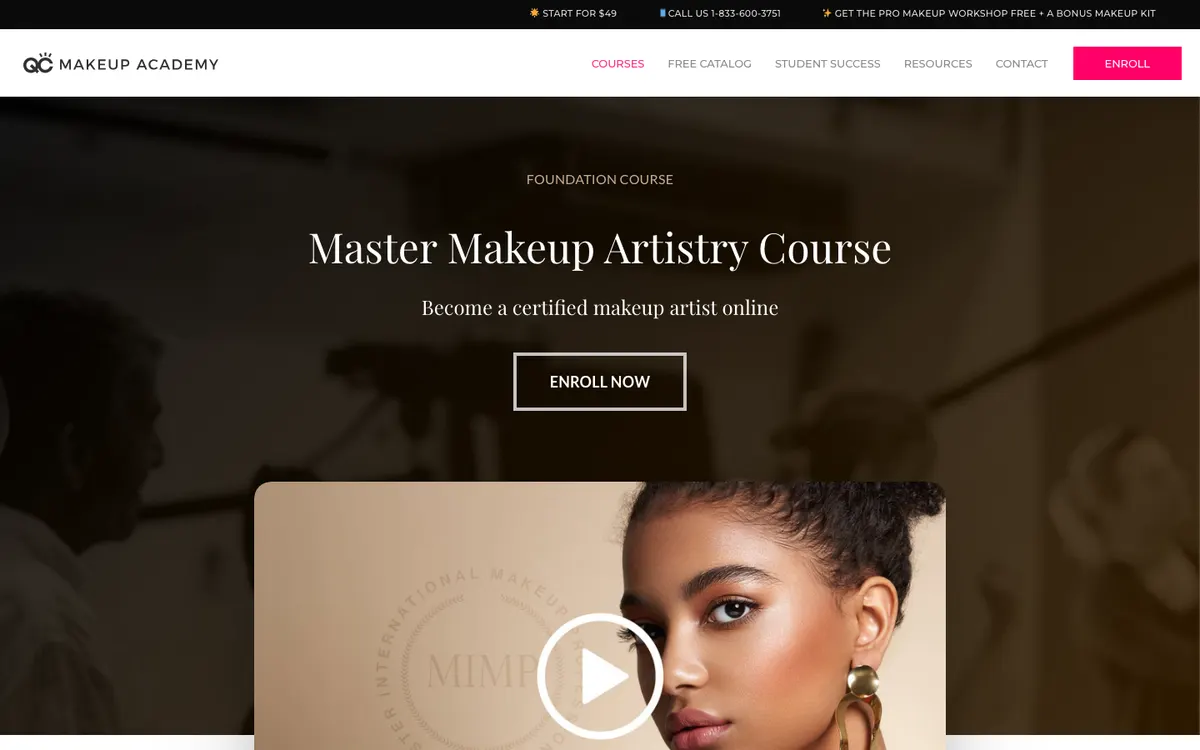
QC Makeup Academy Master Makeup Artistry. QC advertises a $49 initial payment to start Master Makeup Artistry; the course page does not show the full tuition. Study is self-paced and organized into units, so ask how assignment feedback fits the pace you intend to maintain.
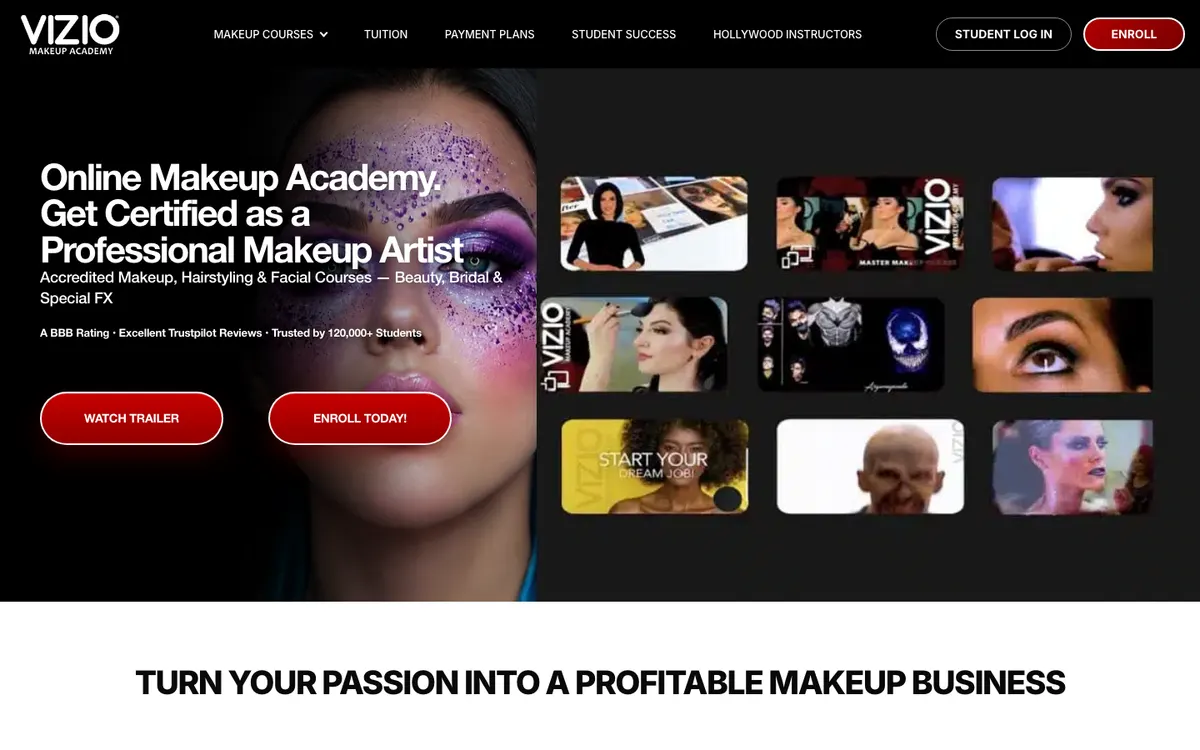
Vizio Makeup Academy Online Certification. Vizio offers self-paced study with lifetime access. Current tuition is not available here; request a complete quote before comparing its instructor support and access terms with QC’s.
Best online programs for aspiring makeup artists
QC and Vizio are the two makeup schools in this comparison. Neither listing establishes that its private course replaces the state authorization you may need.
- QC Makeup Academy Master Makeup Artistry offers self-paced certification study with assignment feedback and professional product discounts for aspiring makeup artists.
- Vizio Makeup Academy Online Certification features online teaching by Hollywood makeup artists and live instructor feedback for students preparing to enter the field.
Compare the two schools’ feedback, study access, and costs in the Makeup Artist Certification comparison, with reviews linked for a closer look.
Top programs compared
The 2 highest-scored online makeup artist certification programs in our ranking, side by side.
| Criterion | ||
|---|---|---|
| Our score | 8.7/10 | 8.5/10 |
| Format | Self-paced | Self-paced |
| Duration | Self-paced, unit-based course. | Self-paced with lifetime access. |
| Accreditation | — | Described by the school as "accredited" (accrediting body not named on the homepage). |
| Best for | Aspiring makeup artists who want a self-paced, feedback-based certification with pro… | Aspiring makeup artists who want online courses taught by Hollywood makeup artists with… |
| Full review | QC Makeup Academy (QC Career School) review | Vizio Makeup Academy review |

Scores from our editorial method. See the full ranking of 2 programs.
Common mistakes to avoid
Do not treat an academy’s certificate name as a state-issued credential. Similarly, professional product discounts may lower purchasing costs but do not demonstrate competence or legal authorization. Confirm what the certificate actually assesses.
Avoid choosing a course solely because its examples look polished. Ask how students submit work and whether feedback covers sanitation, shade matching, and technique. A low initial payment can conceal a much larger tuition obligation, so compare the complete agreement rather than the enrollment deposit.
FAQ
Does an online makeup certificate replace an esthetics license?
Do not assume that it does. The California board's FAQs illustrate why private course completion and state licensing must be checked separately.
Is QC's advertised starting payment the total tuition?
No. The advertised amount is an initial payment; the course page does not establish the full tuition. See the QC Makeup Academy review.
How can I compare the two listed schools?
Compare assignment feedback, access, kit requirements, and full cost in the makeup category. Missing tuition should remain an open question, not an assumed bargain.
Is theatrical makeup the same as bridal work?
The contexts differ. Script analysis and continuity are explicit duties in ONET's theatrical makeup profile, so choose portfolio exercises that match your intended setting.