On this page · 8 sections6 min read
What a tax preparer does
A tax preparer gathers client information, applies the rules relevant to a return, checks the result, and explains what the client must review or supply. The IRS preparer-qualification overview distinguishes return preparation from representing a client before the IRS. Decide which service you want to provide before choosing training.
For a beginner, the first useful skill is identifying missing information rather than rushing to enter numbers. A software interview can organize a return, but it cannot make an unsupported client statement reliable. Practice documenting questions and knowing when a return is beyond your present competence.
Choose an initial scope such as a supervised role handling relatively straightforward individual returns. Business returns, multi-state issues, and representation work can require different preparation. A course covering an advanced exam may be valuable without being the easiest introduction to the mechanics of a complete client engagement.

Do you need a license or certification?
Paid preparers who prepare all or substantially all of a federal return generally need a valid preparer tax identification number. The IRS explains the covered activities and exceptions in its PTIN requirement FAQs. A course completion certificate does not substitute for that registration.
A PTIN is also not the same as enrolled agent status. The IRS describes enrolled agents as federally licensed practitioners with unlimited representation rights, while its voluntary Annual Filing Season Program provides a different level of recognition and limited representation rights. Training, registration, and representation authority should be named separately. IRS credential distinctions
State requirements can add another layer. California requires nonexempt paid preparers to register with CTEC and identifies qualifying education, a bond, a PTIN, and background-check steps. Its page also lists exemptions and annual renewal obligations; use the complete official instructions to determine which route applies to you. California Franchise Tax Board guidance
Do not assume that a CTEC continuing-education course is the qualifying education required of a new registrant. Likewise, an IRS-approved CE provider is not necessarily offering a government license or an IRS endorsement of the graduate. Match the particular course and approval to the requirement you are trying to satisfy.
Electronic filing involves a separate operational question from obtaining a PTIN. Before starting an independent practice, verify the current IRS process for your filing arrangement and determine whether you will work through an employer or your own authorized business. This guide does not infer filing authorization from any course purchase.
Step-by-step: how to become a tax preparer
- Choose employment or independent practice. A supervised seasonal position can provide review procedures and software access that an independent preparer must arrange. Ask what returns you would handle and who resolves questions before accepting responsibility for unfamiliar situations.
- Check federal and state requirements. Use the IRS PTIN guidance and your state’s tax-preparer rules. Write down whether you need new-preparer education, registration, or a professional credential instead of assuming a national course covers every jurisdiction.
- Choose the right educational product. Beginner return-preparation instruction, enrolled-agent exam review, and annual CE serve different purposes. Inspect the syllabus for worked returns and practical exercises if you are starting from no experience.
- Practice a full intake and review. Use fictional taxpayer information and identify which documents support each entry. Create a question list when facts are incomplete, and practice explaining why you need the answer before completing the return.
- Learn to verify software output. Reconcile the finished return with the source information and investigate warnings. Do not interpret a successful software calculation as proof that filing status, eligibility, or an election was chosen correctly.
- Arrange professional review and data handling. Decide how sensitive documents will be collected, stored, and accessed. Establish an escalation route for returns outside your competence and make that boundary clear to clients before they pay.
- Maintain the registrations and education your route requires. Track renewal and update obligations separately from the completion date of your first course. If pursuing enrolled agent status, follow the IRS credential process rather than describing exam preparation as licensure.
How long it takes and what it costs
Tax education prices make sense only after separating beginner instruction, EA exam preparation, and continuing education. Easy Tax Academy’s beginner tiers span $297 to $997; Surgent’s prices depend on the package and whether its official pages confirm the amount. A low-cost CE module is not a complete budget for entering practice.
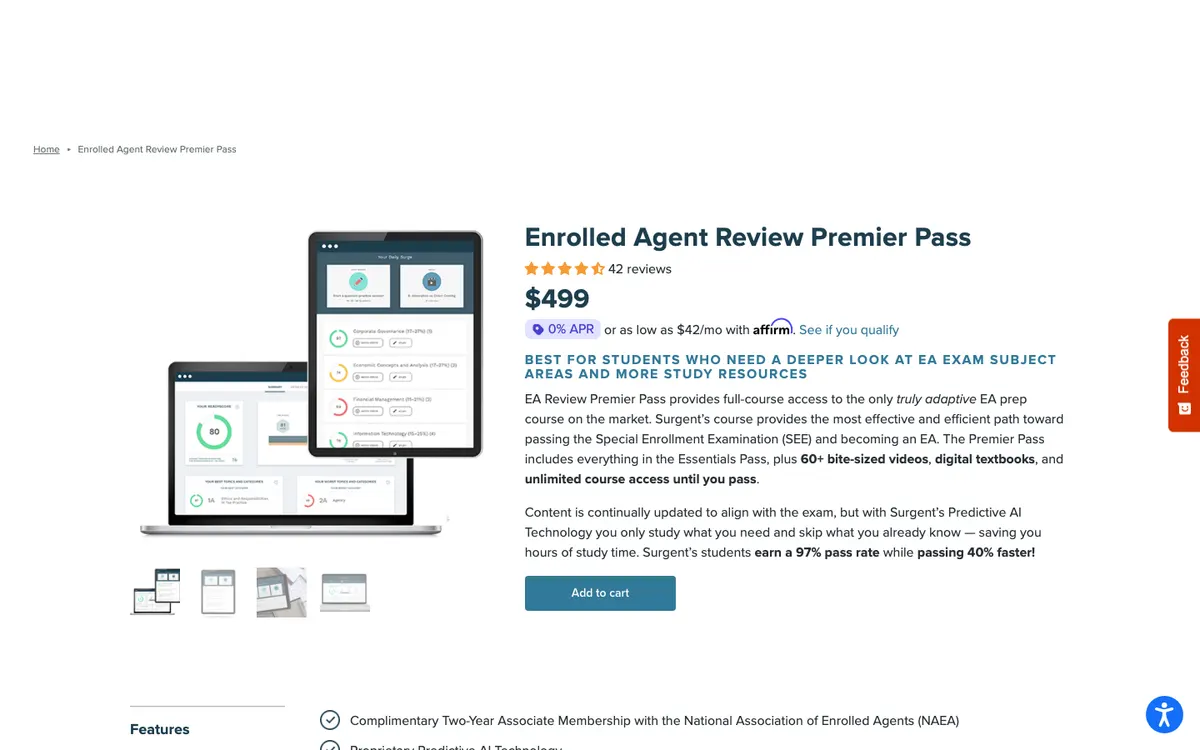
Surgent EA Review Premier Pass costs $499, while Ultimate Pass is $699. Learning is self-paced with unlimited access until you pass; Surgent cites an average of 61 study hours across all three parts, a provider estimate rather than a promised personal timetable.
A partner listing for Surgent EA Review gives three package prices: $299, $499 and $699. The accessible official pages did not display those amounts, and a completion timetable for this offering is unconfirmed. Request the current package terms before using either price or duration to plan your preparation.
Tax IQ Academy IRS and CTEC Approved CE Courses sells individual self-study courses for about $29.99 to $79.99, plus bundles such as the Complete AFSP Bundle. Online courses are self-paced, and live webinars are another delivery option.
At Your Pace Online (TaxCE.com) Tax Preparer CE and AFSP Courses sells online self-study courses and packages, including a 15-hour Tax Preparer CE package and a 10-hour Tax Law package; prices need confirmation. The AFSP schedule calls for 18 CE hours annually, including the 6-hour AFTR course, which should be distinguished from a package’s advertised hours.
Easy Tax Academy Professional Plan (Tax Preparation From Scratch) has a $297 Starter tier, a $497 Professional tier labeled most popular, and a $997 VIP Tax Professional Program. The self-paced online curriculum includes 10 modules, 40+ video lessons, and 20+ practice exercises.
The two Surgent entries describe overlapping EA review offerings, not necessarily two independent schools. Compare the precise package and access terms before buying twice. A provider’s average study-hour claim is also not a personal readiness forecast, particularly if you have never prepared a return.
Plan for the filing season you want to work in, but do not let a calendar target replace competence. Ask about software practice, instructor support, and whether the materials cover the tax year you need. For an independent practice, obtain separate current quotes for software, security, registration, and any professional review arrangement.
Best online programs for aspiring tax preparers
The ranking below includes EA preparation, annual CE, and a beginner course. Choose the type of education first, then compare packages within that purpose.
- Surgent EA Review Premier Pass is self-paced enrolled-agent exam preparation with access described as continuing until you pass.
- Surgent EA Review covers additional EA review packages whose partner-listed prices were not visible on the accessible official pages.
- Tax IQ Academy IRS and CTEC Approved CE Courses offers IRS- and CTEC-approved continuing education rather than a universal initial license.
- At Your Pace Online (TaxCE.com) Tax Preparer CE and AFSP Courses offers tax-preparer continuing education and AFSP coursework.
- Easy Tax Academy Professional Plan (Tax Preparation From Scratch) offers beginner tax-preparation instruction and explicitly separates completion from IRS licensing or endorsement.
The Tax Preparer comparison provides review links for a closer look at beginner instruction, exam preparation, and renewal education.
Top programs compared
The 4 highest-scored online tax preparer programs in our ranking, side by side.
Swipe sideways to compare all 4 programs →
| Criterion | ||||
|---|---|---|---|---|
| Our score | 8.8/10 | 8.7/10 | 8.7/10 | 8.4/10 |
| Price | $499 – $699 | $299 – $699 | $29.99 – $79.99 | — |
| Format | Self-paced | Self-paced | Self-paced | Self-paced |
| Duration | Self-paced; unlimited course access until you pass; Surgent cites 61… | — | Self-paced online courses; live webinars also available | Online self-study; AFSP requires 18 CE hours per year, including the… |
| Accreditation | — | — | IRS Approved CE Provider; CTEC approved (California) | IRS Approved Continuing Education Provider; CTEC courses for California preparers |
| Free trial | — | Free trial offered (sign-up on the Surgent site). | — | — |
| Best for | Enrolled Agent candidates who want adaptive, data-driven exam prep with videos and… | Tax preparers preparing for the IRS Enrolled Agent exam who want adaptive,… | Tax preparers and EAs who need IRS or CTEC continuing education, AFSP hours or a beginner… | Tax preparers who need IRS-approved CE hours, the AFTR course or AFSP credit online. |
| Full review | Surgent (EA Exam Review) review | Surgent (EA Review / Income Tax School) review | Tax IQ Academy review | At Your Pace Online (TaxCE.com) review |


Scores from our editorial method. See the full ranking of 5 programs.
Common mistakes to avoid
Do not call yourself an enrolled agent because you enrolled in an EA review course. The credential belongs to the IRS process, and preparation is only one activity along the way. Use an accurate description of your current status on applications and client materials.
Avoid buying renewal education when you need initial qualification. California’s new-preparer pathway and annual renewal have different educational purposes. Ask the provider which approval applies to the exact course rather than relying on an approval logo elsewhere on its site.
Do not promise a refund amount before reviewing the facts. Build the engagement around accurate preparation and clear documentation. If a return raises a question you cannot resolve, seeking review is part of competent service rather than an inconvenience to conceal.
FAQ
Is a PTIN the same as a professional certification?
No. The IRS distinguishes PTIN holders from enrolled agents, CPAs, attorneys, and Annual Filing Season Program participants.
Does every state use the California rules?
No nationwide uniformity is established here. California’s FTB page describes California registration; verify the rules where you will practice.
Is EA review the best first course for a complete beginner?
Not necessarily. The Surgent review describes exam preparation, while Easy Tax Academy is listed as instruction from scratch.
Does an IRS-approved CE course make me IRS licensed?
No. Compare the course’s purpose with the IRS credential definitions; approval of education does not itself award enrolled agent status.