On this page · 8 sections6 min read
What a transcriptionist does
A transcriptionist converts recorded speech into text according to an agreed format and accuracy standard. O*NET’s word-processing profile includes preparing text from voice recordings as a related task. General transcription, legal transcription, and medical transcription have different terminology and requirements, so choose the intended setting before selecting a course.
The work is not simply fast typing. You must identify speakers, follow the requested treatment of pauses or false starts, research unfamiliar terms appropriately, and mark uncertainty according to the client’s rules. A transcript that reads smoothly can still be wrong if it changes what was said.
A useful practice assignment includes imperfect audio and a style guide. Record which words remain uncertain and why, then compare your output with text checked for accuracy. The goal is to improve the process for resolving uncertainty rather than filling gaps with phrases that merely sound plausible.

Do you need a license or certification?
The cited O*NET and AAERT sources do not establish one nationwide government license for all general transcription work. Clients and employers set accuracy, confidentiality, and qualification expectations. A private training certificate may support an application without being the universal legal entry requirement.
Legal work needs closer investigation. Preparing text from a recording is not identical to serving as a court reporter, taking testimony, or certifying an official record under a court’s rules. Confirm the requirements of the court, agency, state, or contractor for the exact role before accepting an assignment.
AAERT offers a Certified Electronic Transcriber credential with knowledge and practical examinations. Its published process distinguishes that credential from reporter credentials and explains candidate requirements and credential maintenance. A course described as AAERT preparation is not itself the AAERT examination. AAERT certification program
AAERT also states that it does not require a particular preparation course. That means a listed school is one possible preparation route, not proof that buying the course is mandatory. Use the official exam blueprint and current candidate instructions to judge whether your study covers the assessed skills.
Medical transcription is another separate pathway and is not established by the general and legal courses in this category. Do not assume that learning legal terminology prepares you to interpret clinical dictation. Match the education to the actual client work rather than treating all recorded speech as the same specialty.
Step-by-step: how to become a transcriptionist
- Choose general or a defined specialty. Identify the kinds of recordings and clients you want to serve. Compare their style and qualification requirements before buying a course that emphasizes a different setting.
- Measure accuracy before speed. Transcribe an authorized practice recording and review errors by type: words, speaker labels, punctuation, or formatting. A fast first draft is less useful if it requires extensive correction to become reliable.
- Learn the requested transcript style. Practice distinguishing verbatim and edited approaches according to the assignment. Do not silently clean up speech when the client needs an accurate record of how it was delivered.
- Build a research and uncertainty process. Use permitted sources to check names and terminology, and follow the client’s notation rules when audio remains unclear. Avoid guessing a word because it would make the sentence sound more natural.
- Choose training that critiques your assignments. Ask how instructors assess transcripts and explain mistakes. A lesson library can introduce conventions, but feedback on your own work reveals problems you may not hear independently.
- Verify any credential or court requirements. If seeking AAERT certification, use its current exam instructions and blueprint. If seeking official legal work, ask the contracting authority which role, credential, and state requirements apply.
- Prepare secure production and delivery. Agree on authorized tools, storage, file naming, and deletion or retention instructions. Obtain permission before uploading recordings to any third-party transcription or AI service.
For practical preparation, create a quality-control pass separate from the first draft. Listen again while checking speaker changes, numbers, names, and any marked uncertainty. The second pass should have a purpose rather than simply rereading the text and assuming it matches the recording.
Track the time required for an entire assignment, including setup, research, review, and delivery. Audio length is not the same as working time. That distinction helps you evaluate a deadline or payment arrangement without relying on a course’s income claim.
How long it takes and what it costs
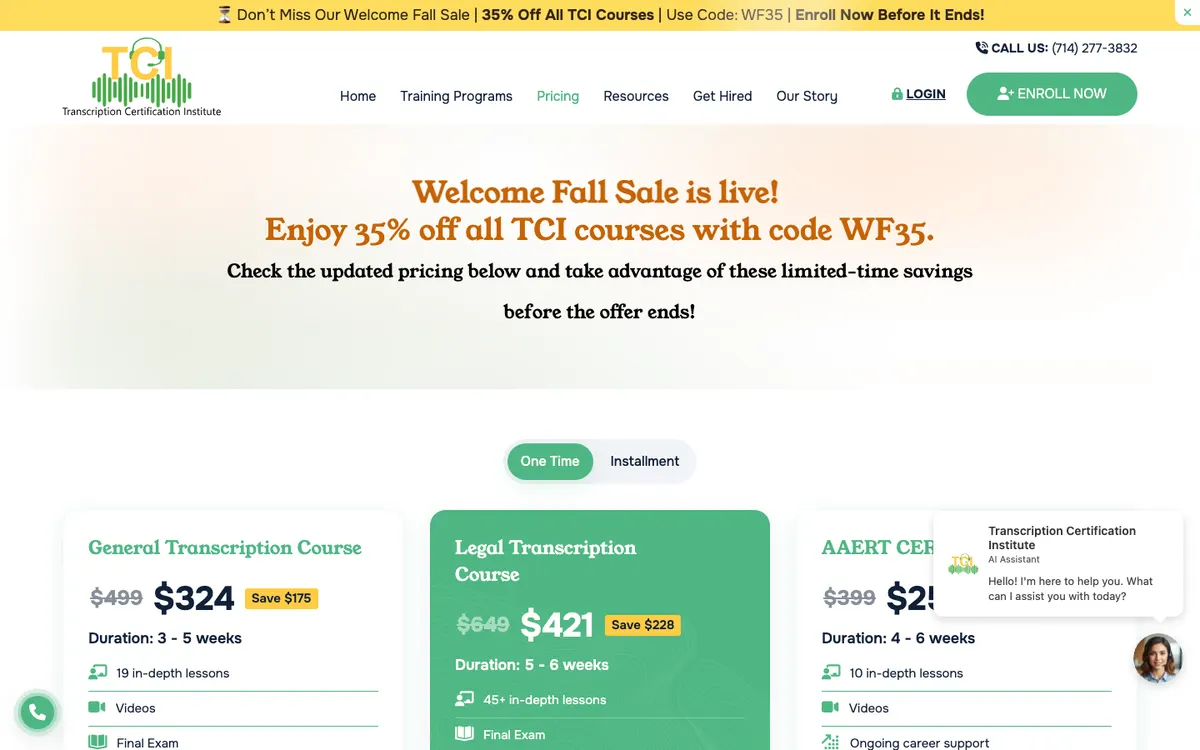
General-transcription tuition is $499 at Transcription Certification Institute and $597 at Transcribe Anywhere. Legal courses and combined packages cost more and come with different access and preparation arrangements. Choose the complete course for your intended work rather than assuming every beginner needs the largest bundle.
Transcribe Anywhere General Transcription: Theory & Practice costs $597, or 3 payments of $200. Legal Transcription is $697, or 3 x $233, and the General + Legal combo is $1,097 versus $1,294 separately. Courses are self-paced with no deadlines and lifetime access; the provider says most learners finish in 2 to 4 months.
Transcription Certification Institute (TCI) General Transcription Course is $499 once or $199 x 3 months. Combination options are General + AAERT Prep at $750, Legal + General at $999, and Legal + General + AAERT Prep at $1,499. Learning is self-paced, with combo estimates ranging from about 7-9 weeks to 10+ weeks.
Transcribe Anywhere gives an estimate of two to four months, while TCI’s combination programs list different week-based estimates. These are study descriptions, not guaranteed job-readiness deadlines. Your starting accuracy, language skills, and time available for practice with feedback affect the appropriate pace.
Ask whether course tuition includes any external examination, and do not assume that “certification” in a business name identifies a government or professional-board credential. Check whether assignments can be resubmitted, how feedback is delivered, and whether support ends before content access does.
Budget for the hardware and software actually required by the course or client after checking compatibility. Headphones, playback controls, and a suitable work environment can affect usability, but no universal equipment total is established here. Try the workflow with your existing setup before purchasing specialized tools solely from a promotional list.
Best online programs for aspiring transcriptionists
Two providers are ranked below. Compare their general and legal tracks, feedback on original transcripts, and separate AAERT preparation options against the kind of audio work you intend to accept.
- Transcribe Anywhere General Transcription: Theory & Practice offers separate general and legal transcription courses plus a combined option.
- Transcription Certification Institute (TCI) General Transcription Course offers general transcription and combinations that may include AAERT exam preparation.
Use the Transcription comparison to examine both reviews and distinguish a course certificate from external exam preparation.
Top programs compared
The 2 highest-scored online transcription programs in our ranking, side by side.

| Criterion | ||
|---|---|---|
| Our score | 8.8/10 | 8.5/10 |
| Price | $597 – $1,097 | $499 – $1,499 |
| Format | Self-paced | Self-paced |
| Duration | Self-paced with no deadlines; most students finish in 2 to 4 months;… | Self-paced; combos take about 7-9 to 10+ weeks |
| Accreditation | Approved by the American Association of Electronic Reporters and Transcribers (AAERT) | — |
| Best for | Beginners who want a thorough, self-paced path into general or legal transcription work… | New transcriptionists who want an affordable online certification with an internship… |
| Full review | Transcribe Anywhere review | Transcription Certification Institute (TCI) review |


Scores from our editorial method. See the full ranking of 2 programs.
Common mistakes to avoid
Do not confuse a training certificate with AAERT certification. The latter requires the issuing organization’s assessment process. State the exact credential on your resume and distinguish exam preparation from an exam already passed.
Avoid treating an automated transcript as a finished product. If the client authorizes automated tools, the output still needs review against the recording and the required style. If the client has not authorized uploading the file, convenience does not supply permission.
Do not quote a delivery deadline based only on the audio’s playing time. Poor sound, unfamiliar terminology, overlapping speakers, and formatting requirements can affect the work. Test a representative authorized sample before making a commitment you cannot meet reliably.
Keep general transcription and court reporting distinct when marketing services. A course in legal vocabulary does not necessarily authorize official record creation or testimony-related functions. Ask the relevant authority about the actual assignment.
FAQ
Does AAERT require a particular preparation school?
Its certification page says no specific training course is required. Candidates should prepare against the current exam blueprint.
Is an AAERT prep bundle the credential itself?
No. The TCI listing includes preparation combinations, while AAERT administers its own examinations and credential rules.
Is general transcription training medical transcription training?
That equivalence is not established. The category comparison describes general and legal options, so investigate clinical-dictation requirements separately.
Does lifetime access mean I must take years to finish?
No. The Transcribe Anywhere entry separates access from a provider completion estimate. Choose a schedule based on accurate practice and feedback rather than access duration alone.