On this page · 8 sections6 min read
What an ASL interpreter does
An ASL interpreter conveys meaning between languages while attending to context, participants, and professional ethics. O*NET’s Interpreters and Translators profile describes conveying information accurately and adapting to subject matter. It covers a broader occupation than ASL interpreting alone, so its tasks are helpful context rather than proof that every language job has the same qualifications. O*NET.
Learning ASL vocabulary and becoming an interpreter are different stages. Interpretation requires receptive and expressive fluency, cultural understanding, decision-making, and the ability to manage meaning in a live exchange. A beginner language-course certificate should not be presented as evidence that you are ready for medical, legal, educational, or other consequential assignments.

Do you need a license or certification?
Check the rules for the state and setting where you intend to interpret. National certification, state authorization, and employer qualifications are separate questions, and this guide does not claim a single uniform US licensing rule. Schools, courts, healthcare organizations, and agencies may have requirements beyond basic language study.
RID describes national certification and distinguishes the National Interpreter Certification from the Certified Deaf Interpreter credential. CASLI handles examinations used in the certification process. Review the applicable route, including its education or alternative-pathway provisions, directly with the organizations rather than assuming any ASL course is an interpreter preparation program. RID certification.
RID’s available-certifications page also addresses educational documentation, including evaluation of non-US degrees. The precise requirements depend on the credential sought. A private course’s accreditation, curriculum length, or completion certificate does not by itself establish eligibility or confer RID certification. RID credential information.
Illinois maintains an Interpreter for the Deaf licensure framework and provides a state license application through its Deaf and Hard of Hearing Commission. This is a concrete reason to investigate state authorization separately from RID certification. Read the applicable scope and exceptions for your setting instead of assuming a national credential completes the state process. Illinois commission.
Step-by-step: how to become an ASL interpreter
- Begin with language and community learning. Choose structured ASL instruction and appropriate opportunities to learn from Deaf teachers and community members. Treat language proficiency as a substantial goal rather than a quick prerequisite you can rush past.
- Clarify your intended interpreting setting. Investigate the state’s rules and the qualifications required by likely employers. Note whether an educational, legal, or other specialization requires additional preparation.
- Plan the professional education route. Review interpreter preparation options, mentorship, and the relevant RID or other accepted credential requirements. Ask how a program assesses language fluency and interpreting performance, not only vocabulary recognition.
- Develop receptive and expressive skill. Practice understanding varied signers and producing clear language, with feedback and consent. An on-demand lesson library is useful support but cannot replicate every conversational condition.
- Practice interpreting under qualified supervision. Work on meaning, ethics, clarification, and managing uncertainty. Do not use an unqualified volunteer role in a high-stakes setting as a shortcut to experience.
- Complete the relevant credential and authorization steps. Apply through the actual certifier and any state process, then maintain the required status. Represent your qualifications precisely and decline assignments outside your competence.
Evaluate language learning separately from interpretation
For an introductory course, ask how receptive understanding and expressive signing are checked. Does the learner submit video, receive corrections, or interact with others? If the course is mainly on-demand video, plan a responsible way to obtain feedback rather than assuming quiz performance equals conversational fluency.
For interpreter preparation, ask about supervised practice, ethical decision-making, and assessment of meaning across languages. A demonstration that you know signs for individual words does not show that you can preserve a speaker’s intent, register, and relevant context in an exchange.
Write down your current level and the next formal requirement rather than describing yourself as an interpreter early. Clear boundaries help you choose suitable practice and avoid misleading people who need qualified language access. The goal is accurate service, not a title obtained as quickly as possible.
Ask who assesses your signing
Before purchasing a language curriculum, find out whether feedback comes from an instructor or only from self-check activities. Vocabulary videos can introduce material, but they do not necessarily reveal whether another signer understands your production. Plan an appropriate feedback route with respect for participants’ time and consent.
For professional preparation, ask how a program assesses interpretation across an extended exchange, including uncertainty and ethical decisions. Keep those expectations distinct from beginner milestones. This helps you choose the next educational step without overclaiming what an introductory certificate demonstrates.
Compare a curriculum resource with professional preparation
Ask whether you are purchasing instruction as a learner or materials intended for someone teaching a class. A ready-made curriculum may supply lesson sequences and activities without providing you with individual assessment or supervised interpreting practice. Compare the support actually included instead of deciding from the word curriculum alone.
For a language course, request examples of how comprehension and production are evaluated. For an interpreter pathway, ask how students receive feedback on conveying meaning, managing clarification, and making ethical decisions. Those are different assessment questions and should not be collapsed into a single promise of fluency.
Keep a list of the next requirement you need to satisfy: language proficiency, formal education, supervised practice, a certification examination, or state authorization. Choose the next purchase only after identifying which requirement it addresses. This makes a staged learning plan more useful than an expensive collection of courses whose certificates do not connect to your intended role.
How long it takes and what it costs
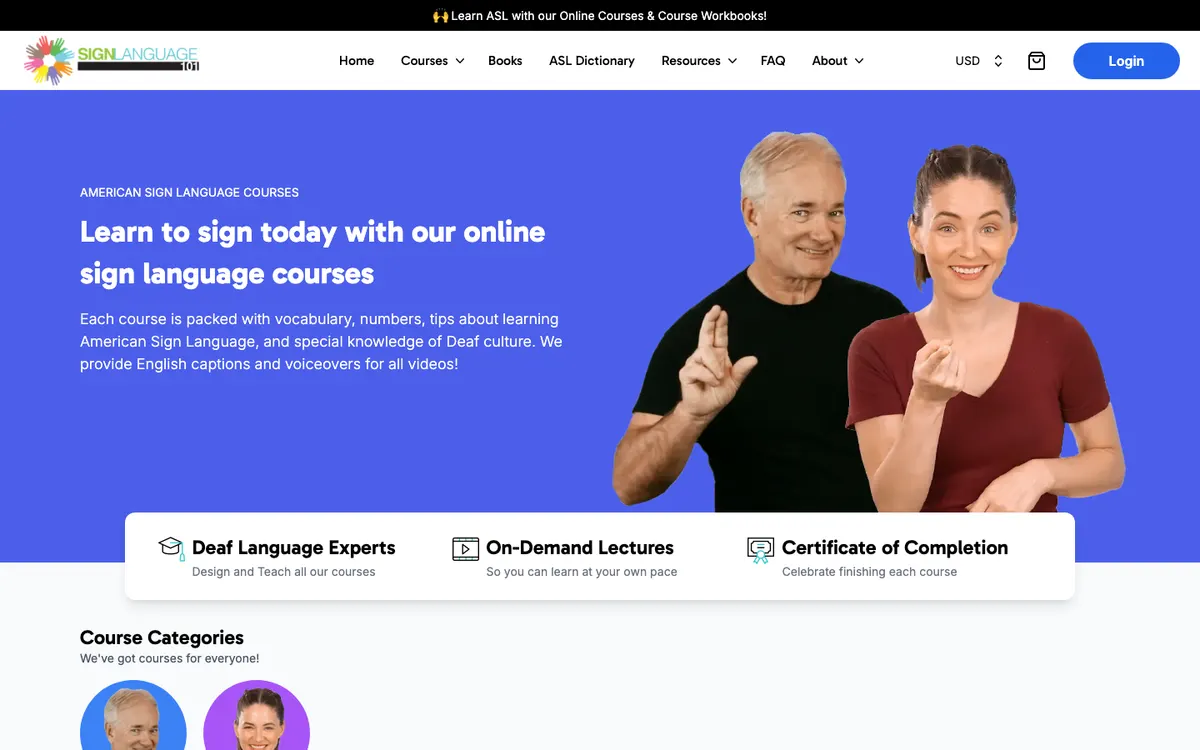
The listed ASL courses are primarily language learning or curriculum products. Sign Language 101’s individual-course and bundle prices span $49.99 to $149.99, but that is not a complete interpreter-training tuition range. Express ASL and ASL Terp Teach describe a 62-week curriculum without usable current prices.
Add professional interpreter education, supervised practice, certification, and any state requirements to a separate plan. A language course’s lesson count cannot establish when a learner will be ready to interpret.
Sign Language 101 ASL Courses. Individual courses cost $49.99 for five lessons. The ASL Essentials Bundle is $89.99 for 20 lessons, with a stated 25% saving, while the Complete Course Bundle costs $149.99 for all four courses. Units are designed to span a week each, although learners progress at their own pace.
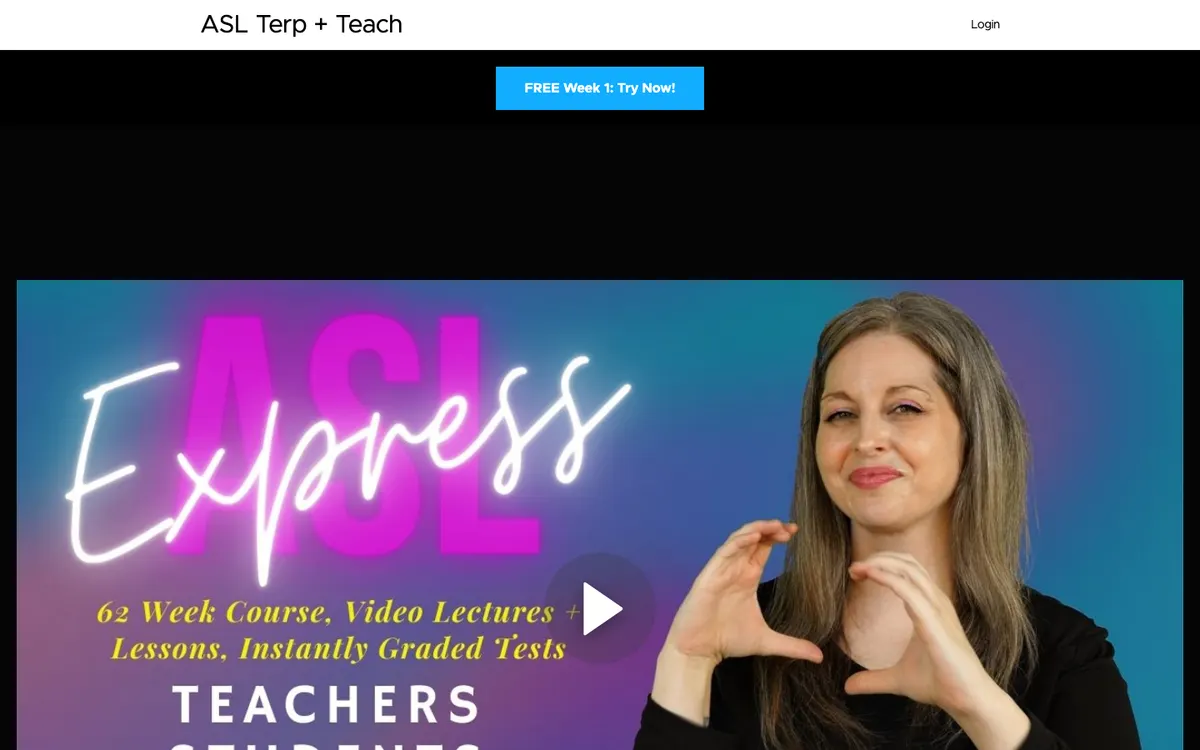
Express ASL (ASL Terp + Teach). This cumulative ASL curriculum spans 62 weeks of lessons and allows self-paced learning. Current tuition is unavailable here. Ask whether your purchase provides instruction, curriculum materials, or both, and how feedback on signing is arranged.
ASL Terp + Teach Express ASL (62-Week Curriculum). The curriculum runs for 62 weeks, with new lessons released each week. Prices are not shown on the public pages, and the checkout price could not be verified because access was blocked. Obtain a direct quote and clarify what the weekly release schedule means for your access.
Best online programs for aspiring ASL interpreters
- Sign Language 101 ASL Courses introduces American Sign Language to beginners studying at home, with versions for children as well.
- Express ASL (ASL Terp + Teach) offers teens, homeschoolers, and adults an extended, structured ASL learning curriculum.
- ASL Terp + Teach Express ASL (62-Week Curriculum) provides a ready-made curriculum for ASL teachers in homeschool, charter, public-school, and college settings, as well as beginners aiming toward interpreting or teaching.
Check the ASL (Sign Language) comparison and its course reviews for the audience and assessment behind each language-learning product.
Top programs compared
The 3 highest-scored online asl (sign language) programs in our ranking, side by side.
Swipe sideways to compare all 3 programs →
| Criterion | |||
|---|---|---|---|
| Our score | 8.7/10 | 8.4/10 | 7.8/10 |
| Price | $49.99 – $150 | — | — |
| Format | Self-paced | Self-paced | Self-paced |
| Duration | Units structured to span a week each; self-paced. | 62 weeks of cumulative, self-paced ASL lessons. | 62-week curriculum with new lessons released every week |
| Accreditation | — | — | No CEUs currently available (per the site) |
| Free trial | Free ASL lessons on the site. | Free Week 1. | — |
| Best for | Beginners learning American Sign Language at home, including kids' versions. | Teens, homeschoolers and adults who want a long, structured ASL curriculum. | ASL teachers (homeschool, charter, public, college) who want a ready-made curriculum, and… |
| Full review | Sign Language 101 review | Express ASL (ASL Terp + Teach) review | ASL Terp + Teach review |



Scores from our editorial method. See the full ranking of 3 programs.
Common mistakes to avoid
Do not conflate beginner ASL courses with interpreter certification. A long curriculum can still be a language course, and a course designed for teachers may be a teaching resource rather than professional interpreter preparation.
Avoid accepting high-stakes assignments because you can hold a basic conversation. Verify qualifications and competence for the setting, not just the ability to understand familiar lesson material.
FAQ
Does Sign Language 101 make me a certified interpreter?
Its review describes beginner ASL learning. Interpreter certification follows a separate process described by RID.
Are NIC and CDI the same credential?
No. RID lists them as distinct credentials. Read the available-certifications page for the applicable route.
Is a 62-week course a guaranteed interpreter pathway?
No. The ASL Terp Teach review describes a curriculum offering; its length does not establish professional eligibility.
Does the category include only interpreter-training programs?
No. The ASL category includes language-learning and curriculum resources. Read the intended audience and assessment before treating a product as professional preparation.