
On this page · 14 sections5 min read
- 01Our verdict
- 02At a glance
- 03Pros & cons
- 04What you’ll learn
- 05Format, schedule and time commitment
- 06Accreditation and what the credential is worth
- 07Price, payment plans and refunds
- 08Who it’s best for — and who should skip it
- 09Pros and cons in detail
- 10How it compares
- 11How to enroll
- 12Score breakdown
- 13Key facts
- 14FAQ
Our verdict
Our verdict7.5/10Flower Architect is a virtual floral design app rather than a course.
You choose from more than 1,700 virtual flowers, place them in arrangements, baskets and garlands, and compose scenes, which can help florists plan designs or show clients a concept before buying stems. Pricing has three tiers, from $9.99 a month or $109.99 a year up to $19.99 a month or $199.99 a year for full access. There is no curriculum, assessment or credential, so it will not teach floristry technique on its own. It suits working florists and hobbyists who want a digital sketchpad for arrangements; learners wanting skills training should pair it with an actual floral design course.
Best for: Florists and hobbyists who want to plan arrangements digitally with 1,700+ virtual flowers.
At a glance
Flower Architect is a virtual floral-design app for creating arrangements and scenes with a library of more than 1,700 digital flowers. Its guided tutorials explain the software workflow, including selecting flowers, positioning them, adding extras, and composing a scene. It is useful to investigate for planning and client presentations, but the software offering does not establish an assessed professional floristry curriculum or credential. Subscription tiers should therefore be evaluated as design-tool access, with practical floral instruction considered separately.
Pros & cons
- 1,700+ virtual flowers to design arrangements and scenes
- Tiers from $9.99/month
- Useful for planning and client presentations
- A design tool, not a floristry course
- No instruction or certificate
What you’ll learn
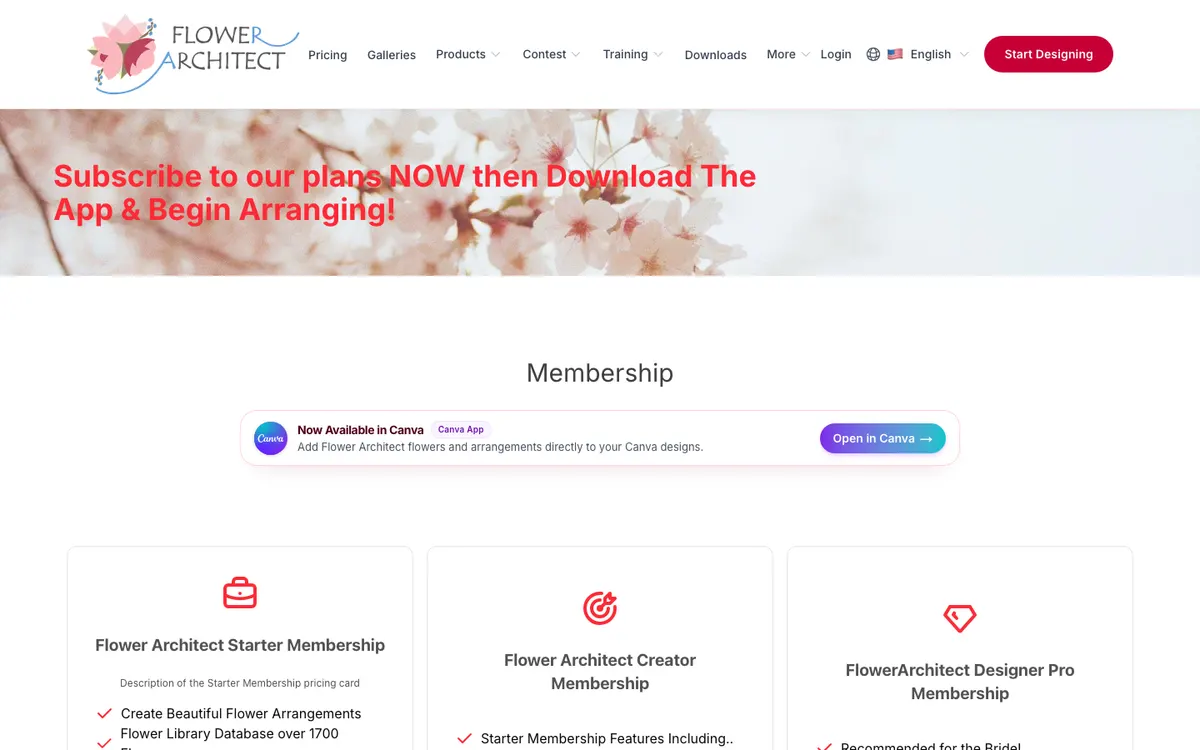
The official homepage describes a virtual arrangement tool using more than 1,700 three-dimensional flowers across 190 flower categories. It targets florists, brides, event planners, and flower enthusiasts. The activity is assembling a visual design in software rather than practicing physical flower handling under a tutor.
The site offers browser and mobile routes and mentions a Canva integration. Those features may help present a concept, but they do not establish that a digital arrangement automatically accounts for every physical material or construction constraint. Treat the result as a planning representation to evaluate alongside practical knowledge.
Format, schedule and time commitment
Flower Architect is a subscription app that you use as needed for individual designs. Access to the tool does not come with a fixed lesson timetable.
There is no course completion schedule or required number of instructional hours in the software offering. Time spent using the tool depends on the arrangement or scene being planned. Before choosing a billing interval, test whether the interface and export or presentation features suit the actual workflow you want to use.
Video: Flower Architect
Accreditation and what the credential is worth
No professional floristry certificate or academic accreditation is documented for the subscription. The homepage includes guided tutorials covering flower selection, placement, extras, virtual scenes, quotation packages, and folders. These explain use of the software; the tutorial descriptions does not establish an assessed professional floristry curriculum. Access to design software should not be presented as qualification to perform every practical floral service.
Price, payment plans and refunds
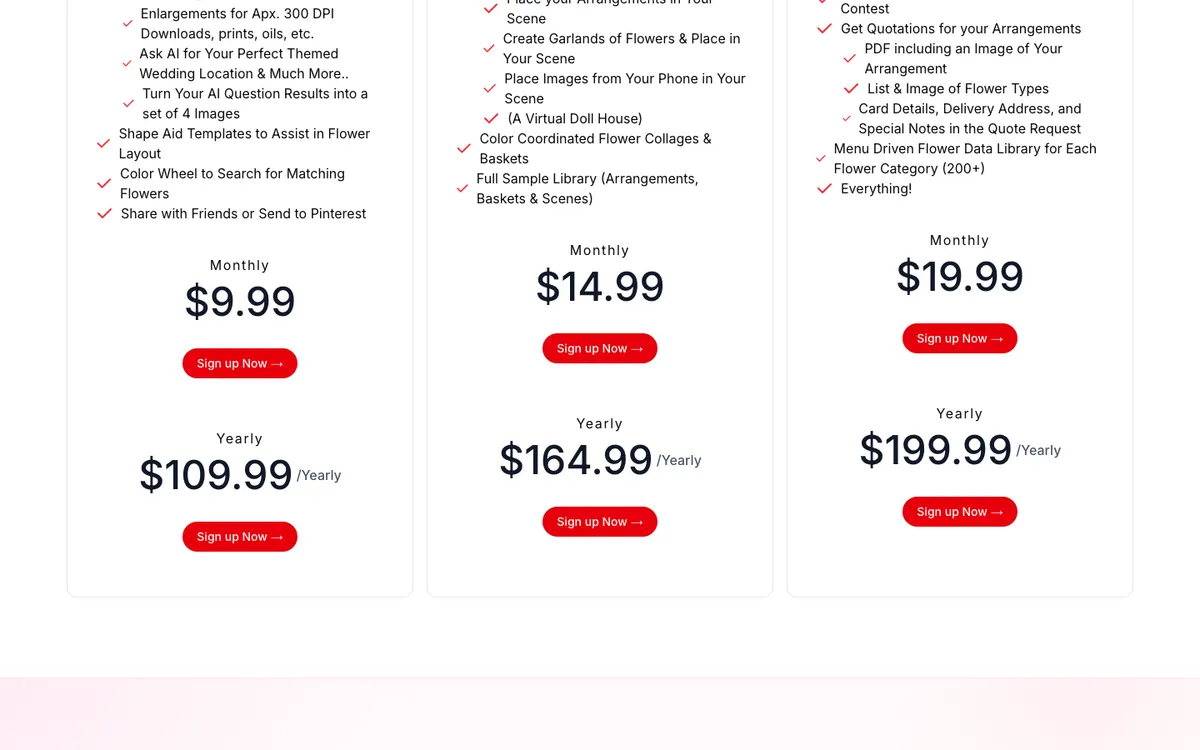
The three tiers cost $9.99 per month or $109.99 per year; $14.99 monthly or $164.99 yearly; and $19.99 monthly or $199.99 yearly. The pricing page mentions trial options alongside these monthly and annual choices.
The listed monthly and annual tiers are software access prices, not tuition. The pricing information mentions trial options but does not establish one universal trial length or refund policy. Compare the exact features available in each tier and the full annual charge before paying, especially if the capability you need is an export, presentation, or scene feature rather than simply browsing virtual flowers.
Monthly or yearly.
No public discount was listed on the official site when we checked. We never publish unverified coupon codes.
Who it’s best for — and who should skip it
Florists and hobbyists who want to visualize arrangements before building them are the clearest audience. The library of 1,700-plus virtual flowers is relevant to planning and presentation, rather than to physical technique practice.
The best fit is someone who already understands the practical project and wants to visualize an arrangement or discuss it with a client. It can also support a hobbyist exploring composition. Skip it as your only purchase if you need foundational instruction in handling materials, constructing arrangements, or running a floral service, because those outcomes are not documented by the software subscription.
Pros and cons in detail
A visual planning workspace. More than 1,700 virtual flowers support arrangement and scene design, with tiers starting at $9.99 monthly. Planning and client presentations are the practical reasons to investigate that library.
The large virtual-flower selection gives users material to experiment with before physically assembling a design. Multiple pricing tiers allow a choice of access level rather than one large course fee. Browser and mobile routes also make the tool worth testing in the setting where you would actually plan or show a design.
No assessed floristry pathway. This subscription provides a design tool, and no professional certificate could be verified. It cannot demonstrate that you have mastered handling or constructing real floral arrangements.
The central limitation is product category: a design tool and a floristry course are different purchases. A virtual scene cannot by itself demonstrate a student’s practical technique or provide an assessed professional credential. The trial and feature limits therefore deserve more attention than the number of virtual flowers alone.
How it compares
Flower Architect is the only listing in our floral category. QC Event School is an adjacent option because its official catalog includes floral design, while Domestika provides a broader creative marketplace. Neither is the same kind of software purchase, and the differences are useful when deciding whether your immediate need is a design tool or instruction.
QC Event School Event & Wedding Planning Certification offers self-paced online study with tutor feedback for aspiring planners. Its professional event certifications carry approval from the International Live Events Association (ILEA), but the certifications are issued by QC and are not licenses. The homepage does not publish tuition. Investigate the particular floral course separately rather than assume that an event-planning certification automatically includes every design subject.
Domestika Courses & Domestika Plus covers illustration, design, crafts, and photography through working artists’ projects for hobbyists and professionals. Its self-paced video catalog adds 100-plus courses per week, and depth and production depend on the teacher. Plus offers teacher-signed course certificates and displays an annual monthly equivalent of $13.79, with a first-year charge of $164.50 and renewal at $329. Monthly Plus costs $33.90, and individual courses are available without that subscription. A suitable creative class would teach a project, rather than provide Flower Architect’s virtual workspace.
Browse Floral Design for the category context. The review methodology explains how we evaluate usefulness, credibility, price, flexibility, and support while distinguishing software access from course enrollment.
Flower Architect’s homepage explains that you can select, rotate, and move flowers, add containers or embellishments, and upload a photograph to create a virtual scene. Folders help organize designs, and a quotation package supports presenting the proposal. Those functions make the workflow more specific than a gallery of arrangement images.
How to enroll
Use Start Designing on the homepage to inspect the browser route, or follow Pricing to compare subscription tiers. The site also directs users to mobile access and its Canva app. Check the actual product environment before choosing an annual payment based only on sample gallery images.
Before subscribing, verify the selected tier, trial conversion, billing amount, cancellation process, and any limits on the output you need. Confirm that the tool supports your intended presentation workflow. No account was created for this review, so private features and the practical quality of exported designs are not independently tested here.
Score breakdown
Design tool without a curriculum.
Niche software product.
From $9.99/month.
App available anytime.
No instruction support.
Weighted average of five criteria. Read our methodology.
Key facts
FAQ
Is Flower Architect a floristry course?
No, it is a virtual floral design app.
How much does it cost?
From $9.99/month or $109.99/year up to $19.99/month or $199.99/year.
Sources
Information checked on October 5, 2026. Prices and offers can change; confirm on the official site.