
On this page · 13 sections5 min read
Our verdict
Our verdict8.7/10QC's interior decorating course makes sense for a career changer who wants to start a small residential decorating or e-design business and needs both the design basics and the business kit: $1,498 paid in full buys the IDDP certification, seven one-on-one audio feedback sessions from a working designer, textbooks and four months of DesignFiles software.
If you want to become a licensed interior designer, this isn't the route; that takes an accredited degree and, in some states, the NCIDQ exam. Watch the refund clock: you have 14 days after enrolling to change your mind.
Best for: Career changers who want to start a residential decorating or e-design business, with mentor feedback and ready-made business tools.
At a glance
Friends keep asking you to “just come look at the living room.” You’ve repainted three rooms in your own house, rearranged your sister’s furniture twice, and you have a Pinterest board with 4,000 pins. At some point the idea of charging for this stops sounding silly. QC Design School’s online interior decorating course is aimed at people standing right there.
QC Design School is part of QC Career School, a distance-learning school for creative careers. Its interior decorating course leads to the International Design and Decorating Professional (IDDP) certification. On October 30, 2026, it cost $1,498 all-inclusive paid in full, or $1,798 if you pay monthly over a year.
How we reviewed it: we read the course page, tuition page and FAQ on October 30, 2026, and compared QC with the other design and home styling programs on our site. We haven’t taken the course.
Some links on this site earn us a commission if you enroll. Your price stays the same. Our rankings are based on our editorial criteria; some partners may be featured more prominently. How we review
Pros & cons
- Mentor-reviewed projects, including seven one-on-one audio feedback sessions from a practicing designer
- Business tools included: templates, a Canva suite and four months of DesignFiles Pro for mood boards and floor plans
- Up to a year to finish, with printed textbooks shipped to you
- $300 off when you pay in full ($1,498 instead of $1,798)
- The IDDP is QC's own designation, not an interior design license or an accredited degree
- Mentor feedback comes as recorded audio on your assignments, not live sessions
- Only 14 days to ask for a refund
- The sales page's 'total value' figures ($5,000+) inflate what you're actually getting
What the course actually walks you through
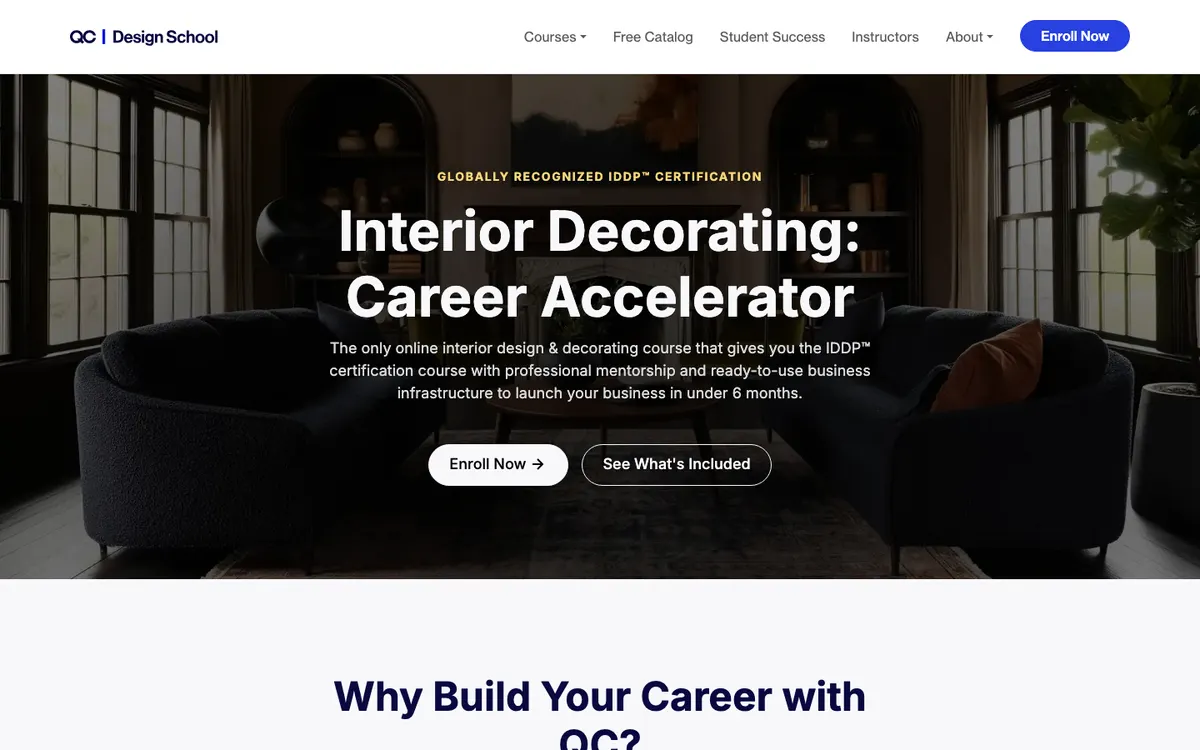
QC’s outline moves in the order a real project does. First come design principles, color and style, and how to run a project from consultation to final reveal. Then measuring, drafting scaled floor plans and furniture layouts, and turning concepts into visual presentations. The course ends with a final project: a fully developed design concept you can use as your first portfolio piece.
Every stage has projects that a mentor reviews. That’s the core of the program, and the part a YouTube playlist can’t give you.
The mentor, in practice
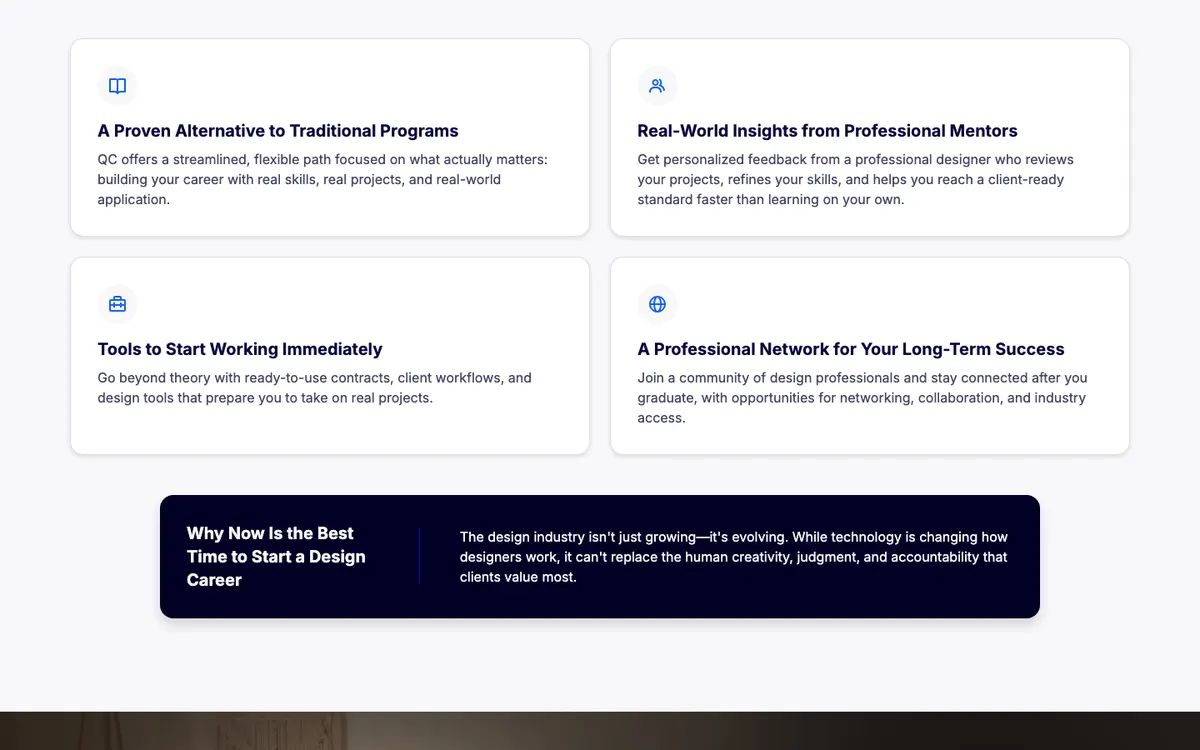
QC pairs you with a working designer. The course page names Deborah Soulier, founder of Soulier Design Studio, as an example. You submit assignments, and you get seven one-on-one audio feedback sessions over the program: recorded critiques where your mentor talks through what works and what doesn’t in your plans and boards.
Picture it: you send in a living room plan on a Sunday. A few days later you play back your mentor’s notes while making dinner. The sofa’s too big for the walkway, the accent color fights with the floor, but the lighting plan is solid. You fix it and move on. That loop, repeated across the course, is what gets your work to a level a paying client will accept.
There’s also a student success team for questions that aren’t about design, such as deadlines or technical issues, and a masterclass with HGTV designer Jane Lockhart.
The business kit
QC puts a lot of weight on helping you launch, and this is where the package is genuinely useful. You get business templates, a Canva suite for branding, and four months of DesignFiles Pro with tutorials, which you can use to build 3D mood boards, digital floor plans and invoices. Bonus modules cover marketing (with a mentor-led business review) and virtual design workflows, so you can sell e-design services to clients you’ll never meet in person.
Textbooks are included and shipped to you, which helps if you’d rather highlight a page than scroll.
Time and pace
You have up to a year to finish. QC says many students complete it in 2 to 6 months. A realistic plan for someone with a full-time job: one unit every two or three weeks, working evenings and one weekend afternoon, and you’ll be done in about six months.
Who it fits, and who it doesn’t
It fits a stay-at-home parent planning a return to work through a flexible side business, a real estate agent who wants to offer styling advice to sellers, or a retail employee in a furniture store who wants to move into design consultations. All three need practical skills, a portfolio and a business setup more than theory.
It doesn’t fit someone who wants to work on commercial projects, hospitals or office buildouts, where firms hire designers with accredited degrees. It’s also a stretch for someone who just wants to redo their own home: $1,498 buys a lot of paint and a few hours with a local decorator.
Video: QC Design School (QC Career School)
The catch: a designation, not a license
The IDDP is QC’s own certification. It shows you’ve completed structured training with professional feedback, which helps when you pitch your first clients. It isn’t a license, and it isn’t an accredited degree.
That matters because some US states regulate the title “interior designer.” Decorating and styling are generally open to anyone, but calling yourself an interior designer may require an accredited degree, work experience and the NCIDQ exam, depending on your state. Check your state’s rules before you print business cards.
Two smaller points. The refund window is only 14 days from enrollment. And the “total value” numbers on the sales page (over $5,000) are marketing; judge the course by the $1,498 or $1,798 you’ll actually pay.
Other QC paths, and other schools
QC sells related certifications on the same model. On October 30, 2026, home staging (ISRP), outdoor and garden design (ILDP) and feng shui design (AFDP) were each $1,398 paid in full, and professional organizing (AIOP) was $1,298. If you’re sure you want to focus on getting homes ready for sale, the staging course is more targeted.
Outside QC, Staging Diva is a staging-focused program built around running a staging business; see our home staging certification ranking. For general design inspiration at a low price, video platforms like Domestika have short interior design courses, without mentorship or a certification.
The full list is in our interior design courses ranking.
Before you enroll
Look up your state’s rules on the “interior designer” title, so you know what you can call yourself. Then enroll when you can start the first unit the same week, so you’ve seen the material and the first mentor feedback process before the 14-day refund window closes. If you can afford it, pay in full: it saves $300. If you can’t, the monthly plan spreads the cost over a year, so check that the monthly amount fits next to your other bills before the first payment goes out.
14-day money-back guarantee: contact QC within 14 days of enrolling for a tuition refund (official FAQ, October 30, 2026).
Pay in full ($1,498) or monthly installments over one year ($1,798 in total)
No public discount was listed on the official site when we checked. We never publish unverified coupon codes.
Score breakdown
Decorating curriculum with business-launch modules.
Established distance school; designation is QC's own.
$1,498 including mentorship and software trial.
Self-paced online.
Personal mentorship from professionals.
Weighted average of five criteria. Read our methodology.
FAQ
How much does QC Design School's interior decorating course cost?
On October 30, 2026, the IDDP course was $1,498 all-inclusive if you pay in full, or $1,798 on the monthly plan, paid over a year.
Can I get a refund from QC Design School?
Yes, within 14 days of enrolling. QC's FAQ says you can contact the school during that period for a refund of your tuition if the course isn't for you.
Is the IDDP certification the same as being a licensed interior designer?
No. The IDDP is a professional designation issued by QC. Decorating doesn't require a license, but some states regulate the title 'interior designer,' which generally requires an accredited degree and the NCIDQ exam. Check your state's rules before you advertise your services.
Sources
- https://www.qcdesignschool.com/online-courses/interior-decorating
- https://www.qcdesignschool.com/
- https://www.qcdesignschool.com/tuition/
- https://www.qcdesignschool.com/faq/
Prices and offers can change; confirm on the official site before you enroll.