On this page · 14 sections5 min read
- 01Our verdict
- 02At a glance
- 03Pros & cons
- 04What you’ll learn
- 05Format, schedule and time commitment
- 06Accreditation and what the credential is worth
- 07Price, payment plans and refunds
- 08Who it’s best for — and who should skip it
- 09Pros and cons in detail
- 10How it compares
- 11How to enroll
- 12Score breakdown
- 13Key facts
- 14FAQ
Our verdict
Our verdict8.6/10Serving Alcohol Inc. sells state-approved online training for alcohol servers, sellers and managers, plus food handler certification.
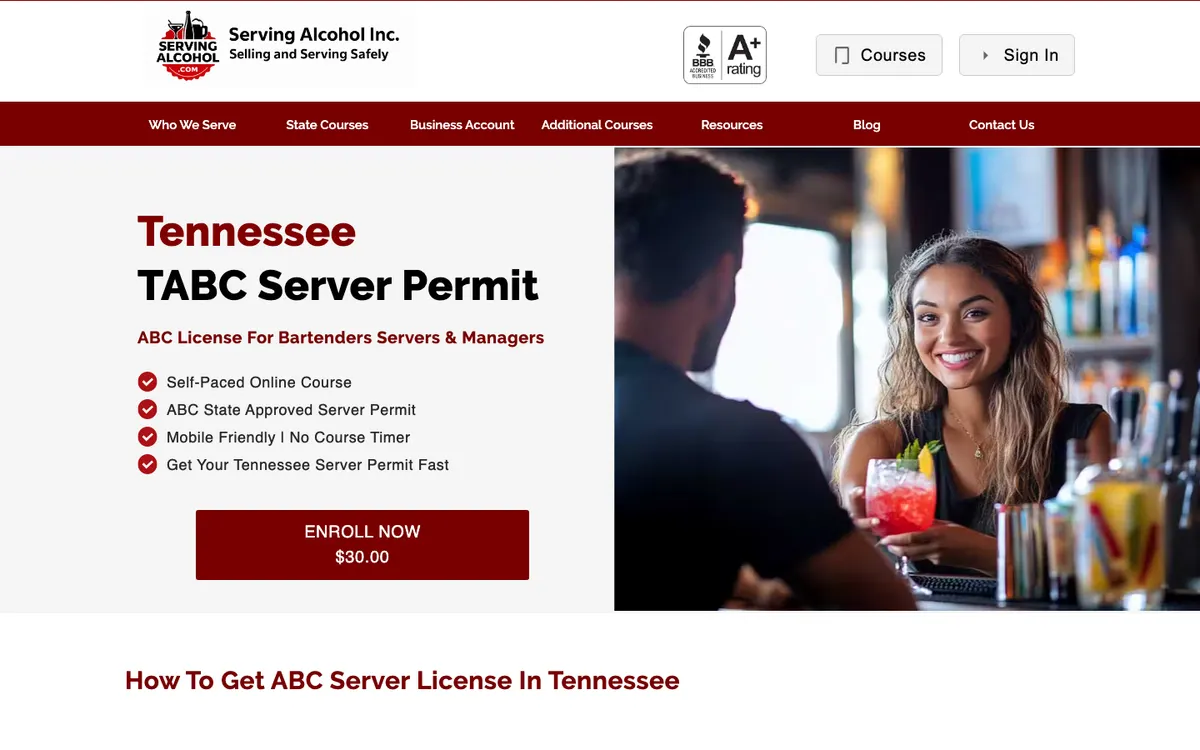
On its Tennessee page, the TABC server course costs $30, an off-premise seller course $12.95 and a manager course $29.99, with the state's $20 application fee paid separately. Courses are self-paced with no timer and work on mobile, and businesses can track staff on a dashboard. This is compliance training, not a bartending school, so it teaches responsible service and the law rather than mixology. It is a quick, inexpensive way to get legally certified, provided you confirm the course is approved in your state.
Best for: Bartenders, servers and store clerks who need a state-required responsible alcohol service permit quickly and cheaply.
At a glance
Serving Alcohol sells responsible-service and seller training, with state-specific courses and related manager or food-handler products. It is useful for workers and businesses seeking the appropriate compliance education. It is not a comprehensive bartending school: the Tennessee example concerns responsible alcohol service and a permit process rather than cocktail technique, bar speed, or a professional mixology qualification.
Pros & cons
- State-approved courses at low prices
- Self-paced with no course timer, on mobile
- Manager and food handler courses too
- Business dashboard to track staff
- Compliance training, not a full bartending school
- State application fees are extra
- Approval and pricing vary by state
What you’ll learn
The Tennessee page describes alcohol-awareness education for people directly serving alcohol. The broader catalog separates server, off-premise seller, manager, and food-handler products. These labels identify different responsibilities, so a worker should use the course requested for the actual role rather than buy the cheapest title in the catalog.
The provider’s positioning centers on service responsibilities and applicable rules rather than an extensive practical beverage curriculum. Someone wanting drink preparation, equipment practice, or supervised bar work should not assume those skills are included. A compliance certificate can be relevant to a hospitality job without being a complete preparation for every task performed during a shift.
Businesses are offered a dashboard to track staff training. That is an administrative feature for monitoring completion, not a substitute for checking which course each employee needs. A manager organizing group enrollment should verify account setup, staff identifiers, and reporting before buying several different course products.
Format, schedule and time commitment
Serving Alcohol advertises self-paced, mobile-friendly online study without a course timer. Age and documentation requirements depend on the state. Identify the applicable product and learner requirements before assuming that the same enrollment process works for every jurisdiction.
The site advertises self-paced mobile learning without a course timer, while its Tennessee information also describes a minimum training-program length. Those statements should not be collapsed into a promise that any learner can finish immediately. Confirm how the required content and completion process operate in the selected course, especially if a work start date depends on receiving documentation.
Online flexibility helps a worker study outside a shift, but application processing is a separate part of the Tennessee route described on the page. Completing lessons and obtaining an application identifier are not the same event. Plan both the course and the state-facing steps rather than assuming that an online purchase completes the entire permit process.
Video: Serving Alcohol Inc
Accreditation and what the credential is worth
The provider lists state-approved alcohol-server courses, including Tennessee Alcoholic Beverage Commission approval, and separately advertises an ANAB-accredited food-handler course. The stated server outcome is a state permit or certificate. Its Tennessee information describes permits as valid for two years from January 1, 2025.
The provider identifies Tennessee Alcoholic Beverage Commission approval for the Tennessee course, while its food-handler product has a separately stated ANAB accreditation claim. Those recognitions apply to different products. ANAB language associated with food handling should not be used to characterize every alcohol course, and one state’s course approval should not be expanded to nationwide acceptance.
That permit and validity description comes from the provider’s Tennessee explanation. Confirm the current requirements and exact document with the receiving authority or employer before purchasing. The course description does not decide an individual worker’s eligibility or replace state application instructions.
Price, payment plans and refunds
As of October 5, 2026, Tennessee TABC server training was $30, off-premise seller training $12.95, and Responsible Alcohol Manager training $29.99. The Tennessee page listed food-handler cards from $65. State charges were additional, including a $20 Tennessee TABC application fee.
The official Tennessee page advertised 15% off for business accounts certifying staff on October 5, 2026. Check the employer account’s eligibility and the offer’s continued availability before assuming the discount applies to either a group or an individual purchase.
The $30 Tennessee server tuition plus the page’s $20 application fee gives a $50 combined amount for those two listed charges. The application fee is paid separately and described as nonrefundable on the provider’s page. The $12.95 seller course and $29.99 manager course are different products, not discounted ways to obtain the same server training.
The available course information does not establish a general refund policy across Serving Alcohol’s catalog. Ask about tuition cancellation separately from the state application fee. Also confirm whether you need food-handler education before adding it, since a product’s presence in the catalog does not make it a requirement for every worker.
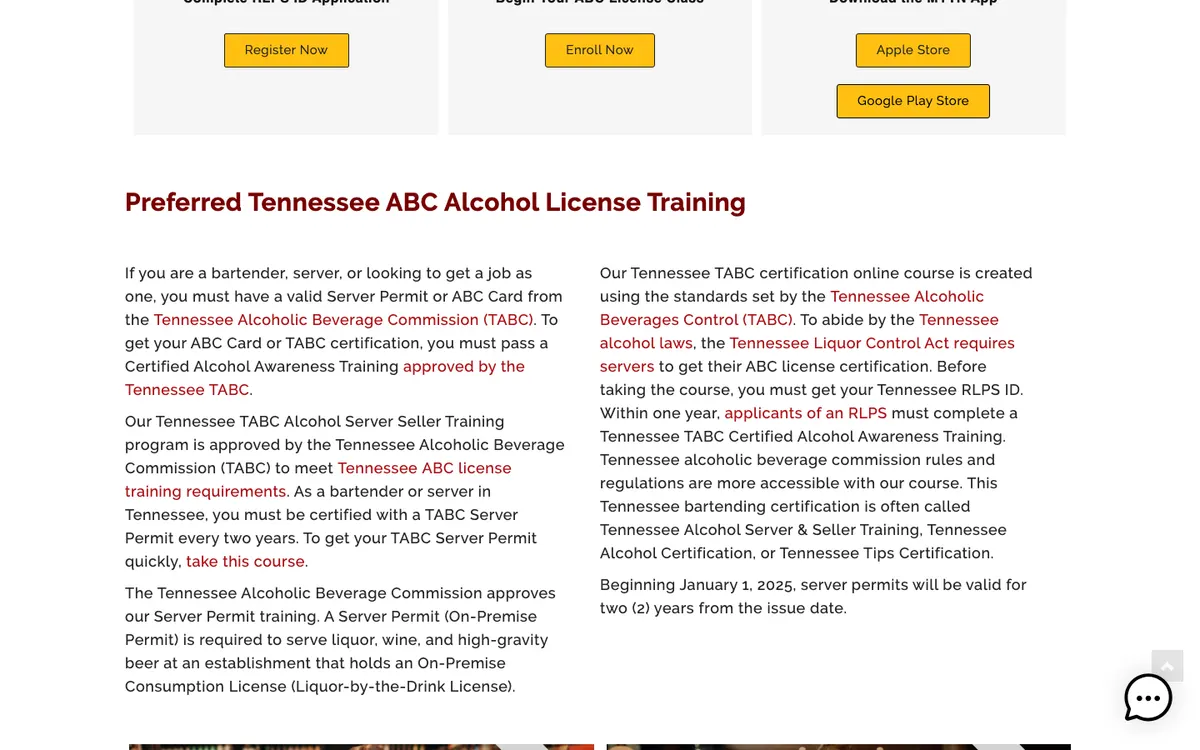
15% off advertised on the official Tennessee page for business accounts certifying staff
↪See offer details and conditionsWho it’s best for — and who should skip it
Serving Alcohol fits a server, seller, manager, or employer who has identified the correct state-specific training requirement. It is less suitable for a beginner seeking a full bartending education or someone who has not yet established which jurisdiction’s course is needed. A worker moving between states should check the new location’s requirements rather than assume an existing certificate transfers automatically.
The dashboard may be particularly useful to a business managing several employees, while an individual learner may care more about mobile access and document delivery. Those are different buying priorities. Confirm that the selected account type and course meet the actual use instead of choosing from the broad brand description alone.
Pros and cons in detail
Low published course prices and self-paced access make the service relatively easy to budget at the individual-product level. The separate manager and seller options allow training to be matched to a role. Staff tracking adds a concrete benefit for employers who need to organize completion across a team.
The main drawbacks are the separate state fee, variable approval across jurisdictions, and the narrow compliance focus. A low-priced course does not teach all practical bartending skills, and no-timer language does not remove the need to complete required material. These are limits of scope rather than reasons to dismiss the service when compliance education is exactly what the buyer needs.
How it compares
Serving Alcohol is the only provider in this site’s bartending category. The useful comparisons here are therefore its server, seller, manager, and food-handler products, which address different responsibilities. They are neither interchangeable packages nor competing schools.
For Tennessee, start with the employer’s stated server-training need and add manager or food-handler education only when relevant. The category does not provide evidence for a practical bartending-school comparison. Use the Bartending Certification category with the distinction between permit-related education and hands-on occupational skills in mind.
How to enroll
The Tennessee page directs learners first to the server-permit application and RLPS identifier step, then to course enrollment. Follow that state-specific sequence, confirm eligibility and the application charge, and select the matching course through Enroll Now. Save both the course certificate and application documentation, and verify issuance of the required permit before relying on it for work.
Follow the Tennessee instructions on the official program page. Our methodology assesses curriculum, credibility, value, flexibility, and support, recognizing that responsible-service compliance and comprehensive bartending instruction are different purchases.
Score breakdown
Covers responsible service, ID checks and refusal of sale for state compliance.
State-approved courses (e.g. Tennessee TABC) and ANAB-accredited food handler training.
Courses from $12.95 to $30.
Self-paced, no timer, mobile friendly.
Standard customer support; no instructor.
Weighted average of five criteria. Read our methodology.
Key facts
FAQ
Is Serving Alcohol Inc. state approved?
Yes for supported states; for example, its Tennessee course is approved by the Tennessee Alcoholic Beverage Commission.
How much is the Tennessee server course?
$30, plus the state's $20 non-refundable application fee.
How long is a Tennessee server permit valid?
From January 1, 2025, permits are valid for two years from the issue date, per the page.
Sources
- https://servingalcohol.com/
- https://servingalcohol.com/tennessee-tabc-alcohol-server-training/
- https://servingalcohol.com/job-search-for-bartenders-waitstaff/
- https://servingalcohol.com/california-alcohol-server-certification-courses-compared/
- https://servingalcohol.com/scdor-alcohol-server-certificate-what-to-carry/
Information checked on October 5, 2026. Prices and offers can change; confirm on the official site.