On this page · 8 sections6 min read
What a singer does
A singer performs vocal music for live audiences or recordings, with preparation shaped by the musical setting. The O*NET musicians-and-singers profile covers performance on stage and for broadcast or recorded media. A choir, a theater production, a band, and a studio session can require different abilities even though all involve singing.
Choose your initial goal before selecting lessons. Joining an ensemble may emphasize pitch, rhythm, and following direction, while a solo event engagement also requires repertoire planning and communication with accompanists. An online course should be evaluated against the next skill you need rather than a vague promise of professional success.
A useful starting point is an unedited recording of a comfortable song. Listen for steady timing, intelligible words, consistent pitch, and where the phrasing becomes uncertain. That gives a teacher or course a concrete problem to address instead of reducing progress to whether you can reach a higher note.

Do you need a license or certification?
The cited occupational profiles do not identify a nationwide government singer license or a mandatory online singing certificate. Employers, ensembles, and clients assess the requirements of their own roles. A lesson-completion badge should therefore be treated as a record of study rather than permission to perform or proof of audition readiness.
The BLS musician profile describes substantial skill development and formal study in some musical pathways. That does not make a particular commercial course the universal entry route. Follow the education and audition expectations of the setting you actually want to enter.
Ask how a course assesses progress. Automated pitch feedback, lesson completion, and an instructor reviewing a recorded performance measure different things. If nobody hears an individual performance, the certificate cannot tell an audition panel how the learner sings.
Teaching in a public school is a separate employment and credential pathway. Likewise, recording or publishing a cover involves permissions that are not automatically supplied by access to a lesson or backing track. Check the relevant requirements for those activities rather than assuming a singing subscription covers every professional use.
Vocal instruction is also different from clinical voice care. A course should not be presented as a substitute for appropriate healthcare evaluation of persistent discomfort or voice changes. Ask a prospective teacher how they handle concerns beyond the limits of remote instruction instead of relying on claims that one exercise fixes every problem.
Step-by-step: how to become a singer
- Choose a musical setting and comfortable baseline. Select a song suited to your current ability and record a complete take. Identify one or two specific difficulties so you can compare lessons based on the help they offer.
- Start a structured beginner sequence. Look for a progression from coordination and listening to phrases and complete songs. A large song library can be enjoyable, but it may not explain which foundational skill you should practice next.
- Arrange useful feedback. Find out whether the product offers automated exercises, teacher responses, live lessons, or self-study only. If your main problem is difficult to describe, individual feedback may matter more than access to additional videos.
- Build an appropriate repertoire. Choose material for the ensemble, audition, or performance you want. Keep keys, versions, lyrics, and accompaniment organized so that each rehearsal starts with the correct music rather than searching through files.
- Practice complete performances. Rehearse entrances, endings, microphone use where relevant, and recovery after an error. An uninterrupted take shows whether a skill remains dependable outside an isolated exercise.
- Seek suitable ensemble or performance experience. Read the audition instructions carefully and prepare the requested material. Distinguish a stylistic mismatch from a technical problem when reviewing the result, and use any specific feedback to guide the next practice goal.
- Add skills for the next opportunity. Studio work may require repeatable phrasing and harmony parts, while theater can require acting and movement. Choose further training for those actual demands instead of assuming another beginner certificate is the necessary next step.
A useful practice exercise compares singing with and without the original recorded vocalist. The original can conceal uncertain entrances and make your own pitch harder to evaluate. Use the accompaniment appropriate to your goal and listen to your independent recording before deciding which phrase needs work.
Keep a short practice log that records the exercise, the song passage it supports, and what changed. Do not judge the session only by how many minutes you completed or how many lessons you watched. The purpose is to develop an ability you can reproduce in music, not merely a streak inside the platform.
For audition preparation, rehearse the submission process as well as the song. Check the requested format, accompaniment rules, and whether the recording should be uninterrupted. A technically polished file that ignores the instructions can fail to show the panel what it needs to evaluate.
How long it takes and what it costs
The three singing options use different payment models: a membership, an app, and a one-time download. 30 Day Singer’s $10.75 monthly equivalent requires annual billing, while Singorama’s $99.95 comes from its program listing and is not visible on the homepage. Singing Carrots has no confirmed tuition figure here, so a simple price range would hide those differences.
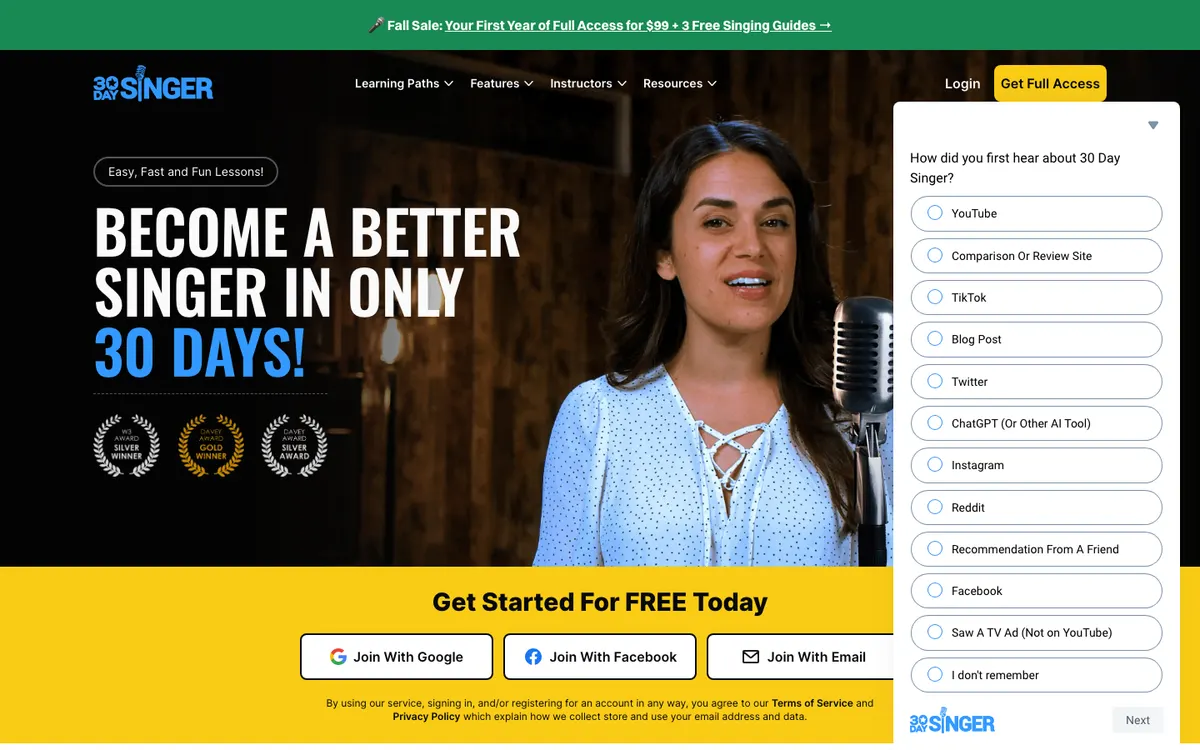
30 Day Singer Full Access costs $10.75/month when billed annually; a free Basic access tier is also available. The membership includes a beginner course organized around 30 days, which gives your initial practice a defined sequence.
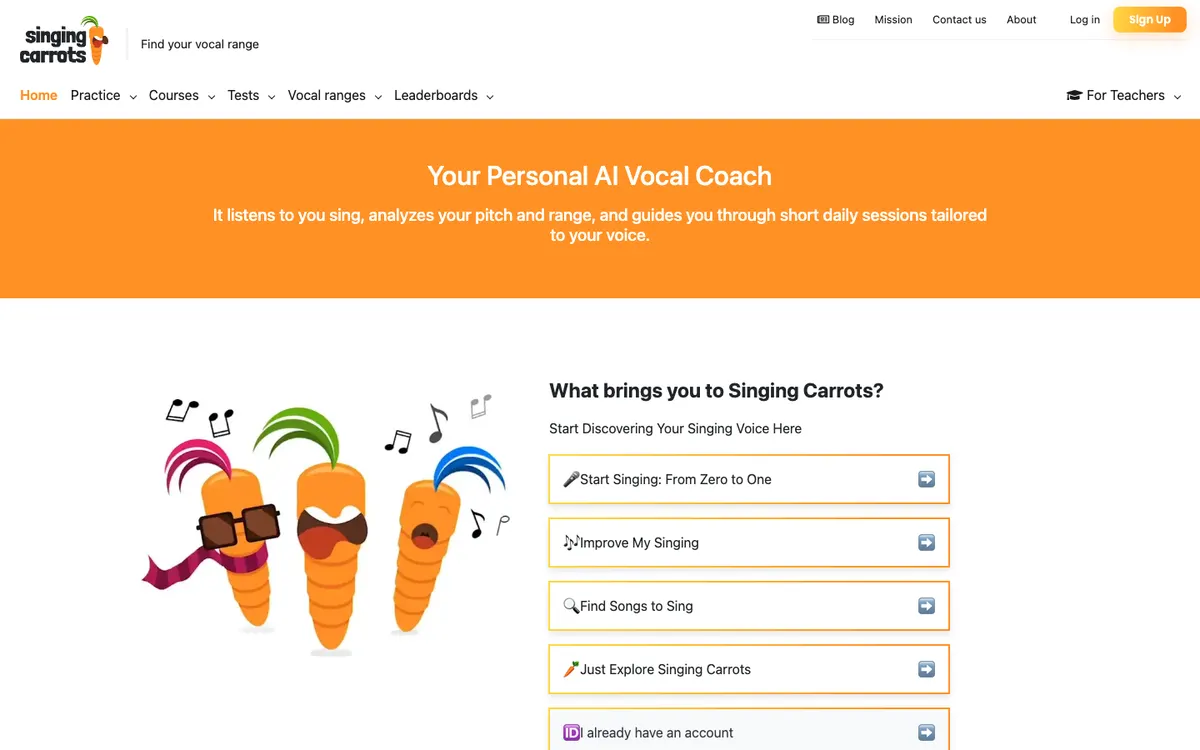
With Singing Carrots, you work at your own pace. The site recommends 15-20 minutes of practice, 3 times a week; request a written quote for the exact course because its tuition is not confirmed here.
Singorama lists its instant-download course at $99.95, although that price is not visible on the homepage and needs confirmation. Study is self-paced, with exercises of about 15 minutes a day.
A beginner sequence organized around thirty days is a learning structure, not a guarantee of professional readiness. Likewise, a provider’s suggested practice routine is not a universal completion schedule. Your starting coordination, repertoire, and access to feedback affect what a useful next step looks like.
Check whether a subscription includes personal feedback or whether that requires a separate service. Ask how the annual billing works, when access renews, and what happens if the course is not a good fit. A low monthly equivalent can obscure a larger upfront commitment if the billing period is not read carefully.
For a performance goal, obtain separate quotes for accompaniment, coaching, or recording support where needed. Those costs depend on the actual audition or engagement and are not included in a universal budget here. Begin with a usable practice setup rather than assuming expensive recording equipment will solve a vocal-learning problem.
Best online programs for aspiring singers
In category rank order, these options offer three ways to organize singing practice: membership lessons, an app, and downloadable instruction.
- 30 Day Singer Full Access offers a beginner-oriented membership with an annual-billing price and a free Basic tier.
- Singing Carrots offers app-based singing practice whose tuition needs confirmation.
- Singorama offers self-paced downloadable learning, with a listing price that requires current confirmation.
Use the Singing Lessons comparison to examine each format and the supporting reviews.
Top programs compared
The 3 highest-scored online singing lessons programs in our ranking, side by side.
Swipe sideways to compare all 3 programs →
| Criterion | |||
|---|---|---|---|
| Our score | 8.3/10 | 8.2/10 | 7.9/10 |
| Price | Free | — | $99.95 |
| Format | Subscription | App | Self-paced |
| Duration | Membership; beginner course designed around 30 days. | Self-paced; the site recommends practicing 15-20 minutes, 3 times a… | Self-paced; exercises of about 15 minutes a day. |
| Free trial | Free Basic Access tier. | Free account with free tools (vocal range test, pitch… | — |
| Best for | Beginner singers who want structured, low-cost video lessons with a money-back guarantee. | Singers who want AI-guided pitch and range exercises with free self-assessment tools. | Self-learners who prefer a one-time-purchase downloadable singing course over a… |
| Full review | 30 Day Singer review | Singing Carrots review | Singorama review |



Scores from our editorial method. See the full ranking of 3 programs.
Common mistakes to avoid
Do not choose a course only for a promise of expanded range. A performance also needs timing, clear words, phrasing, and consistency. Ask how the exercises support complete songs and whether the program provides feedback on those broader skills.
Avoid practicing only the most exciting phrase. Prepare the opening, transitions, quieter sections, and ending so that the whole song is dependable. Record a complete take to identify where concentration or coordination changes over the course of the piece.
Do not interpret a course title as an employment promise. A short beginner challenge can provide useful structure without making the learner ready for every audition. Judge the next step through demonstrated performance and the requirements of the intended opportunity.
When comparing formats, distinguish an app’s measurement from a teacher’s interpretation. A pitch display can provide information without explaining why a passage remains difficult. Choose additional feedback when the tool is no longer answering the question you need to resolve.
FAQ
Is a singing certificate required for auditions?
The BLS profile does not establish a universal course-certificate requirement. Follow the instructions of the specific ensemble, employer, or production.
Can someone with no experience start with 30 Day Singer?
The 30 Day Singer listing explicitly describes a beginner audience without prior experience. That establishes the intended starting level, not a guaranteed outcome after a fixed period.
Is the advertised monthly equivalent a monthly billing plan?
The advertised 30 Day Singer price is an annual-billing equivalent. Confirm current payment and renewal terms before comparing it with a month-to-month subscription.
Is Singorama’s listed price freshly verified on its homepage?
The Singorama entry says the price came from the program listing and was not visible on the homepage. Confirm the current checkout price rather than treating the $99.95 figure as guaranteed.