On this page · 8 sections6 min read
What a software developer does
A software developer turns requirements into software that can be tested, maintained, and used reliably. O*NET includes analyzing user needs, designing or modifying systems, testing, documentation, and collaboration with other technical staff. Writing code is central, but understanding a problem and maintaining a working system are also part of the occupation. O*NET.
An online course can help you learn syntax and patterns, but a useful beginner project must work beyond the instructor’s demonstration. Choose a target such as web applications, backend services, or another defined area before buying a broad subscription. Security operations and networking courses in the same catalog may serve a different career objective.

Do you need a license or certification?
The listed bootcamps and learning platforms award educational credentials, not a universal government software-developer license. The cited occupational profile does not establish a mandatory national coding certificate. Employers may still require a degree, technical assessment, experience, or specific knowledge, so evaluate the roles you actually intend to pursue.
A vendor certification can be relevant to a particular platform, but it is distinct from a course-completion certificate and from the ability to build software. Ask what is assessed and whether any exam voucher or external certification is included. Do not infer those benefits from the word certification in a course title.
Professional responsibility also depends on the project. Access to production systems, personal data, or a security-testing target requires authorization and appropriate controls. Training in coding or cybersecurity does not grant permission to experiment on systems you do not own or have explicit authority to test.
Step-by-step: how to become a software developer
- Pick a first role and technology path. Use a small set of relevant job descriptions to identify recurring skills, then select one coherent curriculum. Avoid mixing unrelated languages and specialties before you can finish a basic application.
- Learn programming through small working tasks. Practice data structures, control flow, functions, and error handling in the chosen language. Explain why your code works instead of measuring progress only by lessons completed.
- Build a project without copying the entire solution. Choose a narrow problem with clear inputs and outputs. Add features incrementally and keep a history of your changes so you can trace mistakes.
- Learn testing and debugging. Reproduce a failure, inspect the relevant state, and verify the correction. Include invalid inputs and error cases, because a successful demonstration on one example does not establish reliability.
- Document and share responsibly. Provide setup instructions, limitations, and a description of your contribution. Remove credentials and private information before publishing code or screenshots.
- Prepare for collaborative work. Practice version control, review feedback, and explaining tradeoffs. A portfolio should show that another person can understand and run your project, not just that you can display a finished screen.
Use a project to choose the next lesson
Build a small application that stores and retrieves information, validates input, and displays meaningful error messages. Write down a user task before adding visual polish. If you cannot complete that task without following the tutorial line by line, revisit the relevant concept and implement a variation yourself.
Keep a short decision log explaining a data model, a validation rule, or a tradeoff you made. Ask another learner or developer to follow your setup instructions and report where they get stuck. Their confusion often reveals missing assumptions in your documentation or environment setup.
When using coding assistance, inspect and understand the generated changes. Test behavior and explain why the solution fits the requirement. A hiring conversation may probe those decisions, and a project you cannot explain provides weak evidence regardless of how polished it looks.
Make the project runnable by someone else
Before submitting an application, test your setup instructions from a clean environment you control. Document the required dependencies and configuration without publishing secrets. Ask a reviewer to follow the instructions and identify where they need extra explanation. That exercise tests the maintenance and collaboration side of development, and it can reveal issues hidden by a project that runs only on your own machine.
How long it takes and what it costs
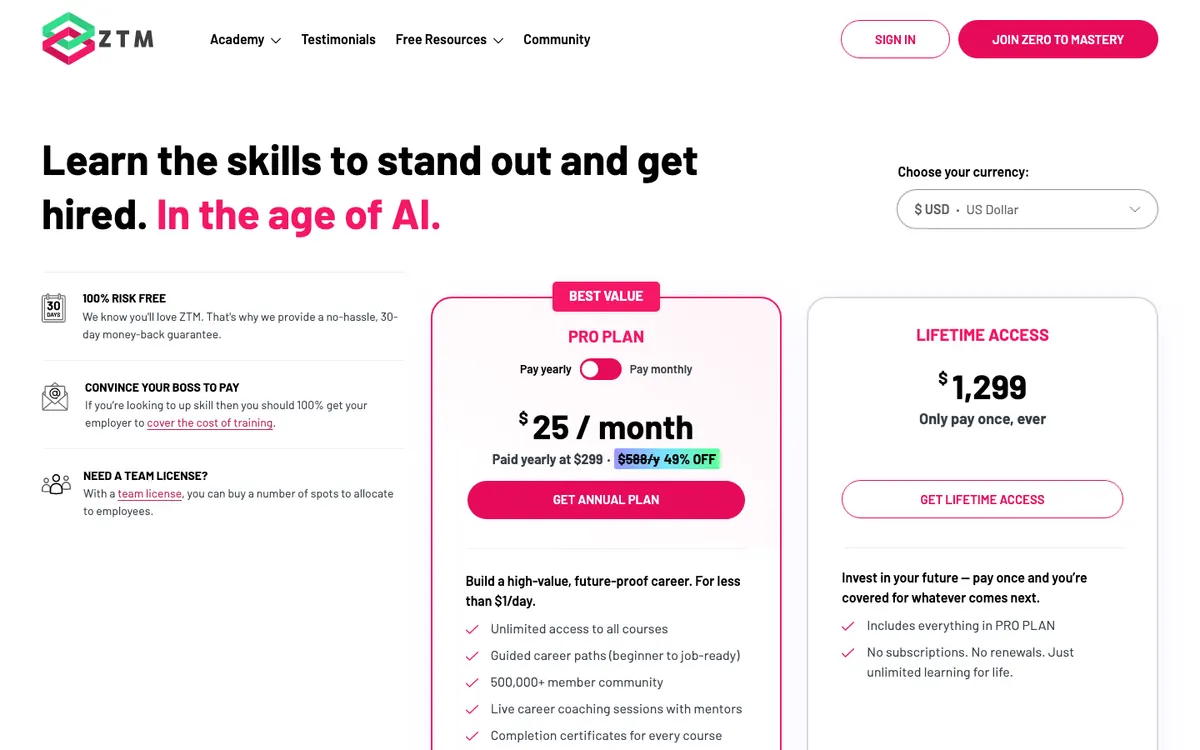
The catalog combines broad learning subscriptions, specialized security training, and other technical programs. Compare like products: Zero To Mastery’s annual membership and Codecademy’s subscription tiers use a different cost model from MyDFIR’s one-time SOC Analyst course or INE’s certification bundles.
Subscription length is not a bootcamp graduation timeline. Estimate your likely access period from the work you can complete and the projects you intend to build, then check renewal terms. None of these access terms establishes how many weeks a particular learner will need to find employment.
Zero To Mastery Academy. Pro costs $299 per year, equivalent to about $25 per month, and monthly billing is also available. Lifetime access costs $1,299 in one payment. The membership covers more than 170 courses; choose a focused sequence rather than treating the library size as a completion target.
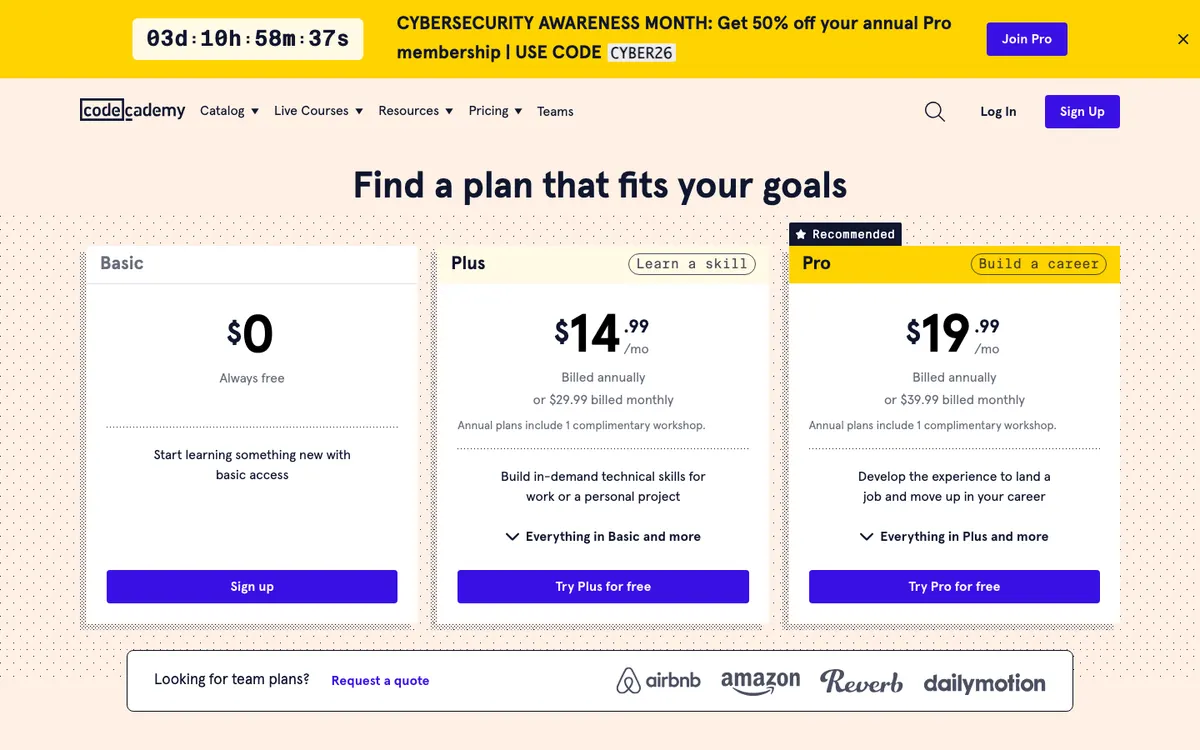
Codecademy Pro. Plus costs $14.99 per month when billed annually, or $29.99 with monthly billing. Pro is $19.99 per month billed annually, or $39.99 monthly. All Access is $54.99 per month billed annually. These are subscription choices, so compare the annual commitment as well as the displayed monthly rate.
INE Cybersecurity Training Subscriptions. Certification bundles with three months of Premium cost $399, against a $599 full price. Premium renewal is $350 after three months, then $799 per year. Premium includes more than 3,500 hours of training content and over 750 hours of hands-on labs; inspect the renewal sequence before enrolling.
MyDFIR SOC Analyst Course. The self-paced SOC Analyst Course costs $499 as a one-time purchase. MyDFIR Forge is a separate membership at $99 per month or $999 per year, with a new investigation scenario each month. A free SOC Community tier is also available.
Educative Unlimited. Educative Unlimited uses a subscription model, but a usable current price is unavailable here. Ask for the billing amount and access terms for the plan you intend to use for coding or system-design interview practice.
Best online programs for aspiring software developers
- Zero To Mastery Academy gives self-taught developers a single membership with more than 170 project-based courses and a career-focused community.
- Codecademy Pro brings interactive exercises, projects, and career paths together in a subscription for beginning coders.
- INE Cybersecurity Training Subscriptions serves security and networking professionals with extensive labs and INE certification vouchers.
- MyDFIR SOC Analyst Course teaches aspiring SOC analysts through practical investigations led by a working practitioner.
- Educative Unlimited uses text-based interactive lessons for software engineers preparing for coding and system-design interviews.
Browse the Coding Bootcamp comparison for the wider selection and individual reviews, distinguishing development curricula from specialist security training.
Top programs compared
The 4 highest-scored online coding bootcamp programs in our ranking, side by side.
Swipe sideways to compare all 4 programs →
| Criterion | ||||
|---|---|---|---|---|
| Our score | 8.9/10 | 8.8/10 | 8.7/10 | 8.7/10 |
| Price | $299 – $1,299 | $14.99 – $54.99 | — | $399 – $799 |
| Format | Subscription | Subscription | Subscription | Subscription |
| Duration | Membership; 170+ courses. | Subscription. | Subscription. | Subscription; 3,500+ hours of training content and 750+ hours of… |
| Free trial | — | Free basic plan; trial offered on paid plans. | A few free interactive courses are available. | — |
| Best for | Self-taught developers who want a single membership with 170+ project-based courses and a… | Beginners learning to code who want interactive exercises, projects and career paths in… | Software engineers preparing for coding and system design interviews who prefer… | Security and networking professionals who want lab-heavy training plus INE certification… |
| Full review | Zero To Mastery review | Codecademy review | Educative review | INE review |




Scores from our editorial method. See the full ranking of 9 programs.
Common mistakes to avoid
Do not interpret every highly ranked technical provider as a direct beginner software-development route. INE and MyDFIR emphasize security or networking work, which may be valuable but does not replace a chosen application-development curriculum.
Avoid buying several overlapping subscriptions while leaving projects unfinished. Also avoid presenting tutorial code as an original client project. Clearly label what was guided, what you changed independently, and what the application still cannot do.
FAQ
Do I need a bootcamp certificate to write software?
The ONET profile describes development tasks rather than a universal licensing certificate. Evaluate actual employer requirements and build evidence of those tasks.
Are all listed programs coding bootcamps?
No. The coding category includes broad platforms and specialized security training. Match the syllabus to the role rather than relying on the category label.
Does annual access mean I will be job-ready in a year?
No. The Zero To Mastery review describes a membership, not an individual employment deadline.
What should a beginner project demonstrate?
Requirements, implementation, testing, and documentation align with ONET's developer duties. Explain your own decisions and the project's remaining limitations.