On this page · 13 sections5 min read
- 01Our verdict
- 02At a glance
- 03Pros & cons
- 04The course: from "what is this alert?" to a written report
- 05What a week might look like
- 06Before you buy: check your computer
- 07The Forge: school instead of textbook
- 08The catch: no refunds, and no beginner on-ramp
- 09Who should look elsewhere
- 10Before you enroll
- 11MyDFIR Academy vs alternatives
- 12Score breakdown
- 13FAQ
Our verdict
Our verdict8.7/10At $499.97 once, MyDFIR's SOC Analyst Course is a good buy for someone who already passed Security+ or knows networking and now needs investigation practice and portfolio projects to talk about in a SOC interview.
Complete beginners should start with the free community tier or a fundamentals course, because the labs assume IT basics from day one. Watch out for the setup: you build your own lab, on a Windows PC with 16 GB of RAM, and there are no refunds.
Best for: People with IT or Security+ basics who want hands-on SOC investigation practice and portfolio projects before applying for analyst roles.
At a glance
Security+ is done, the certificate is on your LinkedIn, and the job ads still ask for “hands-on experience triaging alerts in a SIEM.” You’ve watched the videos. You’ve never opened a real alert and decided, on your own, whether it’s an attack or a backup job running at 2 a.m. MyDFIR Academy is built for that gap between the exam and the first SOC analyst job.
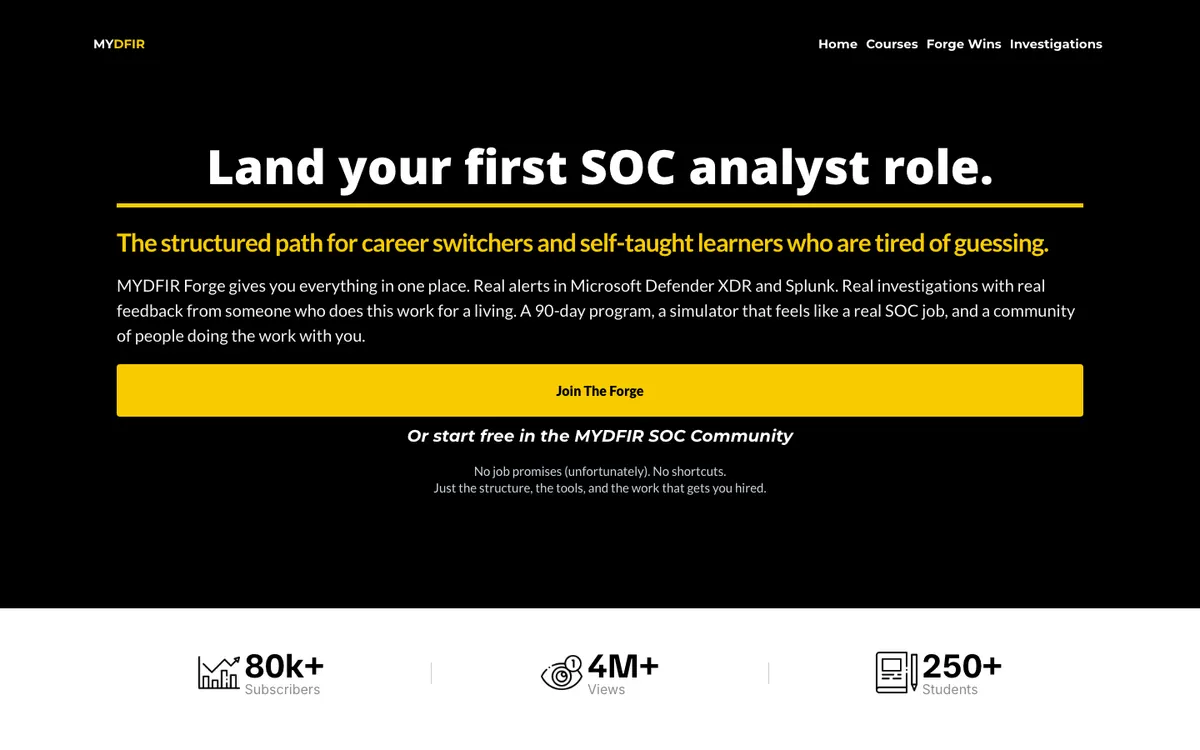
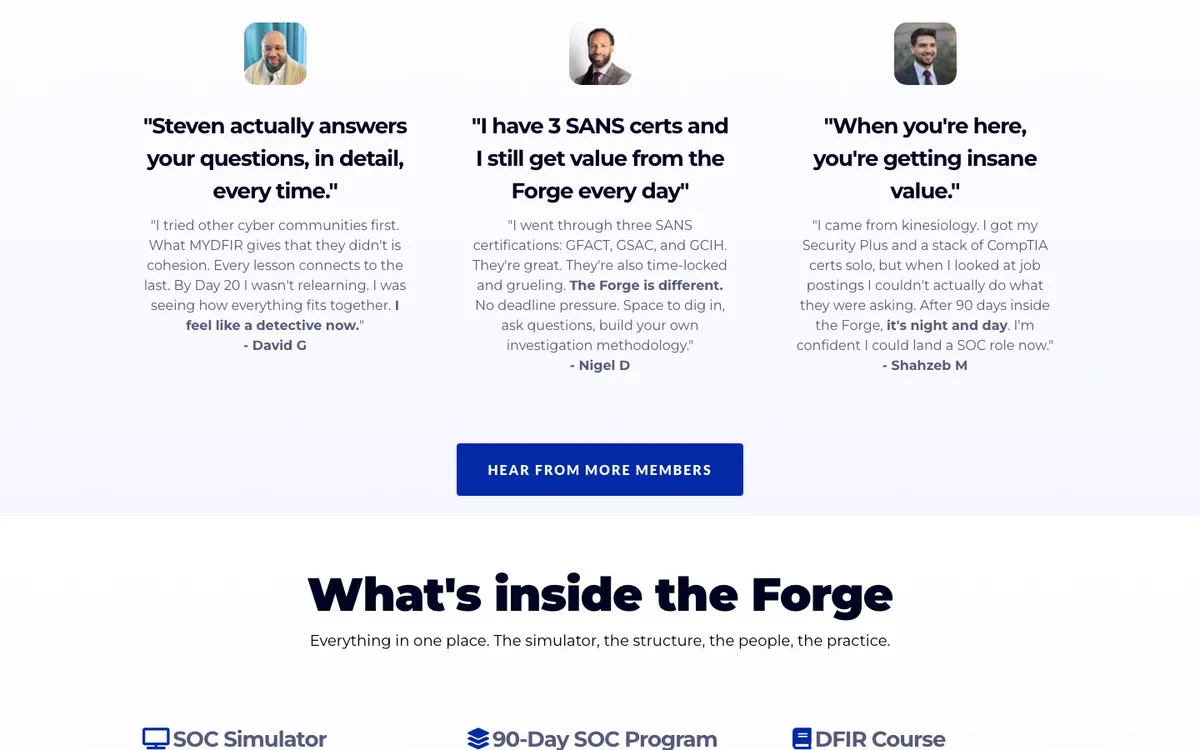
It’s run by Steven, who goes by MyDFIR on YouTube and has more than ten years in security operations, according to the site. He sells two things. The SOC Analyst Course cost $499.97 once on October 30, 2026. The MyDFIR Forge membership, which includes that course and adds a simulator, live calls and job support, cost $99 a month or $999 a year. A free SOC Community tier also exists.
How we reviewed it: we read the homepage, the full course page and both FAQs on October 30, 2026, and compared MyDFIR with the other security training on our site. We haven’t taken the course.
Some links on this site earn us a commission if you enroll. Your price stays the same. Our rankings are based on our editorial criteria; some partners may be featured more prominently. How we review
Pros & cons
- Teaches how to investigate an alert and write it up, not just how to click through a tool
- Five course projects and a capstone report that the instructor reviews, which gives you something concrete for a résumé
- Forge adds a SOC simulator with alerts in Splunk and Microsoft Defender XDR, plus a live call every Sunday
- Free community tier and free YouTube lessons let you judge the teaching style before paying
- No refunds on the $499.97 course, per the enrollment page
- You build and run your own lab: a Windows PC with 16 GB of RAM and 250 GB of disk, and ARM Macs aren't recommended
- No accredited credential at the end, so you'll still need Security+ or similar for HR filters
- Forge's monthly plan drips one lesson a day; getting everything at once means paying $999 for the year
The course: from "what is this alert?" to a written report
The SOC Analyst Course has eight chapters and more than 30 labs. It covers SOC basics, frameworks, indicators of compromise, open source intelligence, what the course calls the art of investigations, and job readiness. The labs touch identity, cloud, network, malware and endpoint work.
What stands out is the angle. Steven says plainly that the course doesn’t teach you to master a tool. It teaches you to ask the next question. An IP address in a log is just data; finding out who owns it, whether it has hit other clients and what happened right after it connected is the job.
It ends with a capstone. You write a full investigation report, and Steven reviews it. Add the five course projects and you leave with real material for an interview, where “tell me about an investigation you ran” is a standard question.
What a week might look like
Say you work help desk and study at night. Monday and Wednesday, an hour each on a chapter and its lab. Saturday morning, two hours on a project: building the lab, sending logs to the SIEM, writing up what you found. That’s about four hours a week. At that pace, eight chapters and five projects fill roughly three months, which matches the 90-day rhythm of the Forge.
Part of chapter 6 stays locked for 14 days after you enroll. That’s deliberate: Steven doesn’t want people speed-running the course over a weekend and skipping the practice. If you were planning to binge it before an interview next week, adjust the plan.
Before you buy: check your computer
This is where many buyers get surprised. You set up your own lab environment. The course page asks for a 64-bit Intel or AMD processor running Windows, 16 GB of RAM or more and 250 GB of free disk space. ARM Macs (M1, M2, M3) aren’t recommended because of virtualization limits; the page suggests the cloud if that’s all you have.
Plan an evening just for setup. The lab files are large downloads, and a slow connection can turn that evening into two.
The Forge: school instead of textbook
The site uses a neat comparison: the course is a textbook you own, the Forge is a self-paced school. In the Forge you get the same lessons, released one a day for 90 days on the monthly plan, or all available from day one on the annual plan. Around that sit a SOC simulator with alerts in Splunk and Microsoft Defender XDR, a full attack scenario to investigate each month, a live call every Sunday, a weekly Mentorship Monday Q&A, and résumé, portfolio and LinkedIn reviews.
After the 90-day program comes a DFIR course on digital forensics and incident response. Monthly members get it after day 100; annual members get it right away.
The math: twelve months at $99 is $1,188, so the $999 year saves $189 if you’re sure you’ll stay. If you only want three or four months of practice before applying, monthly costs $297 to $396 and you can stop.
The catch: no refunds, and no beginner on-ramp
The course page says it in capitals: no refunds, all sales final. Steven’s answer is to send you to his free “Teachings” playlist and free SOC mini-course first, so you can judge his style before paying. Do that. It’s an hour that protects $500.
The other limit is the starting level. The FAQ says it’s “yes and no” for beginners: you’re expected to understand basic IT, networking and security concepts. If you don’t yet know what DNS or a subnet is, the labs will stall you on the setup screen. And there’s no accredited credential at the end. MyDFIR also says, with welcome honesty, that it makes no job promises.
SOC Analyst Course: no refunds, all sales final (enrollment page, October 30, 2026).
Course: one payment or installments at checkout. Forge: $99 monthly or $999 yearly.
No public discount was listed on the official site when we checked. We never publish unverified coupon codes.
Who should look elsewhere
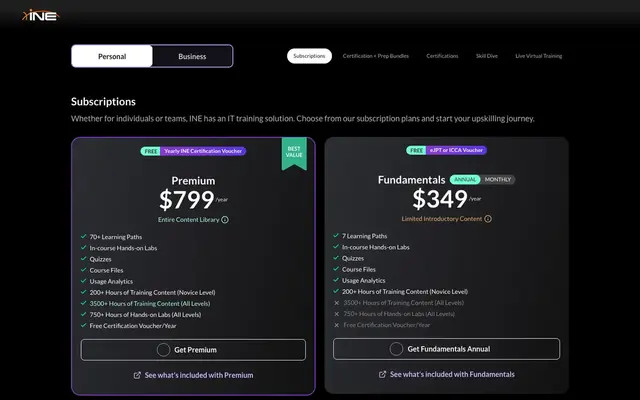
If you’re starting from zero, get the fundamentals first. INE sold its Fundamentals plan at $349 a year on our last check, with an exam voucher for the eJPT included. If you’d rather have a broad library of programming and IT courses on one subscription, Zero To Mastery listed its Pro plan at $299 a year. Our coding bootcamps ranking compares the rest, from short courses to full career programs.
If your target job ads ask for Security+ and you don’t have it, that comes first. MyDFIR assumes it, or something like it.
Video: MyDFIR Academy
Before you enroll
Run three checks this week: watch two of the free videos, make sure your PC meets the lab specs, and pull up five SOC analyst job ads near you to see which tools they name. If they mention Splunk or Defender, the Forge simulator is the closer match. If you’d rather own the material and work alone, buy the course and start with chapter 1 the same weekend.
MyDFIR Academy vs alternatives
How MyDFIR Academy stacks up against other coding bootcamp programs we reviewed, on the facts published by each provider.
Swipe sideways to compare all 4 programs →
| Criterion | This review | |||
|---|---|---|---|---|
| Our score | 8.7/10 | 8.9/10 | 8.8/10 | 8.7/10 |
| Price | Free – $999 | $299 – $1,299 | $14.99 – $39.99 | $149 – $249 |
| Format | Self-paced | Subscription | Subscription | Subscription |
| Duration | Self-paced. Forge's SOC program runs 90 days (one lesson a day on the monthly plan, everything available at once on the annual plan); part of the course's chapter 6 opens 14 days after enrollment | Membership; 170+ courses. | Subscription. | Subscription. |
| Free trial | Free MyDFIR SOC Community tier. | — | Free basic plan; trial offered on paid plans. | A few free interactive courses are available. |
| Best for | People with IT or Security+ basics who want hands-on SOC investigation practice and portfolio projects before applying for analyst roles. | self-taught developers and career changers who can study a couple of hours a day and want one membership covering web development, data, cloud and security, with projects to show in interviews. | Beginners and working professionals who want to learn to code through interactive browser exercises, with career paths on Pro. | Software engineers preparing for coding and system design interviews who learn faster by reading and running code than by watching videos. |
| Full review | You are here | Zero To Mastery review | Codecademy review | Educative review |


“—” means the information was not published or not yet checked. See all 9 coding bootcamp programs.
Score breakdown
Investigation-driven SOC content with monthly scenarios.
Practitioner-led niche academy without accreditation.
One-time $499 course; free community tier.
Self-paced with optional weekly calls.
Weekly meetings and AMA in the Forge.
Weighted average of five criteria. Read our methodology.
FAQ
Is MyDFIR worth it for getting a SOC analyst job?
It can help if you already have IT or Security+ basics: the course gives you labs, five projects and a reviewed capstone report to discuss in interviews. MyDFIR itself says there are no job promises. It doesn't replace the certifications many job ads ask for.
Should I buy the SOC Analyst Course or join the Forge?
Buy the course ($499.97 once, October 30, 2026) if you study well alone and want to own the material. Join the Forge ($99 a month or $999 a year) if you want the SOC simulator, the Sunday live call and résumé reviews. The Forge includes the same course content, released one lesson a day on the monthly plan.
Can I do MyDFIR on a Mac?
Only with workarounds. The course page says ARM Macs (M1, M2, M3) aren't recommended because of virtualization limits, and suggests using the cloud if you have no other machine.
Sources
- https://academy.mydfir.com/l/products
- https://www.mydfir.com/
- https://academy.mydfir.com/p/soc
- https://academy.mydfir.com/
Prices and offers can change; confirm on the official site before you enroll.