On this page · 15 sections5 min read
- 01Our verdict
- 02At a glance
- 03Pros & cons
- 04What the four-month plan looks like
- 05The part that justifies the price
- 06The catch: a subscription that keeps running
- 07What to do in the first week
- 08Is it for beginners?
- 09What it costs per finished program
- 10Who it suits
- 11Who should skip it
- 12Alternatives
- 13Your next step
- 14Score breakdown
- 15FAQ
Our verdict
Our verdict8.7/10Coders who already know the basics and want real AI or data projects reviewed by a person get the most from Udacity: the 4-month bundle, about the time a Nanodegree takes, was $423 on October 30, 2026.
If you're starting from zero and need cheap daily practice, Codecademy costs a fraction of that, and if you want a mentor-led bootcamp with a weekly mentor call, Springboard is closer. The catch: it's a subscription, so every month you fall behind costs you another month's fee once the bundle ends.
Best for: working professionals with basic programming skills who want project-based AI, data or cloud training with reviewer feedback and a set four-month goal.
At a glance
You’ve watched the tutorials. You can follow along when someone else builds a chatbot on screen. Then you open a blank editor on a Sunday afternoon and freeze. The thing missing isn’t more videos; it’s a project with a spec, a deadline you set yourself, and someone who reads your code and tells you what’s wrong with it.
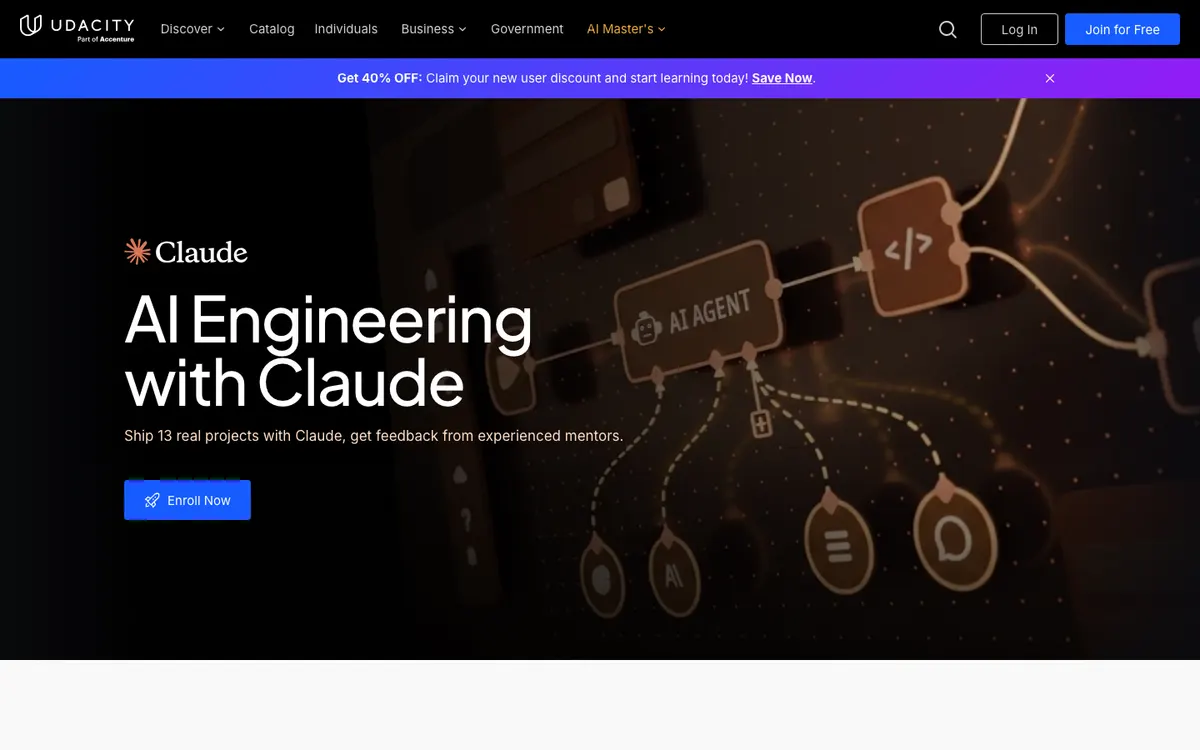
That’s the core of Udacity, which Accenture now owns. Its Nanodegree programs in AI, data, programming and cloud are built around real projects reviewed by people, with mentors and career coaching on top. You pay a subscription that opens the whole catalog of more than 500 courses.
How we reviewed it: on October 30, 2026, we read Udacity’s plans page and program listings. We haven’t completed a Nanodegree.
Some links on this site may earn us a commission if you enroll. Your price stays the same. Our rankings are based on our editorial criteria; some partners may be featured more prominently. How we review
Pros & cons
- Projects reviewed by people, not only auto-graded
- Clear hour counts per Nanodegree (e.g. 50 hours for Agentic AI, 73 for AI Programming with Python)
- One subscription opens the whole catalog of 500+ courses
- Career coaching and interview prep included
- Cancel or pause anytime
- After the 4-month bundle, billing continues month to month until you cancel
- Monthly price isn't printed on the plans page; you see the bundle total
- A Nanodegree certificate isn't a degree or a vendor certification
- Intermediate programs assume you can already code
What the four-month plan looks like
Udacity’s main offer is a 4-month bundle: $423 in total on October 30, 2026, with 15% off. Udacity picked four months because, it says, that’s the average time to finish a Nanodegree. After those four months, the plan becomes month-to-month at the regular rate until you cancel. The monthly price itself wasn’t printed on the page we read.
So here’s the realistic plan. Take the Agentic AI Nanodegree (intermediate, 50 hours). At five hours a week (two weeknights and a Saturday morning), that’s about ten weeks of work, which leaves room for a busy month at the office before the bundle ends. AI Programming with Python, the beginner option at 73 hours, takes closer to fifteen weeks at the same pace, so it’s tighter.
The part that justifies the price
Video lessons exist everywhere. What Udacity sells is the loop between your project and a reviewer. You submit, and someone checks it against the project rubric and sends back notes: this function breaks on empty input, this model is overfitting, this README doesn’t explain how to run anything. You fix it and resubmit. That’s slow and sometimes humbling, and it’s exactly how a code review at work feels.
By the end you have a few finished projects in a public repository, which is what a hiring manager will open, and a program certificate for your profile. Career coaching and interview prep come with the subscription.
15% off the 4-month bundle subscription (displayed on the pricing page).
↪See offer details and conditionsCancel anytime.
Monthly subscription or multi-month bundle; cancel anytime.
The catch: a subscription that keeps running
Subscriptions reward people who finish. If a new job, a baby or a bad quarter slows you down, the bundle ends and the monthly billing starts. Udacity lets you pause or cancel anytime, which helps, but you have to remember to do it. Put the date of month four in your calendar the day you subscribe.
The other limit is the credential. A Nanodegree certificate shows you completed reviewed projects. It isn’t a degree, and it isn’t an AWS or Google Cloud certification, which you’d earn by passing the vendor’s own exam.
What to do in the first week
The first week decides whether the subscription is a good buy, so treat it like a trial you’re paying for. Open the program’s syllabus and find the first project, not the first lesson. Read its spec. If you can picture yourself building it in the hours you have, start the lessons with that project in mind. If the spec reads like a foreign language, switch to an easier program now, while it costs you nothing extra.
Then book your study slots like meetings. Two weeknights of 90 minutes and a Saturday morning of two hours gives you five hours. Tell someone at home what those slots are for. It sounds fussy, but a self-paced subscription has no teacher waiting for you, and the only deadline you have is the end of month four.
Last, submit something early, even if it’s rough. The first review tells you more about the reviewers’ standards than any lesson will, and it’ll show you whether the feedback is the thing you’re paying for.
Is it for beginners?
Partly. There are beginner programs, and AI Programming with Python is the obvious entry point. But many popular programs (agentic AI, generative AI, data engineering) are labeled intermediate and assume you’re comfortable writing Python already. If “for loop” still needs a second look, spend a month on a cheaper interactive platform first, then come to Udacity with the basics in hand. You’ll get more out of each reviewed project, and more out of the money.
What it costs per finished program
Do the arithmetic before you subscribe. If you finish one 50-hour Nanodegree inside the bundle, you’ve paid $423 for the program, the reviews and the coaching. If you finish two, the second one cost you nothing extra. If you finish none, you’ve paid $423 for access you didn’t use, and the meter keeps running in month five.
Who it suits
Analysts moving toward data science. Developers adding AI or cloud skills. Anyone at a company that reimburses training and wants a dated program with a certificate. People who know they work better when someone is going to read what they hand in.
Videos about Udacity (Accenture)
Who should skip it
Complete beginners on a tight budget, and people who want a mentor-led bootcamp with weekly calls and a conditional money-back guarantee. Also anyone who already finishes self-paced courses and builds side projects alone: you’d be paying mostly for reviews you might not need.
Alternatives
Codecademy is the cheap way to learn the basics interactively, with a free tier. Zero To Mastery costs $299 a year for a large catalog of project-based courses, without human reviews. Springboard is a mentor-led bootcamp with a weekly mentor, more structure and a much higher price; its money-back guarantee comes with eligibility conditions. We compare the first two directly in Codecademy vs Udacity, and the whole field in our coding bootcamps ranking.
Swipe sideways to compare all 4 programs →
| Criterion | This review | |||
|---|---|---|---|---|
| Our score | 8.7/10 | 8.9/10 | 8.8/10 | 8.7/10 |
| Price | — | $299 – $1,299 | $14.99 – $39.99 | $149 – $249 |
| Format | Subscription | Subscription | Subscription | Subscription |
| Duration | Self-paced; Nanodegree length varies. | Membership; 170+ courses. | Subscription. | Subscription. |
| Accreditation | Udacity advertises accredited, credit-bearing coursework (details per program). | — | — | — |
| Free trial | Free programs available. | — | Free basic plan; trial offered on paid plans. | A few free interactive courses are available. |
| Best for | working professionals with basic programming skills who want project-based AI, data or cloud training with reviewer feedback and a set four-month goal. | self-taught developers and career changers who can study a couple of hours a day and want one membership covering web development, data, cloud and security, with projects to show in interviews. | Beginners and working professionals who want to learn to code through interactive browser exercises, with career paths on Pro. | Software engineers preparing for coding and system design interviews who learn faster by reading and running code than by watching videos. |
| Read more | You are here | Zero To Mastery review | Codecademy reviewHead-to-head → | Educative review |

“—” means the information was not published or not yet checked. See all 9 coding bootcamp programs.
Your next step
Open the Nanodegree you want and check two lines: its level and its hours. Divide the hours by what you can honestly give each week. If the answer fits inside sixteen weeks, the bundle makes sense. If it doesn’t, start with a lighter course first.
Score breakdown
Project-based Nanodegrees with real-world work.
Well-known platform owned by Accenture.
Prices unverified; subscription costs accumulate.
Self-paced, cancel anytime.
Mentor project reviews.
Weighted average of five criteria. Read our methodology.
FAQ
How much does Udacity cost?
On October 30, 2026, the 4-month bundle cost $423 in total, with 15% off. After four months, the plan converts to month-to-month billing at the regular rate until you cancel. Udacity says four months matches the average time to finish a Nanodegree.
How long does a Udacity Nanodegree take?
It depends on the program and your pace. Udacity lists 50 hours for the Agentic AI Nanodegree and 73 hours for AI Programming with Python. At 5 hours a week, 50 hours is about ten weeks.
Can I cancel Udacity anytime?
Yes. Udacity says you can pause or stop your subscription whenever you need. Cancel before the next billing date if you've finished, or you'll pay another month.
Head-to-head comparisons
Sources
Prices and offers can change; confirm on the official site before you enroll.