On this page · 13 sections5 min read
- 01Our verdict
- 02At a glance
- 03Pros & cons
- 04What six months on Springboard looks like
- 05Who gets the most out of it
- 06Other tracks, same model
- 07The money-back guarantee, read carefully
- 08The catch: you’re buying structure, at bootcamp prices
- 09Cheaper ways to find out if data is for you
- 10Before you apply
- 11Springboard vs alternatives
- 12Score breakdown
- 13FAQ
Our verdict
Our verdict8.3/10Springboard fits a working adult with a degree and a couple of years in an office job who wants to move into data analytics within about six months, with a weekly mentor to keep them honest.
If you can't say yet whether you even like SQL, start with the Google Data Analytics certificate on Coursera ($49 a month) before you commit to bootcamp tuition. The fine print: the money-back guarantee only covers students who hold a bachelor's degree, have two years of relevant work experience and meet every job-search requirement on time, so ask admissions for the terms and a written price before you apply.
Best for: Office workers with a degree who want to switch into data analytics with a personal mentor and career coaching.
At a glance
Monday’s report took you four hours in Excel again. You copied, pasted, fixed a broken formula, and somewhere around the third pivot table you wondered whether the person who builds the dashboards upstairs earns more than you. (Probably.) Springboard’s Data Analytics Bootcamp is aimed at that person: someone with an office job, a degree and enough curiosity about data to want to make it the job.
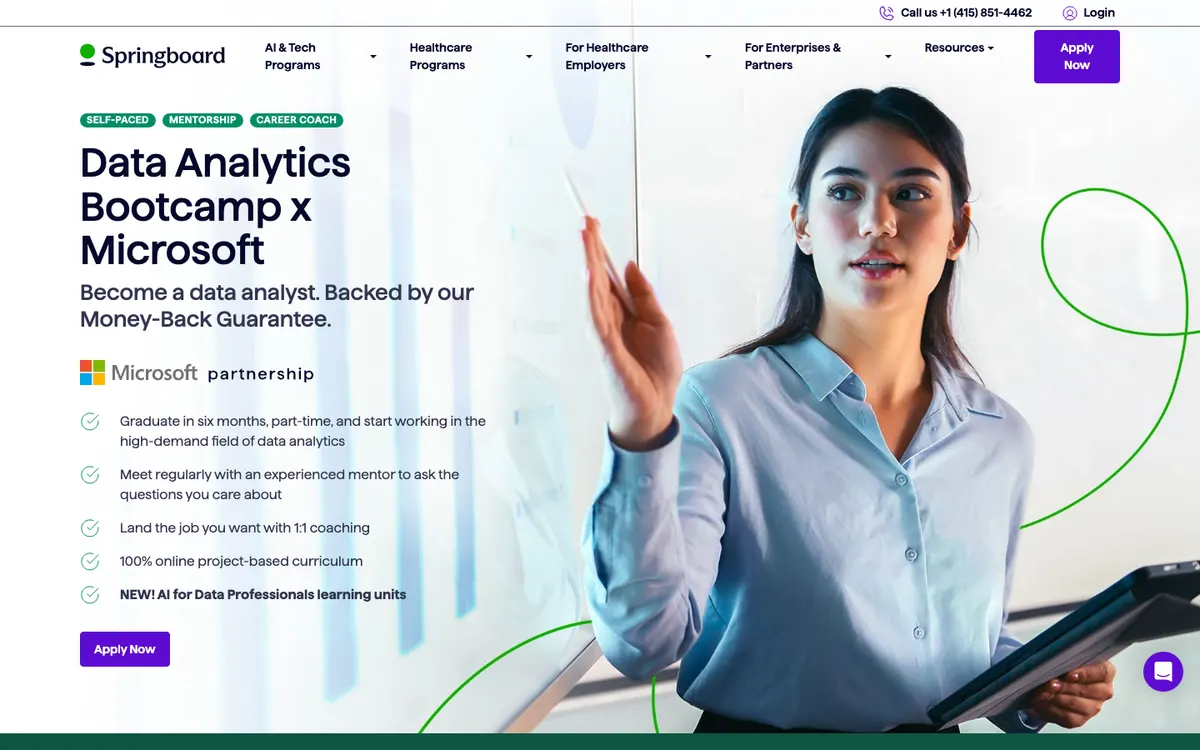
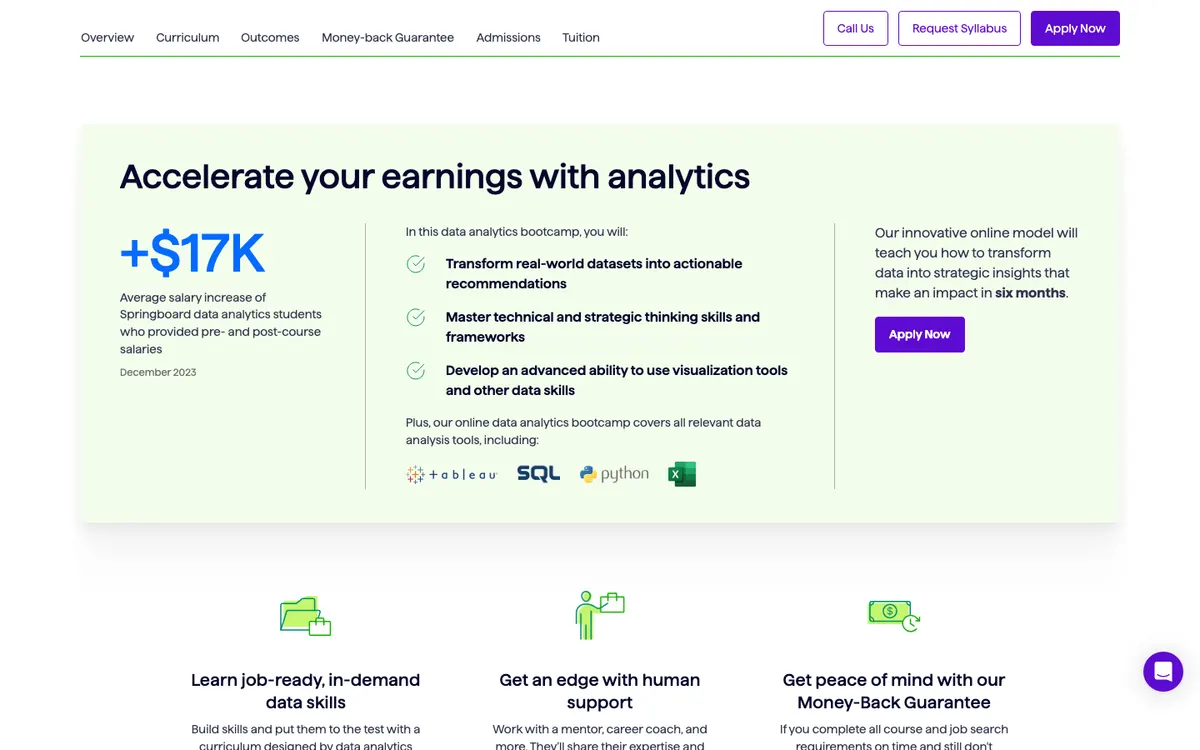
Springboard is an online bootcamp company. Its data analytics track is built in partnership with Microsoft, self-paced, and designed so you can finish in about six months part-time, with a personal mentor, a career coach and a student advisor alongside the curriculum. Other tracks cover software engineering, data science, UX design and cybersecurity.
We wrote this review from Springboard’s course and “how it works” pages and its own program descriptions, read on October 30, 2026, and compared it with the other coding and data programs on our site. We haven’t enrolled. We also couldn’t confirm the current tuition on the course page, so there’s no price in this review; you’ll need a quote from admissions.
Some links on this site earn us a commission if you enroll. Your price stays the same. Our rankings are based on our editorial criteria; some partners may be featured more prominently. How we review
Pros & cons
- One-on-one mentor, a career coach and a student advisor, not just videos
- Covers the analyst toolkit (Excel, SQL, Python, Power BI, Tableau) plus business problem-solving
- Built with Microsoft and designed to be finished part-time in about six months
- Money-back guarantee on the data analytics track for eligible students
- The guarantee has strict entry conditions: a bachelor's degree, two years of relevant experience and every job-search task done on time
- Self-paced with no fixed class schedule, so it takes real discipline to keep a 400-hour program moving next to a job
- Bootcamp-level commitment: a large bill for a skill set some people can start learning on a $49-a-month certificate
What six months on Springboard looks like
Springboard describes the analytics track as roughly 400 hours of work. Spread over six months, that’s about 15 hours a week, or two weeknights and most of a Saturday. Plan for that before you start, because the course doesn’t slow down for a busy quarter at work; you do.
The tools are the ones in real analyst job ads: Excel, SQL, Python, Power BI and Tableau. Springboard also puts weight on business thinking (how to break a vague question from a manager into something data can answer), which is the part self-taught analysts often skip.
The week revolves around the mentor call. You bring the project you’re stuck on, an industry analyst looks at your SQL or your chart, and you leave with two things to fix. A career coach works with you on your résumé, LinkedIn profile and interview stories as you get closer to the end. Portfolio projects, including capstones, give you something concrete to show in interviews.
Because the course is self-paced, there’s no cohort waiting for you on Thursday night. That suits people with shift work or small kids. It doesn’t suit people who need a class time to show up.
Who gets the most out of it
Think of a marketing coordinator who already lives in spreadsheets, a nurse who’s been tracking unit metrics, or an operations lead at a warehouse who knows exactly which numbers the boss asks about. These people bring domain knowledge, and Springboard adds the technical layer and the interview prep. When they apply for analyst roles, they can talk about real problems from their old job, now with SQL and a dashboard to back it up.
It’s a harder road for someone with no degree and no office experience. The curriculum may still be fine for you, but you won’t qualify for the guarantee, and you’d be paying bootcamp tuition without the safety net that justifies much of it.
Other tracks, same model
The same mentor-plus-coach setup runs across Springboard’s other career tracks: software engineering, data science, UI/UX design, cybersecurity and an ML engineering and AI track. The homepage marks the money-back guarantee on software engineering, data analytics and data science. If you’re weighing analytics against data science, analytics is usually the shorter path into a first job; data science asks for more math and more Python.
The money-back guarantee, read carefully
Springboard’s pitch leans on its money-back guarantee: complete the course and the job search requirements on time, and if you don’t land a qualifying role, you may get a full refund. That’s a real commitment, and few online programs make it.
The conditions matter, though. The course page lists eligibility requirements that include a bachelor’s degree and two years of relevant work experience. After graduating, you must keep up the job search as Springboard defines it: regular networking, applications and interviews. Miss a step and the guarantee may no longer apply. “Terms apply” is doing a lot of work in that sentence, so read them in full and keep records of your job search from the first week.
The catch: you’re buying structure, at bootcamp prices
Everything Springboard teaches is available somewhere cheaper. What you pay for is a mentor every week, a coach for the job hunt and a guarantee. For some people, those three things are the difference between finishing and quietly giving up in month two. For others, they’re a very expensive way to learn SQL.
Before you sign, be honest about which group you’re in. If you’ve finished online courses on your own before, a cheaper path will probably get you just as far.
Cheaper ways to find out if data is for you
The Google Data Analytics certificate on Coursera was $49 a month after a 7-day free trial on our last check. It covers spreadsheets, SQL and Tableau at a beginner level, and you can stop paying the day you lose interest.
DataCamp is good for daily practice in SQL and Python in short sessions, and Codecademy Pro was $19.99 a month billed annually on October 30, 2026, with career paths for data analysis.
If you want a bootcamp with live sessions at a lower price, Nucamp runs part-time cohorts; its bootcamps were listed from $199 to $354 a month on our last check.
Compare them all in our coding bootcamps ranking.
Before you apply
Do one free SQL lesson first. If you enjoyed it, book a call with Springboard admissions and ask for three things in writing: the current tuition (upfront and monthly), the full money-back guarantee terms for your situation, and the outcomes report for the data analytics track. Then block 15 hours a week in your calendar for the next six months and see if it actually fits.
Videos about Springboard
Springboard vs alternatives
How Springboard stacks up against other coding bootcamp programs we reviewed, on the facts published by each provider.
Swipe sideways to compare all 4 programs →
| Criterion | This review | |||
|---|---|---|---|---|
| Our score | 8.3/10 | 8.9/10 | 8.8/10 | 8.7/10 |
| Price | — | $299 – $1,299 | $14.99 – $39.99 | $149 – $249 |
| Format | Self-paced | Subscription | Subscription | Subscription |
| Duration | About six months part-time, self-paced (Springboard describes the data analytics track as a 400-hour program) | Membership; 170+ courses. | Subscription. | Subscription. |
| Free trial | — | — | Free basic plan; trial offered on paid plans. | A few free interactive courses are available. |
| Best for | Office workers with a degree who want to switch into data analytics with a personal mentor and career coaching. | self-taught developers and career changers who can study a couple of hours a day and want one membership covering web development, data, cloud and security, with projects to show in interviews. | Beginners and working professionals who want to learn to code through interactive browser exercises, with career paths on Pro. | Software engineers preparing for coding and system design interviews who learn faster by reading and running code than by watching videos. |
| Full review | You are here | Zero To Mastery review | Codecademy review | Educative review |


“—” means the information was not published or not yet checked. See all 9 coding bootcamp programs.
Score breakdown
Career-track curriculum; details unverified this cycle.
Established online bootcamp brand.
Tuition could not be verified.
Online, self-paced with mentor sessions.
Mentor and career-coach model is central to the offer.
Weighted average of five criteria. Read our methodology.
FAQ
How much does the Springboard data analytics bootcamp cost?
We couldn't confirm current tuition on the course page on October 30, 2026. Ask Springboard admissions for a written quote that shows the upfront price, the monthly option and any discount. For comparison, Google's Data Analytics certificate on Coursera was $49 a month on our last check.
Does Springboard really give your money back if you don't get a job?
Only if you qualify. The course page lists a bachelor's degree and two years of relevant work experience as eligibility conditions, and you must complete the course and every job-search requirement (networking, applications, interviews) on time. Read the full terms before you enroll.
How long does Springboard take?
Springboard says you can graduate in about six months part-time. Its own description puts the data analytics track at around 400 hours, which works out to roughly 15 hours a week.
Sources
- https://www.springboard.com/landing/affiliates/
- https://www.springboard.com/
- https://www.springboard.com/courses/data-analytics-career-track/
- https://www.springboard.com/how-it-works/overview
- https://www.springboard.com/blog/springboard-data-courses
Prices and offers can change; confirm on the official site before you enroll.