
On this page · 14 sections5 min read
Our verdict
Our verdict9.1/10For a career changer with no degree in the field who wants a first data analyst credential with a recognizable name, the Google Data Analytics Certificate is hard to beat on price: $49 a month after a 7-day free trial (October 30, 2026), and about $300 if you keep Coursera's pace of 10 hours a week.
If you already work with SQL or Python, or you want a deeper statistics or programming track, DataCamp or an edX professional certificate will take you further. The catch is that everyone else applying for junior analyst jobs has this certificate too, so the case-study project you build in Course 8 matters more than the badge.
Best for: career changers and early-career workers who want an entry-level data analytics certificate from Google for a few hundred dollars, studying evenings at their own pace.
At a glance
Every Monday you spend two hours copying numbers from one spreadsheet into another, and every Monday someone asks for “a quick chart” that takes all afternoon. You’ve started to suspect that the people who build the dashboards have the more interesting job, and probably the better pay. The Google Data Analytics Professional Certificate, sold on Coursera, is the most common first step from that desk to a junior analyst title.
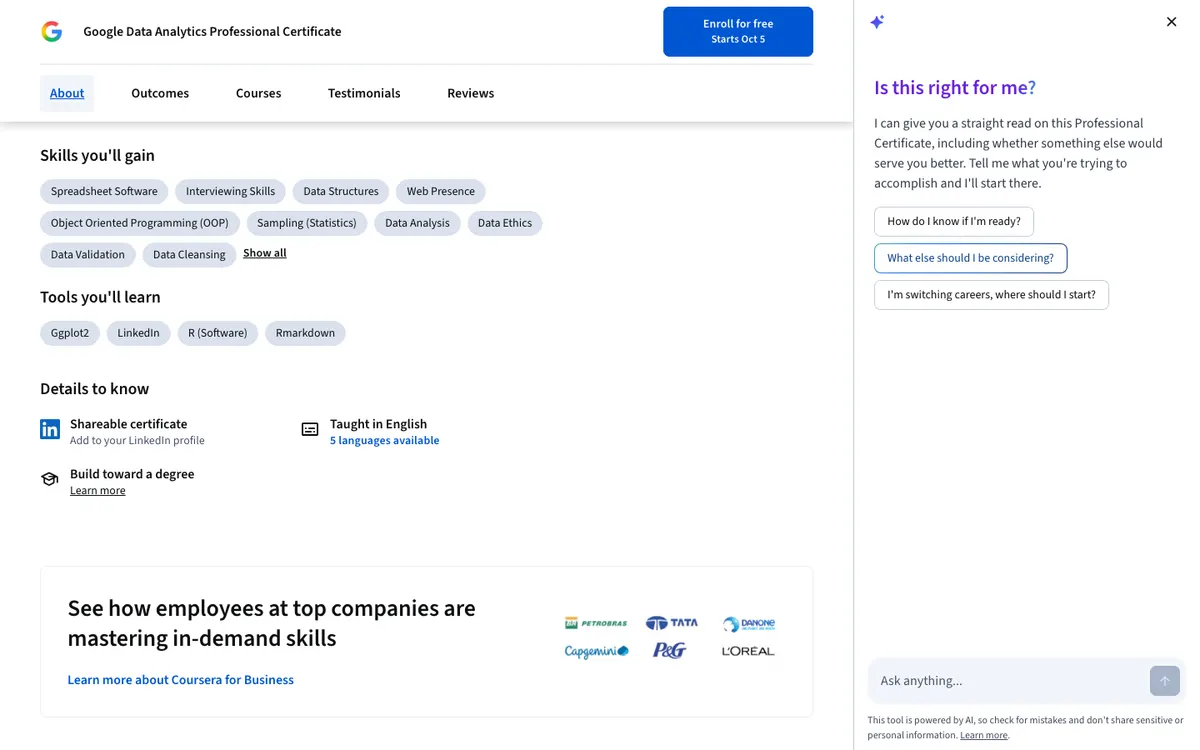
It’s a nine-course series designed by Google for beginners, with no degree or experience required. You learn spreadsheets, SQL, Tableau and an introduction to Python, finish with a case study, and get a shareable Google Career Certificate.
How we reviewed it: on October 30, 2026, we read the full program page, including each course’s description and hours, the cost FAQ and the Coursera Plus page, and compared them with the other data analytics courses on our site. We haven’t taken the certificate.
Some links on this site earn us a commission if you enroll. Your price stays the same. Our rankings are based on our editorial criteria; some partners may be featured more prominently. How we review
Pros & cons
- Low total cost: $49 a month in the US after a 7-day free trial, so 6 months comes to $294 (October 30, 2026)
- Practical tool set for junior analyst roles: spreadsheets, SQL, Tableau and an introduction to Python
- A case-study course that leaves you with a portfolio piece you can show employers
- ACE credit recommendation of up to 12 college credits if you continue to a degree
- Entry level only: the Python course is an introduction, not enough on its own for most analyst job tests
- The certificate is widely held, so on its own it rarely makes an application stand out
- Every extra month at $49 adds up if work or family slows you down
- The final course is about job searching, not analysis, so the analytics content ends at Course 8
What it costs, in months
In the US and Canada, Coursera charges $49 a month after a 7-day free trial. Coursera suggests about 6 months at 10 hours a week, and says most learners finish for less than $300. Six months is $294.
The bill is really a function of your pace. Finish in four months of steady evenings and you pay $196. Stall for three months during a busy season at work and you pay for those three months too, unless you cancel and come back later.
If you think you’ll take a second program after this one (Google’s project management or IT support certificates, for example), Coursera Plus may be cheaper: $59 a month, or $399 a year with a 14-day money-back guarantee.
On October 30, the program page also advertised a limited-time bonus: enroll and get 3 months of Google AI Pro at no extra cost, terms apply.
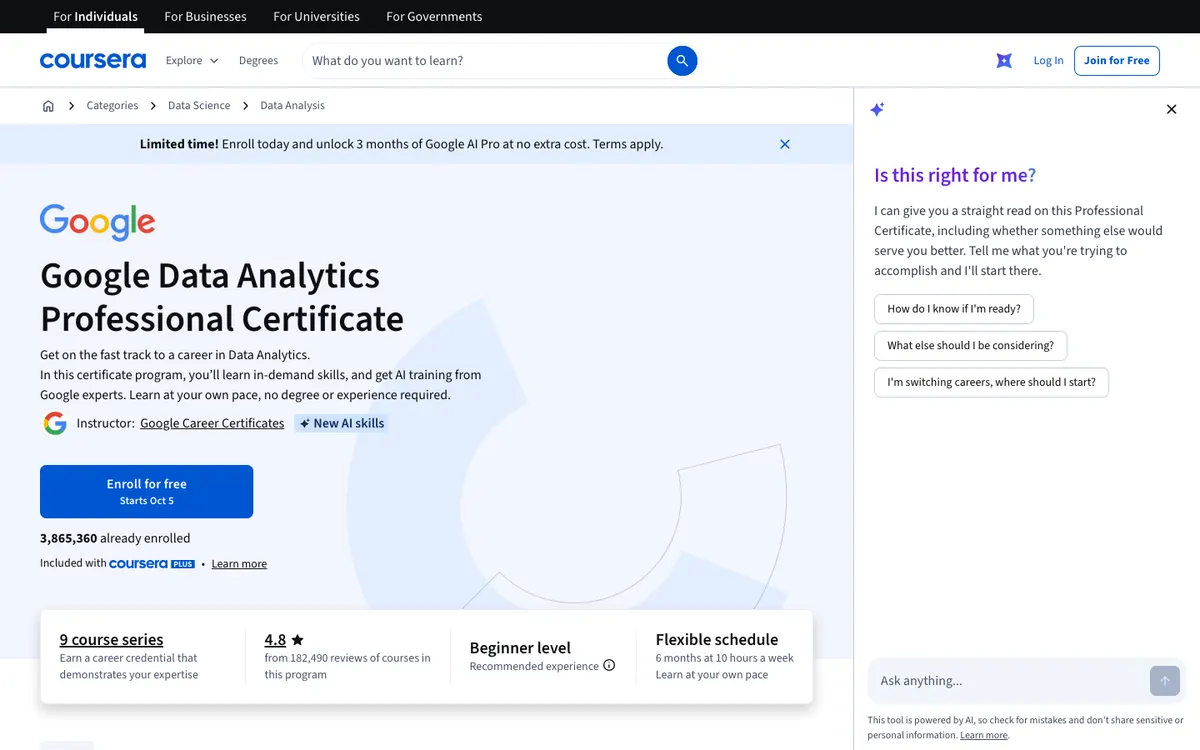
Limited-time: enroll and get 3 months of Google AI Pro at no extra cost (terms apply).
↪See offer details and conditionsCoursera Plus annual plan has a 14-day money-back guarantee.
Monthly subscription; Coursera Plus annual plan available.
What the nine courses cover
The program page lists the hours for each course, about 150 in total:
- Foundations: Data, Data, Everywhere (13 hours)
- Ask Questions to Make Data-Driven Decisions (15 hours)
- Prepare Data for Exploration (19 hours)
- Process Data from Dirty to Clean (16 hours), where SQL starts
- Analyze Data to Answer Questions (26 hours)
- Share Data Through the Art of Visualization (19 hours), with Tableau
- Introduction to Data Analysis Using Python (27 hours)
- Google Data Analytics Capstone: Complete a Case Study (11 hours)
- Accelerate Your Job Search with AI (6 hours): résumé, job search plan and interview practice with Google’s own tools
Course 7 is worth noting if you’ve read older reviews: earlier versions of the certificate taught R. The current one teaches Python, which is the more common requirement in job ads.
Where the time goes
Courses 5 and 7 are the long ones, and they’re where most people slow down. Picture a Tuesday at 9 p.m.: your SQL query returns 14,000 rows instead of 140, and you’ve got 40 minutes before you want to sleep. That’s normal, and it’s also the actual skill. The people who get hired are the ones who stuck with that query until they knew why.
The rest is lighter going. The first three courses are mostly about thinking like an analyst: asking the right question, deciding what data to collect, and judging whether a dataset can be trusted. They’re also where a lot of people quietly drop out, because it feels like theory. Push through; Course 4 is where you start writing SQL.
The case study is the real deliverable
Course 8 asks you to complete a case study you can share with employers. Treat it as the main product of the six months. Pick a dataset connected to the job you want (sales data if you’re in retail, patient wait times if you’re in healthcare), clean it in SQL, analyze it, visualize it in Tableau and write one page on what you found.
A hiring manager reading a hundred applications won’t distinguish one Google certificate from another. They will remember a clear chart about a problem in their industry.
What the certificate is worth
Coursera cites Lightcast job-posting data for 2025: over 270,000 open data analytics jobs in the US, with a median entry-level salary of $97,000. That figure comes from job postings, not from what graduates earn. Coursera also cites a 2022 graduate survey in which 75% reported a positive career outcome within six months.
The certificate also carries an ACE credit recommendation of up to 12 college credits (7 ECTS), which helps if you later enroll in a degree that accepts them.
The catch: it’s a common credential
This is the most popular entry-level data certificate on Coursera, and that cuts both ways. Recruiters recognize it. They also see it on many applications for the same junior role. On its own it shows you can learn; it doesn’t show you can do the job. Pair it with the case study, one or two small projects of your own, and some practice with SQL interview questions.
Who should skip it
If you already write SQL at work or have done a statistics course, the first half will feel slow and you’ll be paying monthly for review. Go straight to a more advanced track. And if you need a credential that counts as a formal qualification, a certificate isn’t a degree.
Video: Coursera
Alternatives
DataCamp is a subscription built around short interactive coding exercises in Python, R and SQL, better for building depth once you have the basics.
edX professional certificates come from universities and companies, from around $500 depending on the program, and some go further into statistics and programming.
See every option in our data analytics courses ranking.
Swipe sideways to compare all 3 programs →
| Criterion | This review | ||
|---|---|---|---|
| Our score | 9.1/10 | 8.8/10 | 8.6/10 |
| Price | $49 – $399 | $165 – $1,481 | — |
| Format | Self-paced | Self-paced | Subscription |
| Duration | 9 courses, from 6 to 27 hours each (about 150 hours listed); Coursera suggests about 6 months at 10 hours a week (program page, October 30, 2026). | edX quotes 2 to 10 months; data programs can run longer, e.g. 1 year 5 months for HarvardX Data Science (9 courses), 1 month for Microsoft Data Analyst (3 courses) | Subscription. |
| Free trial | 7-day free trial. | — | — |
| Best for | career changers and early-career workers who want an entry-level data analytics certificate from Google for a few hundred dollars, studying evenings at their own pace. | working professionals who want a multi-course certificate with a university or company name on it, such as Harvard, IBM or Microsoft, and who can study on their own for several months. | Beginners and spreadsheet analysts who want a daily dose of Python, R or SQL practice in the browser, with nothing to install. |
| Full review | You are here | edX review | DataCamp review |

“—” means the information was not published or not yet checked. See all 3 data analytics programs.
Your next step
Use the 7-day free trial to do the first week of Course 1 and look at the Course 4 syllabus. If you can see yourself spending 10 hours a week on it for six months, keep going. Then choose your case study dataset in month one, not month six.
Score breakdown
Nine courses covering spreadsheets, SQL, R, Tableau and AI tools.
Developed by Google and delivered on Coursera.
Under $300 for most learners at $49/month.
Self-paced online with a free trial.
Peer forums and graded work; little one-on-one help.
Weighted average of five criteria. Read our methodology.
FAQ
How much does the Google Data Analytics Certificate cost?
In the US and Canada, Coursera charges $49 a month after a 7-day free trial (October 30, 2026). At the suggested pace of about 10 hours a week for 6 months, that's $294. If you plan to take more than one program, Coursera Plus costs $59 a month or $399 a year.
Does the Google Data Analytics Certificate teach R or Python?
Python. On October 30, 2026, Course 7 was "Introduction to Data Analysis Using Python" (27 hours). Earlier versions of the program taught R, which is why older reviews still mention it.
Can the Google Data Analytics Certificate count toward college credit?
Possibly. Coursera says completing it earns an ACE recommendation of up to 12 college credits, or 7 ECTS credits. Whether a college accepts them is up to that college, so ask the admissions office before you count on it.
Sources
- https://www.coursera.org/professional-certificates/google-data-analytics
- https://www.coursera.org/courseraplus
- https://www.datacamp.com/pricing/
- https://www.edx.org/certificates/professional-certificate
Prices and offers can change; confirm on the official site before you enroll.