Best overall
Best for career changers and early-career workers who want an entry-level data analytics certificate from Google for a few hundred dollars, studying evenings at their own pace.
PriceFrom $49/mo
Our pick is Coursera (9.1/10), best for career changers and early-career workers who want an entry-level data analytics certificate from Google for a few hundred dollars, studying evenings at their own pace.
Best for career changers and early-career workers who want an entry-level data analytics certificate from Google for a few hundred dollars, studying evenings at their own pace.
Best for working professionals who want a multi-course certificate with a university or company name on it, such as Harvard, IBM or Microsoft, and who can study on their own for several months.
We may earn a commission when you buy through links on this page. Our rankings are based on our editorial criteria; some partners may be featured more prominently. Affiliate disclosure. Not sure which fits? Take the 2‑minute quiz.
We compared 3 online data analytics courses available to US learners, using each provider’s official pages. Published prices run from $49 to $1,481. Start with the table for the key differences, then read each program’s section: price, format, credential, what we like and what to watch out for.
| Courses | Score | Price | Format | Trial / refund |
|---|---|---|---|---|
| 9.1/10 | From $49/mo | Self-paced | 7-day free trial | |
| 8.8/10 | From $165 | Self-paced | Not published | |
| 8.6/10 | Not published | Subscription | Not published |
Prices and terms as published on each official site (checked October 5, 2026); sales change often. “Not published” means we could not find or confirm it.
In order of editorial score.

Best overallBest for: career changers and early-career workers who want an entry-level data analytics certificate from Google for a few hundred dollars, studying evenings at their own pace.
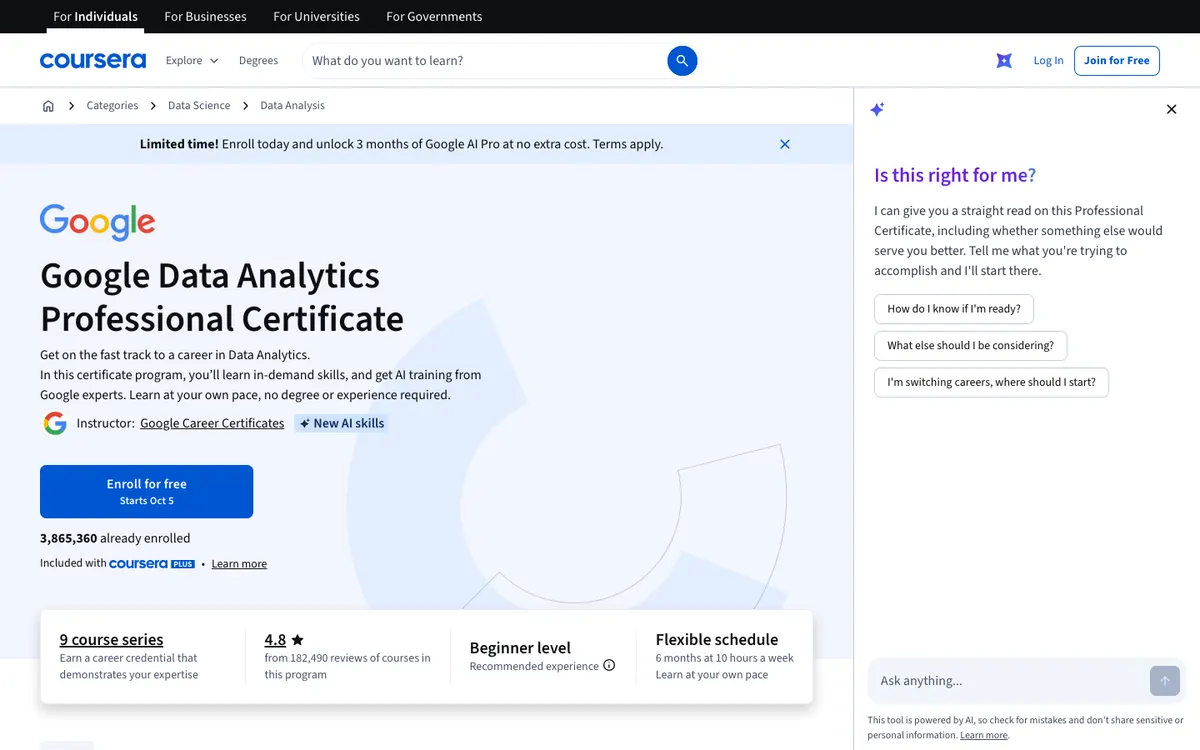
For a career changer with no degree in the field who wants a first data analyst credential with a recognizable name, the Google Data Analytics Certificate is hard to beat on price: $49 a month after a 7-day free trial (October 30, 2026), and about $300 if you keep Coursera's pace of 10 hours a week. If you already work with SQL or Python, or you want a deeper statistics or programming track, DataCamp or an edX professional certificate will take you further. The catch is that everyone else applying for junior analyst jobs has this certificate too, so the case-study project you build in Course 8 matters more than the badge.

Runner-upBest for: working professionals who want a multi-course certificate with a university or company name on it, such as Harvard, IBM or Microsoft, and who can study on their own for several months.
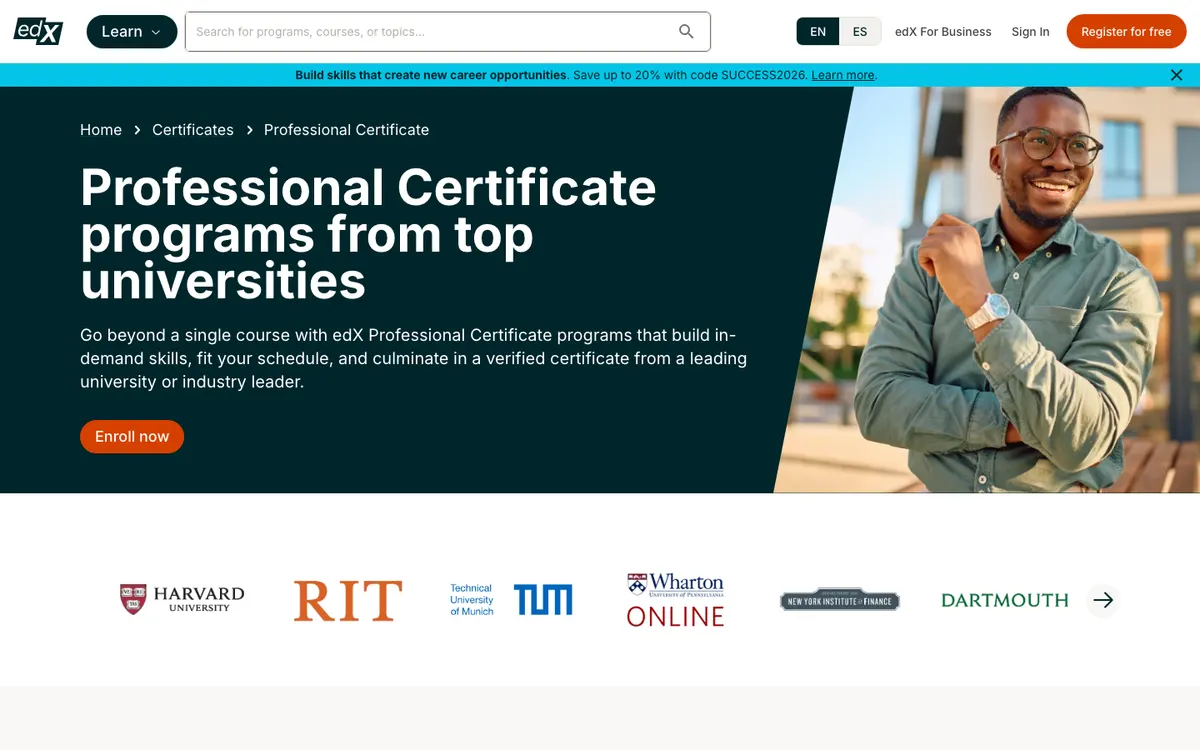
Pay for an edX Professional Certificate when the issuer's name will help you: HarvardX Data Science ($1,481, or $1,332.90 bought as a bundle on October 30, 2026) teaches R, statistics and git over nine courses, and the certificate says Harvard. If you just want a job-ready entry-level analytics certificate for less, Coursera's Google Data Analytics at $49 a month usually costs a few hundred dollars, and DataCamp is better for daily practice. The catch: quality and workload vary by school, and some data programs take over a year, far beyond edX's '2 to 10 months'.
Best for: beginners and spreadsheet analysts who want a daily dose of Python, R or SQL practice in the browser, with nothing to install.
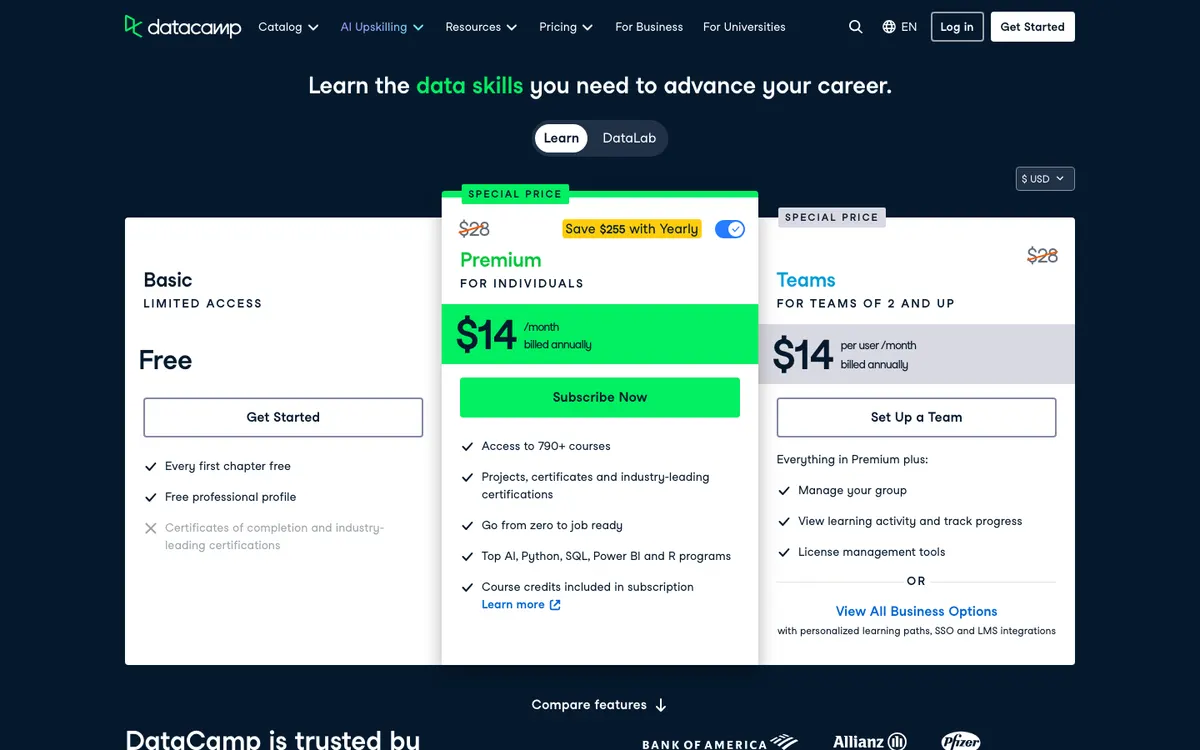
DataCamp is where you practice, not where you get hired. Its short lessons followed by coding exercises in the browser make Python, R and SQL a daily habit for beginners and for analysts moving off spreadsheets. If you want one named credential for a career change, the Google Data Analytics certificate on Coursera gives you a set sequence and a capstone; if you already code, you'll outgrow the guided exercises fast. One more thing: we couldn't load the pricing page on October 30, 2026, so check the plan, renewal and refund terms on DataCamp before you pay.
We do not enroll in or test these programs. We compare them on what each provider publishes (program pages, pricing, syllabus, terms and refund policy) and on what accreditors or regulators list, then score five criteria from 1 to 10. The overall score is the weighted average of those criteria. Our rankings are based on our editorial criteria; some partners may be featured more prominently.
Weights: Curriculum 25% · Credibility 25% · Value 20% · Flexibility 15% · Support 15%
The facts on this page were checked on the official sites between October 5, 2026 and October 5, 2026. Prices and sales change often, so confirm them before you pay. Each review lists its sources. Read the full method.
We may earn a commission when you buy through links on this page. Our rankings are based on our editorial criteria; some partners may be featured more prominently. Read our affiliate disclosure.
Based on our editorial score, Coursera ranks first at 9.1/10. Best for: career changers and early-career workers who want an entry-level data analytics certificate from Google for a few hundred dollars, studying evenings at their own pace. edX follows at 8.8/10.
Among the programs we compared that publish a price, prices run from $49 to $1,481. Prices change often, so check the official site before you enroll.
We rank programs by an editorial score built from five weighted criteria (curriculum, credibility, value, flexibility and support), using each provider’s official pages. Our rankings are based on our editorial criteria; some partners may be featured more prominently.