On this page · 8 sections6 min read
What a data analyst does
A data analyst turns information into an answer to a defined question. The related O*NET business-intelligence analyst profile describes querying data and producing reports that identify patterns and trends. “Data analyst” covers several kinds of work, so this occupational reference should not be treated as proof that every analyst role has identical requirements.
An analyst’s useful output is more than a chart. It includes the question, the source, the method, the assumptions, and an explanation of what the result can support. A polished dashboard built on duplicated records or inconsistent definitions can make a poor decision look well supported.
Choose a starting domain you understand, such as operations, customer support, or marketing reporting. Familiarity with the business question can help you notice when a result is implausible. Build technical skills alongside that judgment rather than collecting tools without a question to answer.

Do you need a license or certification?
The O*NET information cited here do not establish a general US government license for data analysts. Employers may request degrees, experience, technical assessments, or named credentials, but a commercial course certificate is not a universal legal requirement. Read the requirements of the roles you want rather than assuming that one popular certificate opens every analyst position.
Course completion and demonstrated analytical ability are different evidence. Ask whether a program includes original projects, feedback, and assessment of reasoning, or mainly guided exercises with known answers. A certificate can document learning while a portfolio shows how you approach an unfamiliar question.
This selection includes platforms rather than perfectly equivalent single courses. Coursera’s entry describes a particular certificate series, edX offers a range of certificate programs, and DataCamp uses a subscription model. Confirm the exact course, credential issuer, and syllabus before comparing their outcomes.
Data handling has responsibilities even without a dedicated occupational license. An employer or client controls whether you may access, export, or publish its data. Use public, synthetic, or properly authorized information for a portfolio; removing a name does not automatically make every business dataset safe to share.
If the analysis supports a regulated activity, seek the appropriate professional review. A course in data skills does not authorize you to make clinical, legal, or regulated financial decisions. Describe the analysis and its limitations without implying expertise you have not established.
Step-by-step: how to become a data analyst
- Choose a role and inspect its tasks. Compare reporting analyst, business-intelligence, and other realistic entry roles. Write down the tools, data sources, and communication responsibilities that recur, then choose training that addresses those tasks.
- Learn to organize and inspect data. Practice identifying missing values, duplicates, inconsistent categories, and unsuitable units. Record what you changed and why so that another person could reproduce the preparation process.
- Build query and spreadsheet skills around questions. Start with a task such as comparing activity across periods or identifying unresolved cases. Check the output against small examples you can inspect manually before trusting a result on a larger dataset.
- Learn basic analytical reasoning. Distinguish a descriptive pattern from a causal conclusion and identify what the data cannot establish. A course should help you question the result rather than only produce a visualization.
- Create an independent project. Select a public or synthetic dataset and write the question before building the dashboard. Include your assumptions, data-quality checks, and a concise recommendation or explanation that follows from the evidence.
- Request critique and revise. Ask someone to challenge the definitions, chart choices, and conclusion. Keep a record of the revision so your portfolio demonstrates how you respond to problems rather than presenting the first output as unquestionable.
- Prepare for practical hiring tasks. Rehearse explaining a query, investigating an unexpected total, and presenting a finding to a nontechnical colleague. Match your application to roles whose required tools and domain knowledge you can demonstrate.
A strong beginner project might analyze a fictional support queue. Define what counts as an open case, explain how reopened cases are handled, and compare results only after checking that the periods use the same definitions. The point is to show a reliable process, not to claim a dramatic business improvement from a practice dataset.
Write an accompanying decision memo. Explain which action the analysis could inform, what further information would be useful, and which conclusions would overreach. A short, careful explanation can be more persuasive than adding another chart that repeats the same information.
How long it takes and what it costs
Coursera’s certificate route costs $49 monthly in the US and Canada, while edX Professional Certificates start around $500 and vary by program. Those are different billing models, and DataCamp’s price is unconfirmed here. Compare a specific course and expected access period rather than treating the figures as a complete category-wide range.
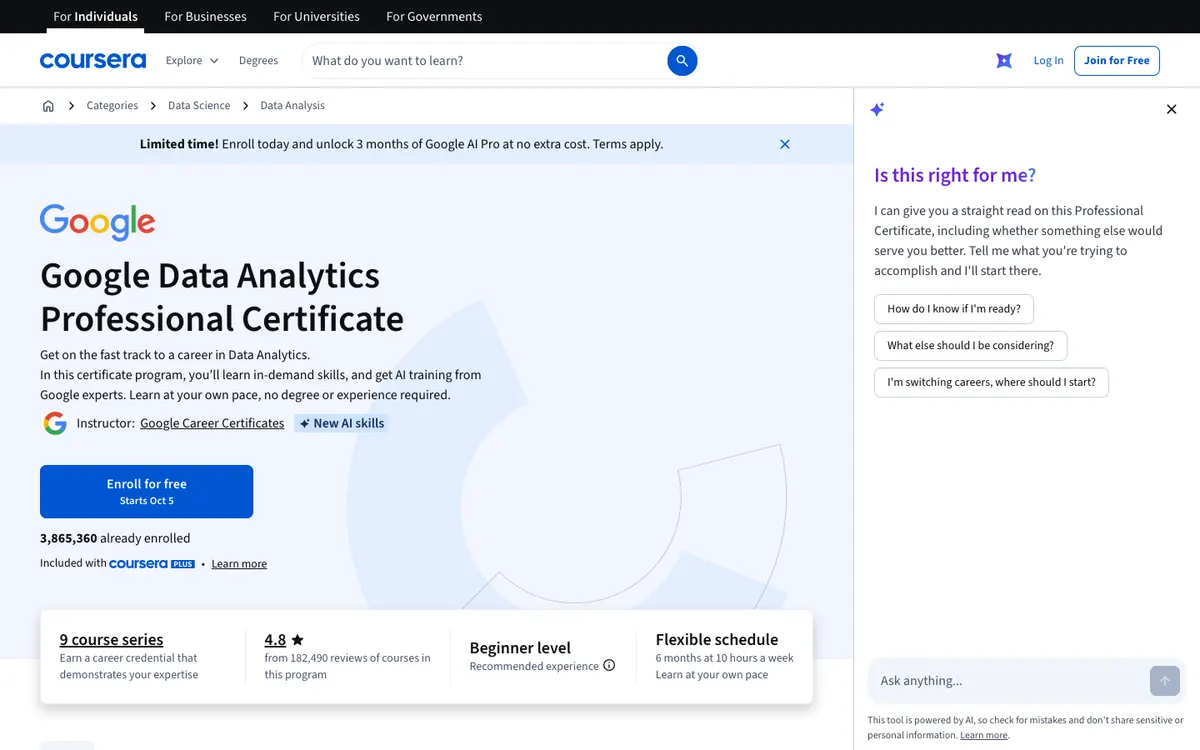
The Google Data Analytics Professional Certificate (Coursera) contains 9 courses and estimates about 6 months of study at 10 hours a week. In the U.S. and Canada, access costs $49 per month after a 7-day free trial; Coursera Plus is another option at $59/month or $399/year.
edX Professional Certificates start at around $500, with pricing determined by the program. Courses run from 2 to 10 months, so identify the actual certificate and syllabus before comparing its total cost with monthly access elsewhere.
DataCamp Premium uses subscription access rather than a single fixed course timetable. Its price needs confirmation here; request the current plan in writing and check that it includes the learning and assessment you want.
Coursera’s study estimate is about six months at ten hours per week, while edX’s entry spans programs lasting two to ten months. These are learning schedules, not guaranteed time-to-employment. The actual total for a monthly subscription depends on how long you remain enrolled and which plan you choose.
Before purchasing annual access, identify the projects you will finish and the feedback available. A large catalog can be useful, but moving between introductory courses may delay the independent work an employer needs to see. Ask whether assessment, certificate issuance, or graded access is included in the listed price.
Best online programs for aspiring data analysts
These three ranked choices include a defined certificate series, a collection of professional certificates, and a subscription platform. Your shortlist should specify the exact curriculum within each.
- Google Data Analytics Professional Certificate (Coursera) lists a nine-course certificate series with an estimated six-month part-time schedule.
- edX Professional Certificates offers professional-certificate options whose prices and durations vary by selected program.
- DataCamp Premium uses a subscription learning format, whose current plan price needs confirmation.
Use the Data Analytics comparison to open the reviews and compare study commitments, payment plans, and program scope.
Top programs compared
The 3 highest-scored online data analytics programs in our ranking, side by side.

Swipe sideways to compare all 3 programs →
| Criterion | |||
|---|---|---|---|
| Our score | 9.1/10 | 8.8/10 | 8.6/10 |
| Price | $49 – $399 | $500 | — |
| Format | Self-paced | Self-paced | Subscription |
| Duration | 9-course series; about 6 months at 10 hours a week. | 2 to 10 months per program. | Subscription. |
| Free trial | 7-day free trial. | — | — |
| Best for | Career changers who want an entry-level, employer-recognized data analytics certificate… | Professionals who want a multi-course certificate carrying a university or industry… | Beginners and analysts who want interactive, browser-based practice in Python, R, SQL and… |
| Full review | Coursera review | edX review | DataCamp review |


Scores from our editorial method. See the full ranking of 3 programs.
Common mistakes to avoid
Do not build a portfolio solely from unchanged course walkthroughs. An employer may recognize the exercise and still need evidence that you can make decisions independently. Add your own question, explain the data preparation, and document why you chose the method.
Avoid presenting correlation as proof that one factor caused another. Identify the limits of the design and explain alternative interpretations. Careful reasoning is part of the skill being demonstrated, not a weakness to hide behind a confident chart title.
Do not publish workplace data without authorization. Use a synthetic example when the real data cannot be shared, and explain that choice honestly. A portfolio should demonstrate analytical ability without creating a confidentiality problem.
Treat software completion streaks as a study aid rather than the final objective. After a guided exercise, attempt a similar task with a different dataset and no step-by-step instructions. That reveals whether you understand the method or only the sequence of clicks.
FAQ
Is a certificate required for every data analyst job?
No universal certificate requirement is established by the ONET profile. Check the education, tools, and experience requested by the specific employer.
Does the Coursera monthly price establish the total cost?
No. The Coursera listing describes subscription pricing and a study estimate; the total depends on the plan and how long you use it.
Is edX one fixed data-analysis course?
The edX entry covers a range of professional-certificate programs. Compare the exact syllabus, issuer, price, and schedule of the one you intend to take.
Should I buy DataCamp without a current quote?
Obtain the current plan and its assessment details first. The DataCamp review does not establish a current price; get the actual amount before budgeting.