On this page · 15 sections5 min read
- 01Our verdict
- 02At a glance
- 03Pros & cons
- 04What you’ll learn
- 05Format, schedule and time commitment
- 06Accreditation and what the credential is worth
- 07Price, payment plans and refunds
- 08Who it’s best for — and who should skip it
- 09Pros and cons in detail
- 10How it compares
- 11DataCamp vs alternatives
- 12How to enroll
- 13Score breakdown
- 14Key facts
- 15FAQ
Our verdict
Our verdict8.6/10DataCamp is a subscription platform for data skills, known for short video lessons followed by interactive coding exercises that run directly in the browser across Python, R, SQL and AI tooling.
Its structured career tracks make it a common starting point for aspiring data analysts and scientists. Prices, trial terms and refund conditions could not be confirmed on DataCamp's pricing page when we checked; check them directly before subscribing. The format is efficient for building fluency, but advanced learners may find exercises too guided and should add real projects. It fits beginners who want daily, hands-on practice without installing software.
Best for: Beginners and analysts who want interactive, browser-based practice in Python, R, SQL and data skills.
At a glance
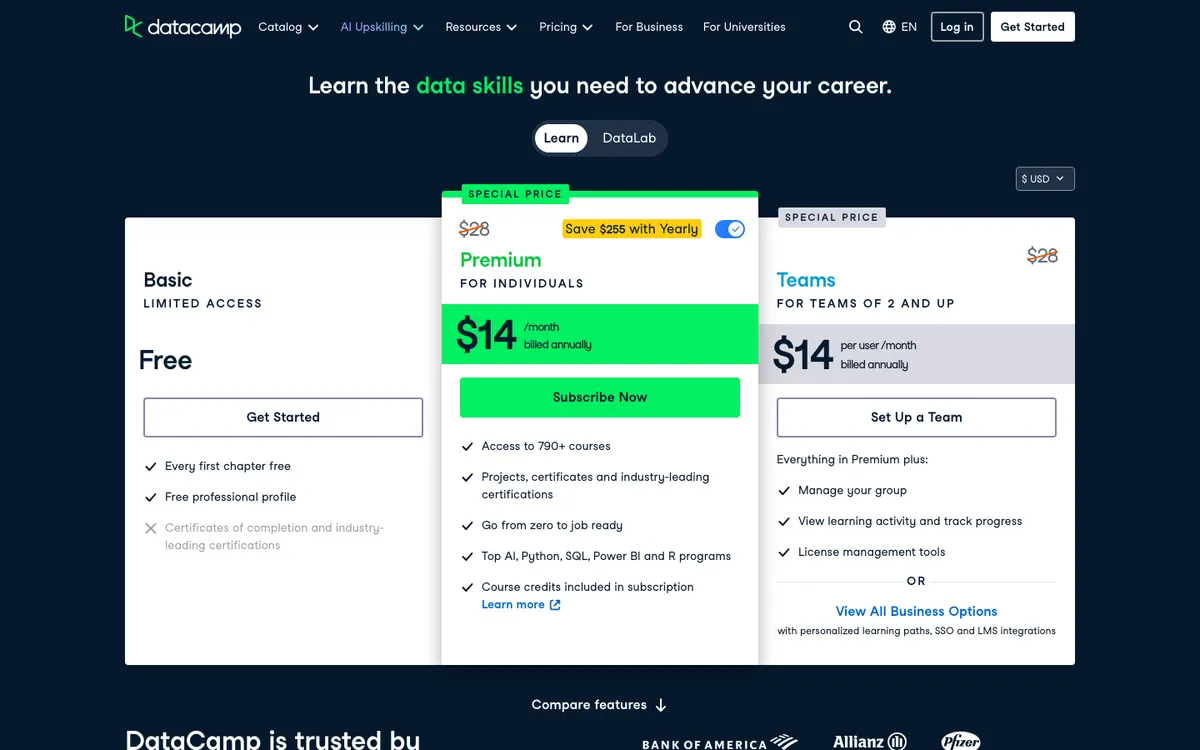
Repeated practice in Python, R, and SQL is DataCamp Premium’s clearest appeal for beginners and working analysts. Browser exercises and organized tracks let you focus on data skills without substantial local setup. Pricing access was blocked during this assessment, so a current Premium checkout total and refund policy could not be verified. Consider it for a consistent practice routine, with independent projects planned alongside the guided exercises.
Pros & cons
- Interactive in-browser coding exercises
- Covers Python, R, SQL, AI and data tools
- Structured career and skill tracks
- Current prices and terms could not be confirmed on the official site
- Short exercises may feel shallow for advanced users
What you’ll learn
The documented learning model combines short explanations with coding exercises completed in the browser. Career and skill tracks group lessons into a sequence, helping a learner choose between a role-oriented path and a narrower technical objective.
The subject range includes Python, R, SQL, data tools, and AI-related learning. That range is useful when someone needs practice across the tools used in analysis, but it does not imply that one track covers every language or advanced topic. Select the intended track and inspect its prerequisites and exercises before buying a subscription based on the overall catalog.
Format, schedule and time commitment
Short exercises and subscription access lend themselves to regular practice rather than a fixed semester. The information available here does not establish a universal hour total, access beyond the selected subscription, or a Premium completion guarantee. Build your schedule around the actual track and the time you can actively use it.
A learner can use the guided format to build fluency, but should separate lesson progress from independent problem solving. Repeating a familiar pattern inside an exercise is different from deciding how to approach an unfamiliar dataset. Reserve time to revisit concepts outside the guided sequence, and do not equate a streak or completion percentage with readiness for every workplace data task.
Videos about DataCamp
Accreditation and what the credential is worth
No blanket accreditation or included university award for Premium could be established in this assessment. Course-completion documents and any separately offered DataCamp certification need to be evaluated under their own terms. Do not assume a general skills subscription includes an external professional credential.
For a learner seeking employment, the relevant question is what the study enables them to demonstrate: writing queries, explaining transformations, or analyzing data accurately. An employer may value that evidence differently from a certificate. If a particular credential is required, verify its issuer, assessment, and inclusion before purchasing a general skills subscription.
Price, payment plans and refunds
Current Premium tuition, trial conditions, renewal rules, and refund terms could not be verified from the pricing page. An accessible overview did confirm the broad data-skills catalog. That is enough to discuss the teaching focus, but not to substitute an estimated amount for the actual plan price.
Compare DataCamp’s actual offer with the Google Data Analytics monthly plan and a specific edX certificate only after confirming billing frequency and access. A discounted monthly equivalent can require annual payment, while a short subscription can be sufficient for a narrowly defined skill. The right cost comparison depends on the planned track and the period during which you will actively use the exercises.
Who it’s best for — and who should skip it
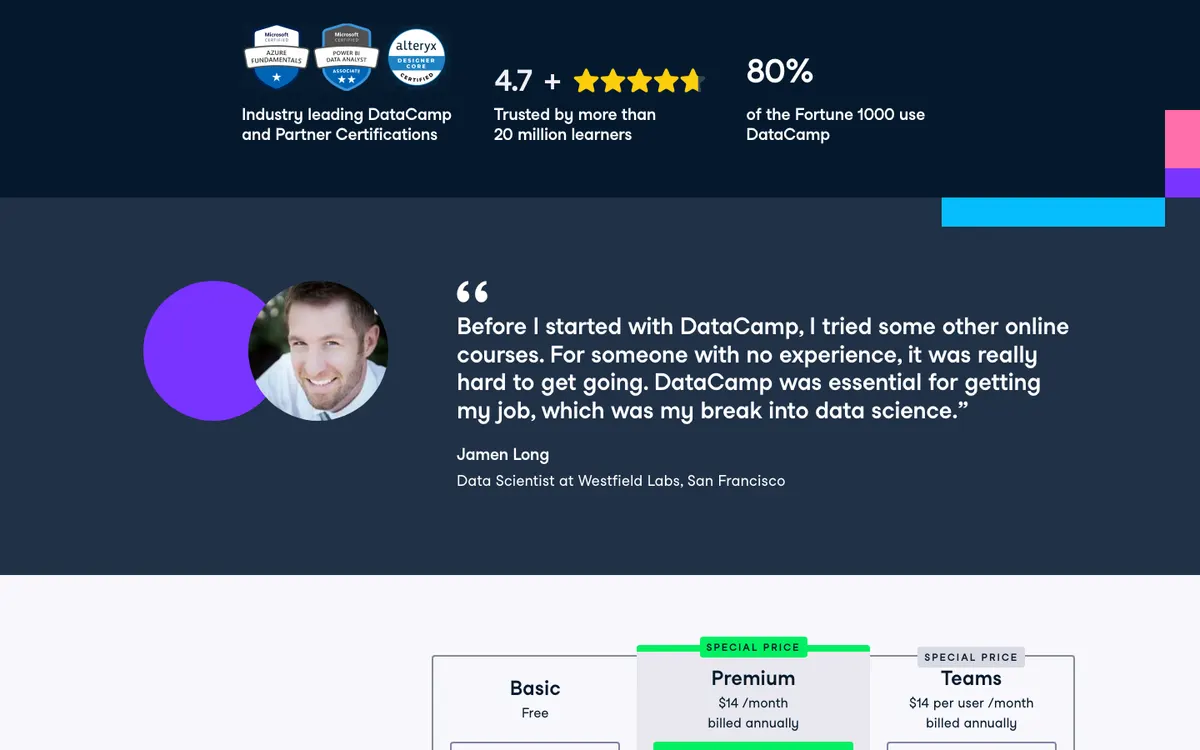
DataCamp fits a learner who wants to practice data syntax and concepts frequently in a guided environment. It can be particularly useful for someone who finds installation and environment setup a barrier to beginning Python, R, or SQL study.
Skip it as a complete substitute for independent project work or personalized career support unless the selected plan expressly includes the services you need. An advanced learner may find some exercises too constrained and should inspect the level before subscribing. A beginner seeking one clearly named Google certificate may prefer Coursera’s defined sequence instead of choosing among many tracks.
Pros and cons in detail
- Coding without local setup: Exercises run interactively in the browser.
- Several data languages: Python, R, SQL, AI, and related tools are represented.
- Organized progression: Career and skill tracks provide a sequence for study.
- Purchase terms unresolved: A current Premium total, trial, and refund policy could not be verified.
- Guided practice has limits: Advanced learners may need more independent problem solving than prompted exercises provide.
Browser-based interaction is the central benefit: learners can move from explanation to practice without assembling a local environment first. Coverage across several data languages and structured tracks can also help maintain a purposeful progression rather than jump among unrelated tutorials.
Guidance helps when you are learning syntax, but independent analysis eventually requires choosing the next step without prompts. Judge a track partly by how you will practice beyond those supports. The commercial uncertainty is separate: the educational format is clear enough to assess, while the actual Premium terms are still needed before calling the purchase good value.
How it compares
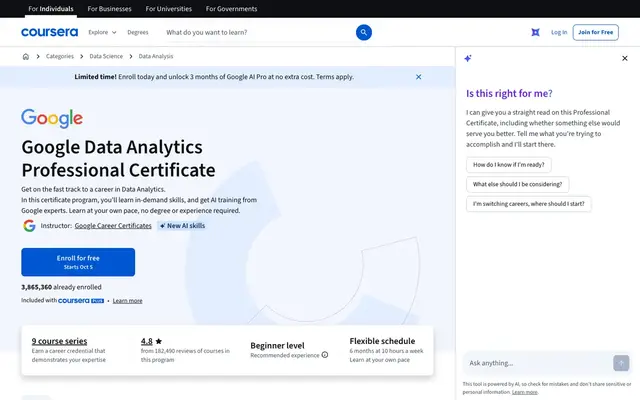
Google Data Analytics Professional Certificate (Coursera): $49 per month in the U.S. and Canada after a 7-day free trial; or Coursera Plus at $59/month or $399/year. 9-course series; about 6 months at 10 hours a week. The Google certificate has a defined nine-course sequence, a published US monthly price, and a capstone case study. Its current official curriculum uses Python rather than R, so choose according to the actual tools you want to learn. See the side-by-side comparison.
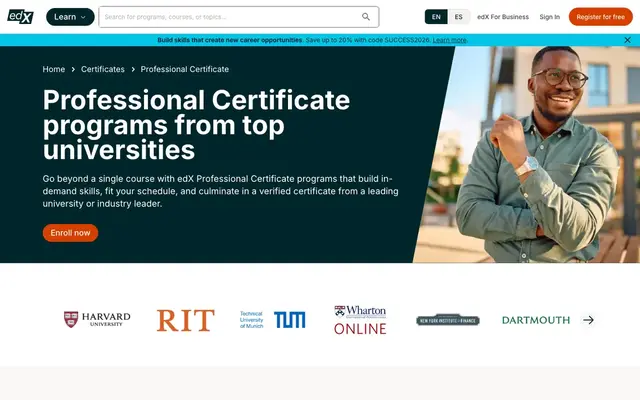
edX Professional Certificates: Professional Certificate programs start at around $500; pricing varies by program. 2 to 10 months per program. edX professional certificates vary by partner and offer a different approach to multi-course study. Inspect a particular data certificate’s level, assessments, and schedule before comparing it with an exercise-centered subscription. See the side-by-side comparison.
The choice between these options is partly about structure. DataCamp offers ongoing access to a collection of tracks and exercises; the Google certificate supplies a named beginning-to-end program; edX requires selecting a specific partner’s sequence. None of those structures automatically establishes deeper learning or better employment outcomes.
For someone who already understands analytical concepts but needs more coding repetition, DataCamp’s format may address the most immediate gap. For someone who needs a complete introductory narrative, the Google sequence may require less curriculum planning. For specialized academic or professional content, an individual edX program deserves closer inspection.
The Data Analytics category lets you compare guided practice with more defined certificate sequences. Our review methodology describes the curriculum, credibility, value, flexibility, and support criteria used to assess DataCamp without assuming an unverified subscription price.
DataCamp vs alternatives
How DataCamp stacks up against other data analytics programs we reviewed, on the facts published by each provider.
Swipe sideways to compare all 3 programs →
| Criterion | This review | ||
|---|---|---|---|
| Our score | 8.6/10 | 9.1/10 | 8.8/10 |
| Price | — | $49 – $399 | $500 |
| Format | Subscription | Self-paced | Self-paced |
| Duration | Subscription. | 9-course series; about 6 months at 10 hours a week. | 2 to 10 months per program. |
| Free trial | — | 7-day free trial. | — |
| Best for | Beginners and analysts who want interactive, browser-based practice in Python, R, SQL and… | Career changers who want an entry-level, employer-recognized data analytics certificate… | Professionals who want a multi-course certificate carrying a university or industry… |
| Read more | You are here | Coursera reviewHead-to-head → | edX reviewHead-to-head → |


“—” means the information was not published or not yet checked. See all 3 data analytics programs.
How to enroll
Use DataCamp’s official catalog to identify a relevant career or skill track, then review the Premium plan that includes it. Inspect available introductory material before committing and confirm that the selected level matches your existing knowledge.
Before payment, verify the payable total, billing period, renewal, cancellation, and refund conditions directly. Ask about any certification or project feature that influenced the choice rather than assuming it is bundled. Start with a defined track and plan independent practice alongside the guided exercises.
DataCamp catalog information and data-certificate comparisons consulted October 5, 2026: source 1, source 2, source 3, source 4.
Score breakdown
Broad data-skills catalog with interactive exercises.
Widely used data-learning platform.
Prices could not be verified this cycle.
Browser-based and self-paced.
Self-directed learning; support details unverified.
Weighted average of five criteria. Read our methodology.
Key facts
FAQ
Do I need to install software for DataCamp?
No, DataCamp exercises run in the browser.
What languages does DataCamp teach?
Python, R and SQL, plus AI and data tools.
Head-to-head comparisons
Sources
- https://www.datacamp.com/affiliates
- https://www.datacamp.com/pricing/
- https://www.datacamp.com/
- https://www.coursera.org/professional-certificates/google-data-analytics
- https://www.edx.org/certificates/professional-certificate
Information checked on October 5, 2026. Prices and offers can change; confirm on the official site.