On this page · 9 sections6 min read
What an insurance agent does
An insurance agent helps clients evaluate and purchase the insurance products the agent is authorized to sell. O*NET’s insurance-sales profile includes life, health, property, casualty, and other insurance. The specific product line matters because training, licensing, and employer arrangements are not identical across all insurance work.
Decide which kind of agency or carrier role you want before buying education. A position may emphasize a particular product, customer group, or service process. Read the actual responsibilities and compensation terms rather than assuming every licensed agent operates an independent business.
A useful beginner exercise is explaining a sample policy’s coverage, exclusions, and unresolved questions in ordinary language. The goal is accurate communication within your authorization, not promising that a product covers every possible loss. Ask a qualified supervisor to review both what you say and what you leave out.

Do you need a license or certification?
Yes, insurance sales agents must be licensed in the states where they work, according to the BLS occupation profile. The relevant state and line of authority determine the pathway. A private course completion certificate is not the producer license itself.
NIPR provides state-specific licensing information and links for applications, renewals, and other licensing tasks. Its guidance states that licenses are issued by the regulating state. Use the state-requirements resource and the state insurance department to establish the exact rules for your application.
Prelicensing education, exam preparation, continuing education, and professional designations are different products. A CE package designed for an existing license holder should not be assumed to satisfy a new applicant’s requirements. Confirm the approval and purpose of the exact course for your state and line before paying.
If you plan to work across state lines, investigate resident and nonresident licensing rather than assuming one license gives nationwide authority. Appointment or other operational requirements may also depend on the state and business arrangement. Ask the regulator or agency to identify what must be completed before you begin selling.
Selling securities or other regulated financial products is a separate question from holding an insurance license. Do not assume that an insurance course authorizes every product mentioned in a financial-services job advertisement. Establish the required qualifications with the employer and relevant regulator before offering those services.
Step-by-step: how to become an insurance agent
- Choose the line of authority and work arrangement. Identify the products you intend to sell and whether you are joining an agency, carrier, or another structure. Ask the employer to name the exact license and any additional qualifications it expects.
- Review the state application pathway. Use NIPR and the insurance department’s current instructions. Record the education, examination, application, screening, and other steps that apply rather than copying a checklist from a different state.
- Select the correct educational product. Confirm that the course is for initial licensing or exam preparation as needed, not only renewal CE. Check the approved state, line, access period, and completion-reporting process.
- Study concepts and state rules together. Learn the meaning of coverage terms and the relevant obligations rather than memorizing isolated practice answers. When a question is wrong, identify the underlying rule and why the alternatives are unsuitable.
- Complete testing and application steps. Follow the official sequence and verify what the education provider reports automatically. Keep receipts and completion documents, but do not treat them as evidence that a license has already been issued.
- Arrange supervised product training. Learn the specific carrier products and the agency’s review and escalation procedures. Ask how uncertain coverage questions, complaints, and policy changes are handled before responding independently to clients.
- Maintain the license and records. Track renewals and continuing education for each applicable license. If your product line, state, or agency arrangement changes, check whether additional authorization is needed.
A useful preparation exercise is a comparison of fictional policies with different exclusions and deductibles. Explain the differences without recommending a product beyond the facts provided. Mark questions that require underwriting or a licensed supervisor’s review instead of making a confident assumption to complete the exercise.
Also rehearse a client conversation after an unexpected coverage question. Explain what you know, identify what must be verified, and document the follow-up. Reliable communication includes returning with a checked answer rather than treating immediate certainty as a measure of professionalism.
How long it takes and what it costs
Aceable Insurance’s initial-license tuition is unconfirmed here. eInsuranceTraining describes state-dependent CE packages and reporting-fee examples, which do not establish the price of beginner preparation. To build a licensing budget, first obtain a quote for the state and line of authority you need.
Aceable Insurance Pre-Licensing needs a course-specific tuition and timetable check before you can budget reliably. Ask for a written quote naming your state, line of authority, and access period; neither the price nor a completion estimate is confirmed here.
eInsuranceTraining.com Insurance Pre-License & CE varies its pricing by state package. Some CE packages include state reporting fees, with examples of $21.12 or $49.20; these should not be mistaken for full beginner-course tuition. Its offerings include 24-hour state CE packages.
The twenty-four-hour CE package example is a renewal-education product description, not a universal prelicensing requirement or time-to-license estimate. Determine the required education for your state and line before choosing a schedule. Exam appointments and application processing are separate from the time spent studying.
Request a full quote identifying tuition, exam preparation, any included exam attempt, state reporting, and access extensions. Obtain official application and testing fees from the relevant authorities instead of assuming the course includes them. If an employer pays for training, read any repayment or employment conditions before accepting.
Evaluate compensation separately from the education decision. Ask how salary, commissions, expenses, and any repayment obligations work in the specific role. A course certificate or license does not establish what you will earn or how quickly a client base will develop.
Job outlook and pay
BLS reports a median annual wage of $62,280 for insurance sales agents in May 2025. Its wage measure includes commissions and certain bonuses but excludes self-employed workers. It is not a guarantee for a new license holder or an estimate of an independent agency’s profit. BLS pay data
Best online programs for aspiring insurance agents
Two providers appear in this ranking. Compare the exact state approval and course purpose first: initial licensing and renewal education are different needs even when a provider sells both.
- Aceable Insurance Pre-Licensing lists self-paced insurance education whose state-package pricing and duration require confirmation.
- eInsuranceTraining.com Insurance Pre-License & CE offers state-dependent continuing-education products that should not be mistaken for a complete initial-license pathway.
The Insurance License comparison links to both reviews and helps distinguish prelicensing study from continuing education.
Top programs compared
The 2 highest-scored online insurance license programs in our ranking, side by side.
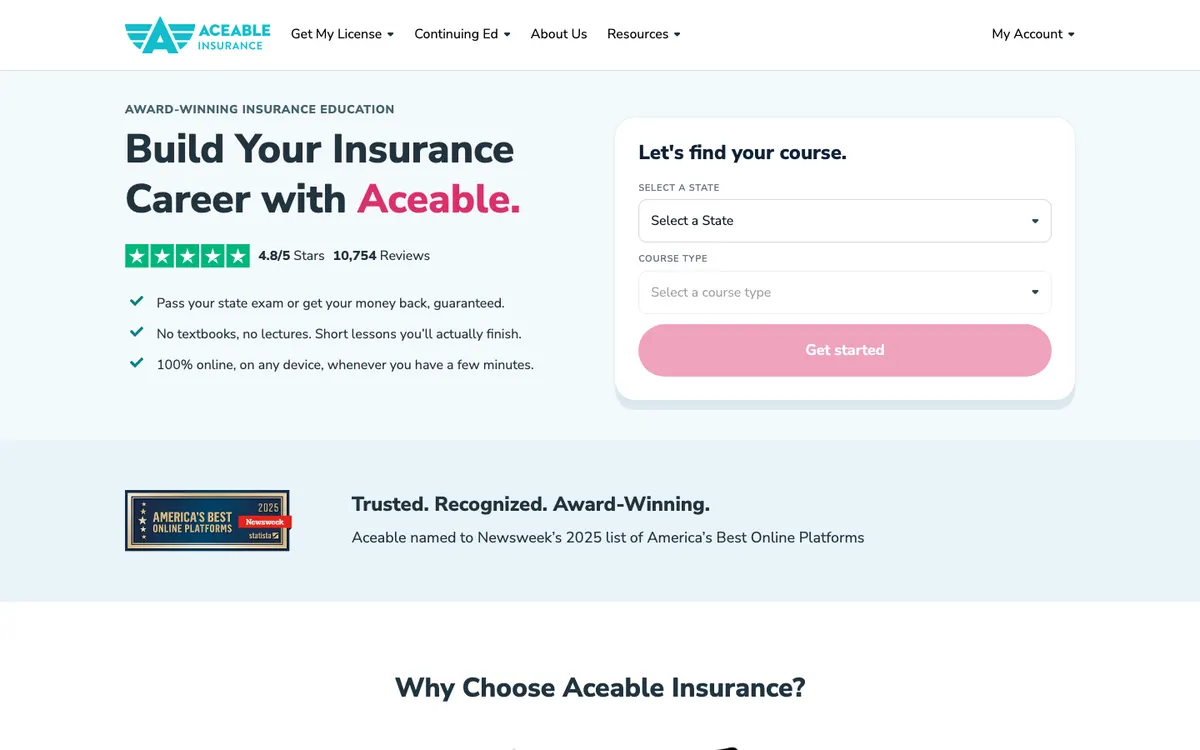
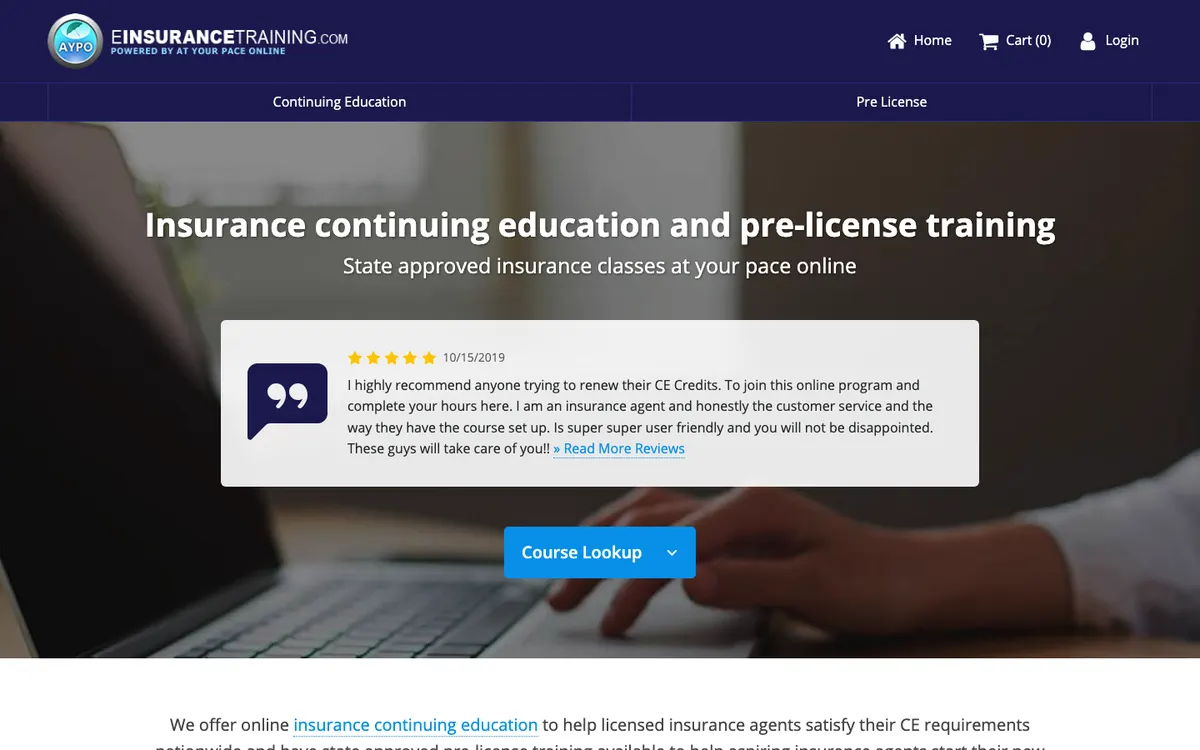
| Criterion | ||
|---|---|---|
| Our score | 8.6/10 | 8.6/10 |
| Format | Self-paced | Self-paced |
| Duration | — | CE packages such as 24-hour state packages. |
| Accreditation | — | State-approved insurance CE (approval numbers listed per course). |
| Best for | Future insurance agents who want a self-paced, adaptive pre-license course for Life,… | Licensed insurance agents who need state-approved CE hours online at their own pace. |
| Full review | Aceable Insurance (AceableAgent) review | eInsuranceTraining.com review |

Scores from our editorial method. See the full ranking of 2 programs.
Common mistakes to avoid
Do not buy CE when you need initial licensing education. The product name, state, and approval purpose must all match the requirement. A low price for a renewal package does not make it a complete entry pathway.
Avoid treating a passing exam result as proof that every licensing and appointment step is finished. Confirm the issued license and the permissions relevant to your role before conducting regulated sales activity. Keep the education provider’s records separate from the regulator’s decision.
Do not promise coverage based on a general description or memory of a similar policy. Check the actual wording and use the agency’s escalation process. Product training should help you recognize uncertainty rather than encourage a confident answer to every question.
FAQ
Does a course certificate let me sell insurance?
No. NIPR explains that the regulating state issues the license. Complete the applicable state and line-of-authority process.
Is a twenty-four-hour CE package beginner training?
Not necessarily. The eInsuranceTraining listing describes continuing education. Verify whether a separate prelicensing product is required for your application.
Is Aceable Insurance tuition confirmed here?
The Aceable Insurance review does not provide a confirmed tuition quote. Request the specific state and line package before comparing costs.
Can one state license be assumed to cover all states?
No. Use NIPR’s state requirements to investigate the resident and nonresident pathways relevant to the work you intend to do.