On this page · 15 sections5 min read
Our verdict
Our verdict8.7/10Your first package of bees is ordered and you want a real beekeeper to email when the hive looks wrong: that's who Beekeeping Made Simple's friendly video course is for.
If you'd rather learn bee biology and disease science, a university extension course goes deeper, and if you only want to know whether beekeeping is for you, the $27 intro course is enough. The catch: on the $19 monthly plan, a new chapter arrives every 10 days, so you won't reach mite treatment or overwintering for weeks.
Best for: backyard beekeepers starting their first hive who want step-by-step video lessons and a mentor to email through the first season.
At a glance
In April, the package of bees arrives, buzzing in a screened box on your porch. You’ve watched three YouTube videos, bought a hive kit, and your neighbor has asked twice whether this is a good idea. Two weeks later you open the hive and see cells you can’t name. Is that a queen cell? Should you do something? Today?
Beekeeping Made Simple is built for exactly that moment. It’s a video course for backyard beekeepers, taught by Laryssa, who has kept bees for 12 years in places as different as Pennsylvania and Hawaii. Her family-run, woman-owned school has enrolled 1,031 students in 9 countries, and paying members can email questions as often as they need to.
How we reviewed it: on October 30, 2026, we read the school’s homepage, course page and pricing page. We haven’t taken the course.
Some links on this site may earn us a commission if you enroll. Your price stays the same. Our rankings are based on our editorial criteria; some partners may be featured more prominently. How we review
Pros & cons
- Eight chapters that follow a real first year: equipment, inspections, mites, harvest, winter
- You can email questions as often as you need, on every paid plan
- Covers cold and warm climates, from Pennsylvania winters to Hawaii
- 30-day free trial on monthly; 30-day money-back guarantee on annual and lifetime
- $27 intro course if you're still deciding
- Monthly plan drips one chapter every 10 days
- One-on-one video chat mentorship only on the $380 lifetime plan
- A small, one-family school (1,031 students), so live chats are monthly, not weekly
- No hands-on practice: you still need a hive or a local club for inspections
What’s in the course
Eight chapters follow the shape of a first year with bees:
- Inside the hive: workers, the queen, drones, honey and pollination.
- Equipment and location: the Langstroth hive, the Flow Hive, safety gear, where to put it.
- Inspecting: telling honey from nectar, pollen, eggs, larvae, queen cells and drone cells, spotting the queen, installing bees, plus a seasonal task chart and a feeding recipe book.
- Pest management: varroa mites, how to do a mite test, treatments, small hive beetle and wax moth.
- Honey harvesting: how much to take, kitchen-utensil harvests and extractors.
- Advanced: preventing swarms, splitting hives, helping a weak colony.
- Overwintering in warm, cold and very cold climates.
- Next steps, including the ten mistakes new beekeepers make most, and planting for bees.
Chapter 3 is the one that earns its keep. Being able to point at a frame and say “eggs, larvae, capped brood, she’s laying” is what turns an anxious inspection into a ten-minute routine.
The three ways to pay
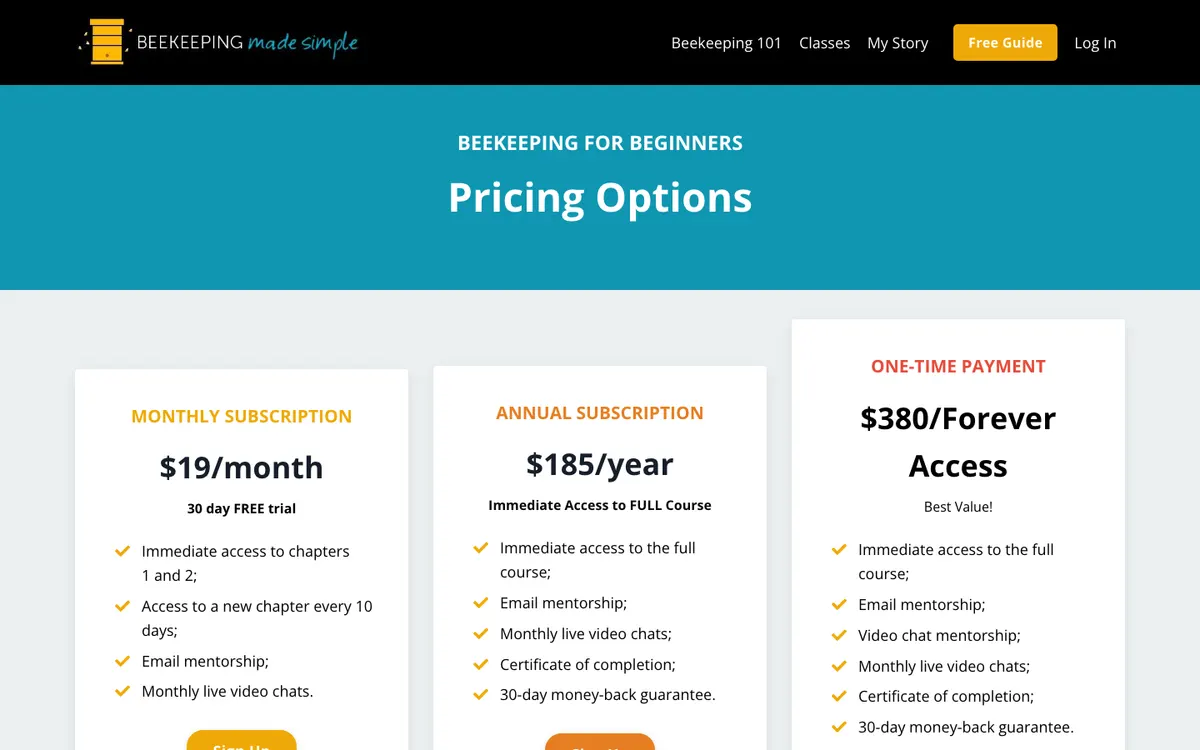
| Plan | Price (Oct. 30, 2026) | What changes |
|---|---|---|
| Monthly | $19/month, 30-day free trial | chapters 1-2 at once, then one every 10 days |
| Annual | $185/year | full course at once, certificate, 30-day guarantee |
| Lifetime | $380 once | adds one-on-one video chat mentorship |
All three include email mentorship and a monthly live video chat. A separate Intro to Beekeeping course costs $27 and never expires.
Picking the right plan
The monthly plan is cheap, but slow. If you start in February, chapters 1 and 2 arrive right away, chapter 3 (inspections) in ten days, and chapter 7 (overwintering) about two months later. That pacing is fine in the quiet months before bees arrive, and frustrating if you sign up in June with a hive already in the yard.
The annual plan gives you everything at once, and it’s the better buy if your bees are already here. It runs for 365 days, which covers one full season, including the first winter. Lifetime makes sense if you want to rewatch the inspection and mite chapters each spring for years, or if you want video calls with the instructor, which only that plan includes.
And if you’re still at “should I even do this,” the $27 intro course answers that question for the price of a veil.
The catch
Two limits. The monthly drip, covered above, means you can’t binge the course before your bees arrive unless you plan two months ahead. And no video course can do your first inspection for you. The school says so itself, in its way: you’ll learn the steps on screen, then rewatch with a real frame in your hands. Pair the course with a local beekeeping club, where someone can stand next to you the first time you lift a frame.
A smaller point: this is a one-family school. That’s the charm (you’re emailing the person who wrote the lessons), and it also means the live chats are monthly rather than every week.
What the mentorship looks like in practice
The course page lists questions students have actually sent: what to do when other bees are robbing the hive, how to store equipment over winter so pests don’t move in, how to help bees through a summer heat wave. That’s the level of help on offer: practical, specific, answered by email. The school encourages small questions, not only emergencies, and uses them to plan new lessons and videos.
One detail to know: if you bought the basic version of the full course, you can post questions in the class notes, but private one-on-one messages aren’t included. Check which version your plan covers before counting on a private reply.
How it differs from a university course
The course page makes a fair point. University extension courses are taught by entomologists and go deep on bee biology and lab methods. Beekeeping Made Simple is about doing it at home: where to store equipment over winter, harvesting in your kitchen, which mite treatment to use without spending hundreds on gadgets. If you love the science, a university course will satisfy you more. If you want healthy bees in your yard this year, this is the more practical choice.
Who it suits
First-year backyard beekeepers, gardeners adding a hive for pollination, families starting a hobby together, and anyone who learns better by watching than by reading a manual.
Who should skip it
Commercial or sideline beekeepers who already run several colonies. People who want a formal credential (the certificate is a personal record). And anyone who won’t actually have bees this year; the intro course is enough for now.
Alternatives
This is the only beekeeping course in our beekeeping courses guide so far. Your other real options are a local beekeepers’ association, which may run a spring beginner class or pair new members with an experienced keeper, and your state university’s extension service, which may offer online or in-person courses with a stronger science focus.
Your next step
Work out when your bees arrive. If it’s two months or more away, start the monthly free trial now and let the chapters drip in. If it’s sooner, or the bees are already here, choose the annual plan and go straight to chapter 3 before your next inspection.
30-day money-back guarantee on the annual and lifetime plans; the monthly plan has a 30-day free trial and can be cancelled anytime (October 30, 2026)
Monthly, annual or one-time.
No public discount was listed on the official site when we checked. We never publish unverified coupon codes.
Score breakdown
Full beginner beekeeping course.
Independent specialist school.
Free trial; $185/year.
Online and self-paced.
Mentor access and live chats.
Weighted average of five criteria. Read our methodology.
FAQ
How much is Beekeeping Made Simple?
On October 30, 2026: $19 a month with a 30-day free trial, $185 a year, or $380 once for lifetime access. The Intro to Beekeeping course is $27, one time.
Do I get the whole course right away?
On the annual and lifetime plans, yes. On the monthly plan, you get chapters 1 and 2 immediately and a new chapter every 10 days, so the eighth chapter arrives about two months in.
Is there a certificate?
Yes, a certificate of completion mailed to you at the end of the course. It's a personal record, not a state or association credential.
Sources
- https://www.beekeepingmadesimple.com/
- https://www.beekeepingmadesimple.com/beekeeping-course-membership
- https://www.beekeepingmadesimple.com/online-beekeeping-course
Prices and offers can change; confirm on the official site before you enroll.