On this page · 14 sections5 min read
- 01Our verdict
- 02At a glance
- 03Pros & cons
- 04Pick the course by your job, not by price
- 05An evening, a test, a card
- 06When your employer wants hands-on skills
- 07The catch: "accredited" means less than it sounds
- 08Who should skip it
- 09Two years from now
- 10Refunds
- 11Alternatives
- 12Before you start
- 13Score breakdown
- 14FAQ
Our verdict
Our verdict8.8/10A CPR card by Monday, earned from your couch: that's ProCPR's pitch, and if your employer accepts online training it's one of the safer bets at $39.95 for CPR and First Aid (October 30, 2026).
You pay only after you train, and a mailed manikin kit plus a Zoom check-off turns it into a blended certificate if your job asks for hands-on skills. Hospitals that require an AHA BLS card specifically won't take it, so book an AHA class instead. Where it falls short: the hands-on option more than doubles the price, and only your employer can tell you whether you need it.
Best for: Workers who need a CPR, first aid or BLS card quickly, at home, and want the option of a remote hands-on skills check if their employer requires one.
At a glance
“Current CPR certification required,” says the offer letter, and your start date is next week. Or the daycare where you just got hired needs a CPR and first aid card on file before you’re alone with the toddlers. Most people in that spot want a course they can finish tonight, a card they can print, and an employer who won’t send them back to do it again. ProCPR, the consumer site of ProTrainings, is built for exactly that.
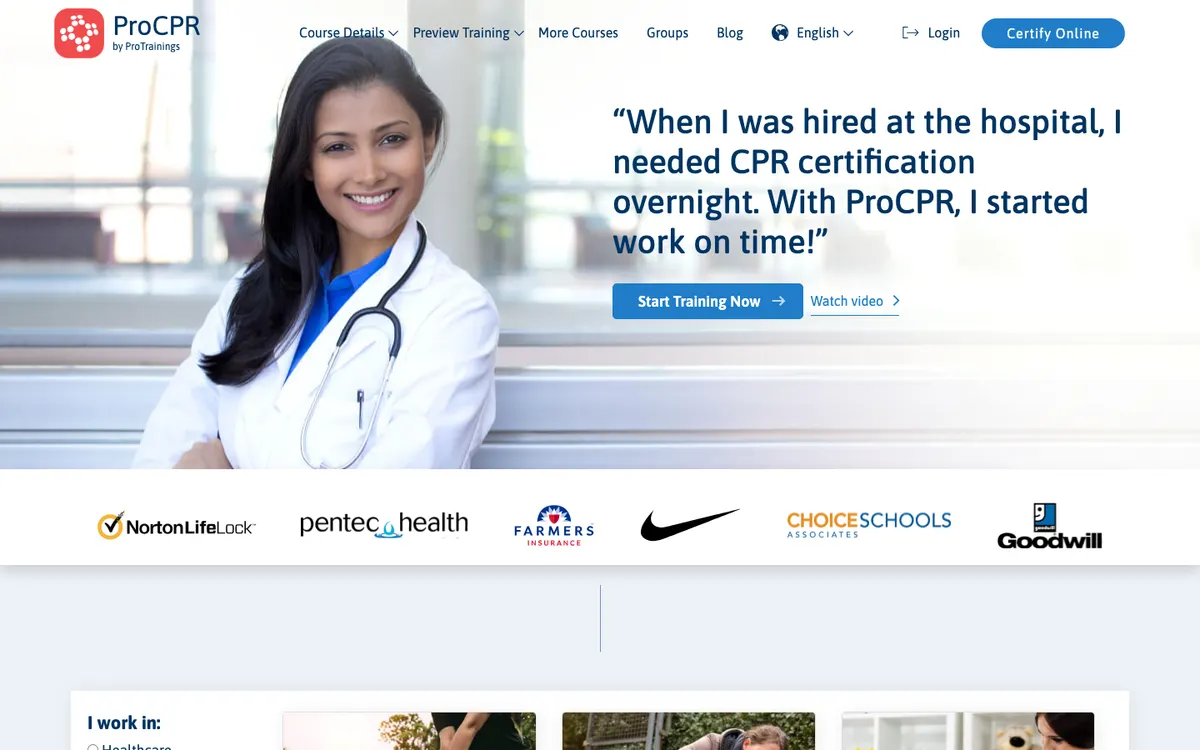
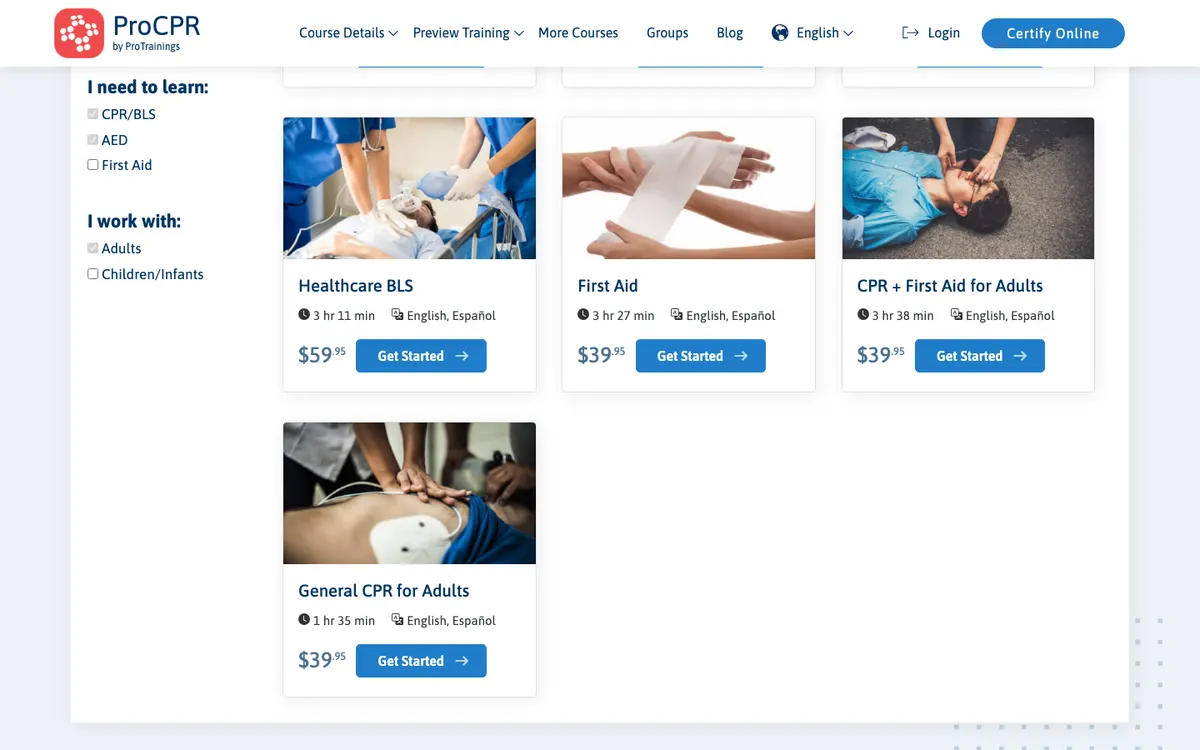
ProCPR sells online CPR, AED, first aid and healthcare BLS courses as video lessons in English or Spanish, followed by a test and a two-year certificate. On October 30, 2026, courses cost $39.95 or $59.95, and you pay only after you’ve completed the training.
How we reviewed it: we read the ProCPR and ProTrainings sites on October 5 and October 30, 2026, and compared prices, formats and acceptance claims with the other CPR providers we list. We didn’t take a course.
Some links on this site earn us a commission if you enroll. Your price stays the same. Our rankings are based on our editorial criteria; some partners may be featured more prominently. How we review
Pros & cons
- $39.95 for CPR, first aid or both, and $59.95 for Healthcare BLS, paid after you finish the training
- SUMO option: a manikin kit by mail and a 30 to 45 minute Zoom evaluation for a blended certificate
- Courses in English and Spanish, with a printable card right away and a printed card in 5 to 7 business days
- 30-day money-back guarantee
- Not an American Heart Association or Red Cross card, which some hospitals and nursing programs require by name
- The hands-on SUMO option raises the price to $99.90 to $159.90
- "99% employer acceptance" is ProCPR's own figure
Pick the course by your job, not by price
| Course | Video length | Online price | With SUMO hands-on kit |
|---|---|---|---|
| General CPR for Adults | 1 h 35 min | $39.95 | $99.90 |
| General CPR for All Ages | 2 h 11 min | $39.95 | $114.90 |
| CPR + First Aid for Adults | 3 h 38 min | $39.95 | $99.90 |
| CPR + First Aid for All Ages | 4 h 42 min | $39.95 | $114.90 |
| First Aid | 3 h 27 min | $39.95 | $39.95 (same price listed) |
| Healthcare BLS | 3 h 11 min | $59.95 | $159.90 |
| Healthcare BLS + First Aid | 5 h 33 min | $59.95 | $159.90 |
Prices and lengths from procpr.org, October 30, 2026. The second price is the one ProCPR lists next to each course for the hands-on option.
Childcare, teaching and coaching jobs usually need the “All Ages” version, which covers infants and children. Nurses, EMTs, dental staff and other clinical workers need Healthcare BLS. Everyone else (a construction site, a gym front desk) usually needs adult CPR, often with first aid. If the job posting doesn’t say, ask HR which one before you start; the wrong course is the most common way to waste an evening.
Risk-free 30-day money-back guarantee.
No public discount was listed on the official site when we checked. We never publish unverified coupon codes.
An evening, a test, a card
The course is video, so you can split it: an hour after dinner, another before bed, the rest the next morning. ProCPR lets you pay after you train, which means you can watch a few modules before deciding. Once you pass the test, you print your certificate and wallet card immediately, and a professionally printed card arrives in 5 to 7 business days. The certificate is valid for two years.
When your employer wants hands-on skills
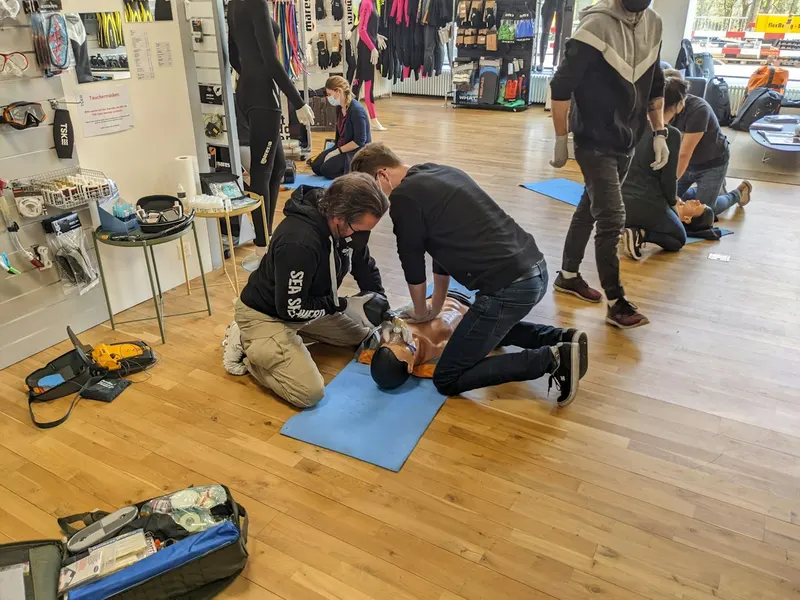
Many workplaces accept online-only CPR. Some don’t, because they want to see you do compressions on a manikin. ProTrainings’ answer is SUMO: for the higher price shown above, you get a manikin kit in the mail, then a 30 to 45 minute skills evaluation over Zoom with an instructor. Pass it and you get a blended certificate that meets hands-on requirements.
It’s clever, and it saves you a Saturday at a training center. But it also means waiting for a package, booking a session, and paying roughly two and a half times the online price. If your job needs hands-on and your start date is in three days, a local in-person class may simply be faster.
The catch: "accredited" means less than it sounds
ProCPR says it’s “nationally accredited” and, in the same section, admits that there’s no national accrediting body for CPR. Both are true in their way. ProCPR follows the AHA and ECC/ILCOR guidelines, says hundreds of state and health boards approve its courses, and publishes a compliance approval packet you can hand to your employer. The “99% employer acceptance” figure is its own.
What it can’t do is give you an American Heart Association card. Many hospitals, nursing schools and EMS programs ask for AHA BLS specifically. If your paperwork says “AHA” or “Red Cross,” ProCPR won’t satisfy it, however good the course is.
Who should skip it
Three groups will be better served elsewhere. Nursing and medical students, because their programs almost always name the AHA BLS Provider course and check the card. People who learn by doing: watching four hours of video teaches you the steps, but it doesn’t teach your arms what the right compression depth and rhythm feel like, and a two-hour in-person class with a manikin does. And anyone who simply wants to be ready for an emergency at home, with no employer involved: a free community class or a cheaper online course covers what you need to know, without paying for a certificate nobody will ask to see.
Video: ProTrainings / ProCPR
Two years from now
The certificate expires after two years, and most employers will ask for a current one at review time. Put the expiration date in your calendar with a reminder a month ahead. ProCPR advertises renewals too, so the second time is usually quicker: you already know the steps, and you’ll mostly be checking what changed in the guidelines.
Refunds
ProCPR advertises a risk-free 30-day money-back guarantee, and because you pay after training, you’re not out of pocket if you stop halfway. Read the refund policy linked in the site’s footer for the details on the SUMO kit, since a mailed manikin is a physical product.
Alternatives
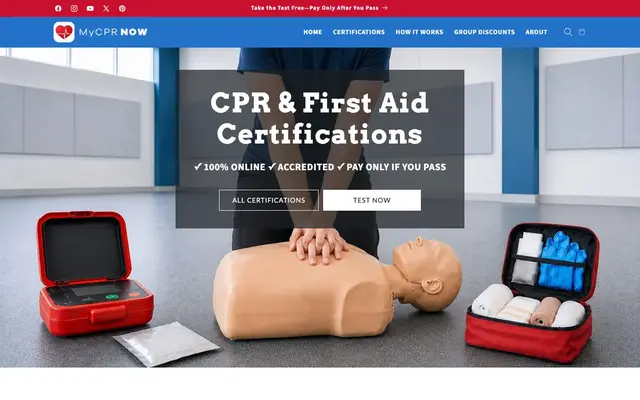
- MyCPR NOW: online CPR from $29.99 on our last check, if your employer accepts online-only.
- American Health Care Academy: the cheapest we list, from $9.95.
- Advanced Medical Certification: from $119, aimed at healthcare workers who need BLS, ACLS or PALS together.
See all of them in our CPR and first aid certification rankings.
Swipe sideways to compare all 4 programs →
| Criterion | This review | |||
|---|---|---|---|---|
| Our score | 8.8/10 | 8.6/10 | 8.5/10 | 8.5/10 |
| Price | $39.95 – $160 | $119 – $1,498 | $9.95 – $119 | $24.99 – $34.99 |
| Format | Self-paced | Self-paced | Self-paced | Self-paced |
| Duration | Video courses from 1 h 35 min (adult CPR) to 5 h 33 min (Healthcare BLS + First Aid); SUMO evaluation 30 to 45 minutes over Zoom; certificate valid 2 years | Self-paced online; free training materials, exam with unlimited retakes | Online, self-paced; CEUs of 2.0-6.0 available depending on course. | CPR Test Center says its CPR and BLS programs can be completed in 30 minutes or less; the CPR course is 21 pages of text. Certificates last 2 years. |
| Accreditation | Follows AHA and ECC/ILCOR guidelines; approved by hundreds of state and health boards (per ProCPR); accredited continuing education available. | Accredited for up to 8 AMA PRA Category 1 Credits via the Postgraduate Institute for Medicine (PIM) | "Accredited by 100+ Boards" (per the site); the site notes there is no national government body that accredits CPR certification. | Lists the eCPRVerify National Registry as its accreditor (the registry itself names American Heart Association, American Red Cross and CPR Test Center as approved providers) and says it is an approved CPR/AED provider for the National Exercise Trainers Association. Not an American Heart Association or Red Cross course. |
| Free trial | — | Free online training materials and practice test before paying for certification | Free CPR class online. | No |
| Best for | Workers who need a CPR, first aid or BLS card quickly, at home, and want the option of a remote hands-on skills check if their employer requires one. | Clinicians renewing ACLS, PALS or BLS whose employer accepts non-AHA online cards, and who want CME credits with it. | People who need an inexpensive online CPR, First Aid, BLS or ACLS card quickly and whose employer accepts online-only training. | Workers whose employer accepts an online-only CPR card (childcare, coaching, hospitality, security) and want the cheapest quick renewal, plus personal trainers covered by NETA. |
| Read more | You are here | Advanced Medical Certification reviewHead-to-head → | American Health Care Academy (cpraedcourse.com) reviewHead-to-head → | CPR Test Center review |


“—” means the information was not published or not yet checked. See all 6 CPR & first aid certification programs.
Before you start
Email HR one question: “Do you accept online CPR from ProTrainings, and do you require a hands-on skills check?” Attach ProCPR’s compliance packet. The answer tells you whether you need the $39.95 course, the SUMO version, or an AHA class, and saves you from paying twice.
Score breakdown
Guideline-based video courses in two languages.
Board approvals and compliance documentation.
From $39.95 with 2-year validity.
Self-paced online with optional skills check.
Compliance resources and support.
Weighted average of five criteria. Read our methodology.
FAQ
Is ProCPR legit and accepted by employers?
It's widely used, and ProCPR says its courses follow AHA and ECC/ILCOR guidelines and are approved by hundreds of state and health boards; you can download its compliance packet. Still, ask your employer first: some require an AHA or Red Cross card, or a hands-on skills check.
How much does ProCPR cost?
$39.95 for CPR, CPR + First Aid or First Aid, and $59.95 for Healthcare BLS, on October 30, 2026. With the SUMO hands-on kit, the listed prices rise to between $99.90 and $159.90 depending on the course.
How long does ProCPR take?
From about an hour and a half (adult CPR) to five and a half hours (Healthcare BLS + First Aid) of video, plus a short test. If you add SUMO, wait for the kit by mail, then book a 30 to 45 minute Zoom evaluation.
Head-to-head comparisons
Sources
Prices and offers can change; confirm on the official site before you enroll.