On this page · 14 sections5 min read
- 01Our verdict
- 02At a glance
- 03Pros & cons
- 04Six parts, from dogs to people
- 05A mentor in your corner
- 06Online Track or Externship Track
- 07Who it suits, and who it doesn’t
- 08Time and money
- 09The catch: QC’s credential, not an independent one
- 10Cheaper options and different goals
- 11Before you enroll
- 12QC Pet Studies (QC Career School) vs alternatives
- 13Score breakdown
- 14FAQ
Our verdict
Our verdict8.6/10Worth it if you want to turn a love of dogs into paid work as a trainer and you'd like a structured course with a mentor reviewing your assignments: QC's online dog training course was $2,098 paid in full on October 30, 2026, covers behavior, learning theory and how to coach owners, and ends with the IDTP designation.
Owners who only want to fix their own dog's leash pulling should buy a $50 video course instead. The catch: the IDTP is QC's own credential, so if you want the independent CCPDT certification, you'll still need its hours and exam on top.
Best for: Aspiring dog trainers who want a structured, humane-methods course with mentor feedback and help starting a business.
At a glance
Bicycles used to set your rescue off, every single one. Today he walks past them on a loose leash, and it took eight months of reading, videos and stubborn practice to get there. Now the neighbors ask how you did it. Some of them would pay you to do it with their dog. QC Pet Studies, part of the distance-learning school QC Career School, sells an online dog training course for people who want to make that a job.
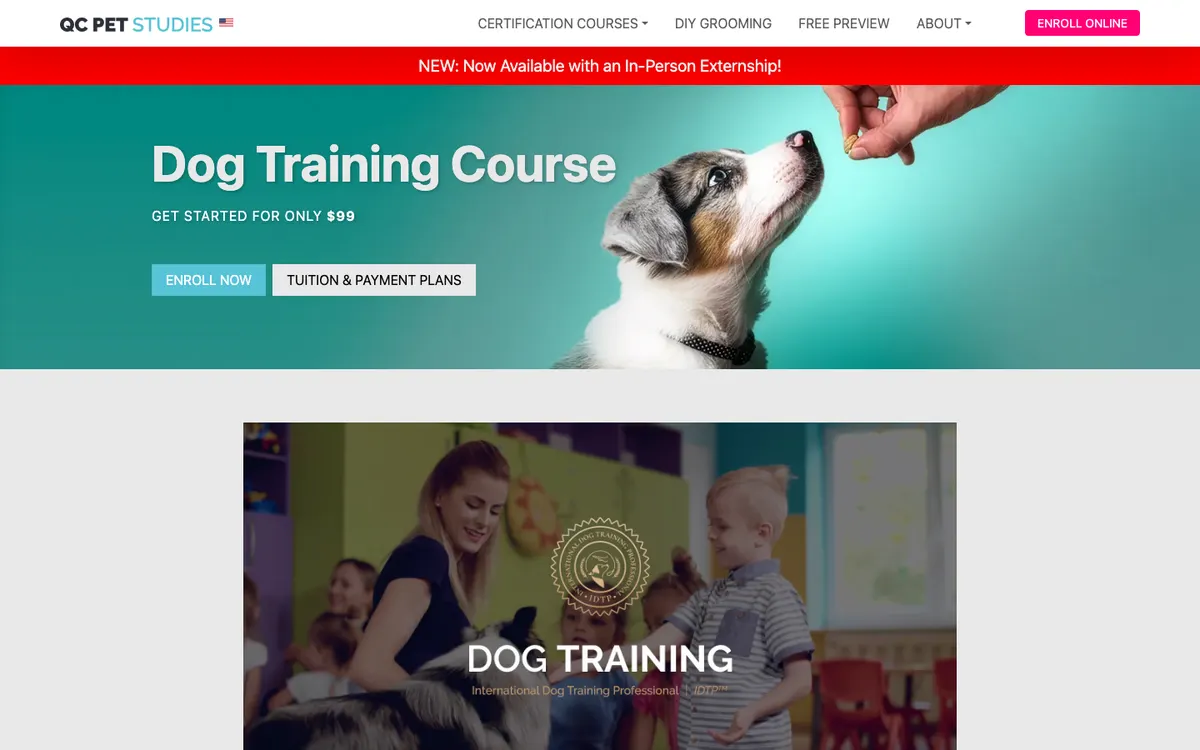
The course leads to QC’s International Dog Training Professional (IDTP) designation. On October 30, 2026, the Online Track was $2,098 paid in full, or a $99 deposit plus 18 monthly payments of $133.27 ($2,498 in total). A new Externship Track, which adds supervised in-person experience, was $3,448 paid in full.
How we reviewed it: we read the course page, its outline and FAQ, and the tuition section on October 30, 2026, and compared QC with the other dog trainer programs on our site. We haven’t taken the course.
Some links on this site earn us a commission if you enroll. Your price stays the same. Our rankings are based on our editorial criteria; some partners may be featured more prominently. How we review
Pros & cons
- Covers the dog and the human side: behavior, learning theory, and teaching owners to train their own dogs
- One-on-one mentor feedback on your assignments
- New Externship Track adds supervised in-person experience
- Up to a year to finish, with a 14-day full refund window and lifetime certification without renewal fees
- The IDTP is QC's own designation, not the independent CCPDT certification many trainers aim for
- Paying monthly costs $400 more than paying in full ($2,498 vs $2,098)
- On the Online Track, all hands-on practice is with dogs you find yourself
Six parts, from dogs to people
QC splits the course into six parts. It starts where it should, with the dog: breed types, how dogs communicate with each other and with us, calming signals and fear responses, stages of development and socialization, normal and abnormal behavior, and how dogs actually learn.
The second part applies that through learning theory: classical and operant conditioning, luring, shaping, targeting, capturing, reinforcement schedules, training tools, and how to address unwanted behavior. The methods are science-based and humane, built on positive reinforcement.
Then comes a part many cheaper courses skip: teaching people. As a trainer, you’ll spend most sessions coaching an owner, not the dog. Explaining why the treat has to come within a second, without making a tired parent feel judged, is a skill, and QC treats it as one.
A mentor in your corner
You don’t work alone. A mentor reviews your assignments and sends feedback. That turns “I think I’m doing this right” into specific corrections from someone who trains dogs for a living. Picture practicing a sit-stay with a friend’s young Lab for an assignment, sending in your work, and getting notes on your timing a few days later. That’s the loop that builds skill.
QC also runs a virtual community with mentors and other students, and free webinars with pet care experts.
Online Track or Externship Track
The Online Track is enough if you have access to several dogs (your own, friends’, a shelter where you volunteer) and you’re comfortable organizing your own practice.
The Externship Track costs $1,350 more paid in full ($3,448). It adds an unpaid placement where you log hours and get feedback from a host business. If you have no network in the dog world, that placement can be worth more than the coursework: it’s experience to put on a website and, often, a first reference. Ask QC how externship hosts are found in your area before choosing it.
Who it suits, and who it doesn’t
It suits someone who wants to work with dogs as a business: puppy classes at a local pet store, private sessions in clients’ homes, or a role at a daycare or boarding facility, which QC lists among the career paths. It suits a vet tech, groomer or shelter worker who handles dogs every day and wants the training side on paper.
It doesn’t suit an owner with one difficult dog. Spending $2,098 to fix your own dog’s jumping is a costly detour; a local trainer for six sessions is cheaper and faster. And if your dog shows serious aggression, that’s a job for a veterinary behaviorist, not a course.
Time and money
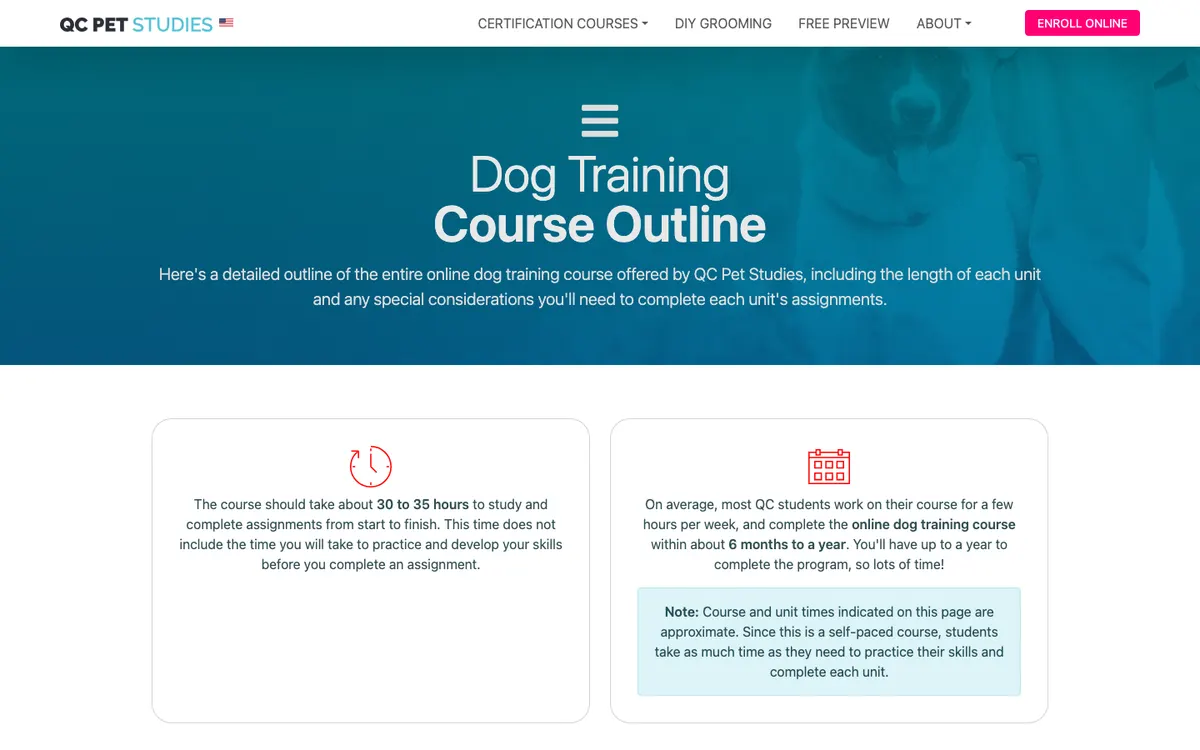
You have up to a year to finish. QC says you can complete the course and start booking clients within about three months. More realistically, with a full-time job, plan on five or six months of evenings and weekend practice sessions.
Pay in full if you can: it saves $400 on the Online Track. QC also offers a 14-day guarantee: you get 14 days to review the materials, and if the course isn’t for you, you contact them for a full refund. Your certification doesn’t expire and has no renewal fees.
The catch: QC’s credential, not an independent one
Dog training isn’t licensed in the US, so anyone can call themselves a trainer. That’s why credentials matter for trust. The IDTP is QC’s own designation. It shows a client you’ve completed structured training with a mentor, which is real, but it isn’t the CCPDT certification that many experienced trainers hold. CCPDT requires logged training hours and a separate exam.
A practical route many trainers take: use a course like QC’s to learn and get started, log your hours with clients, then sit an independent certification later. Plan for that if you want to work with behavior cases or alongside veterinarians.
Cheaper options and different goals
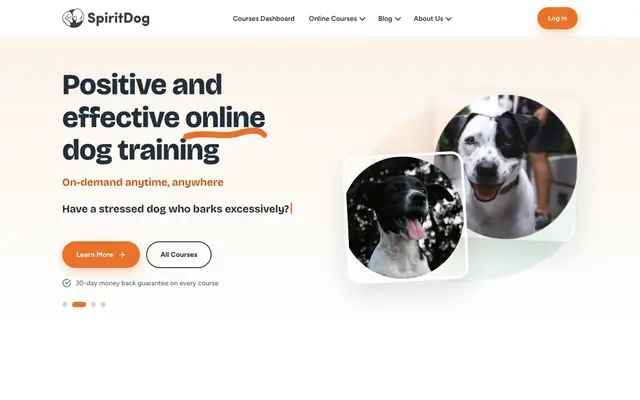
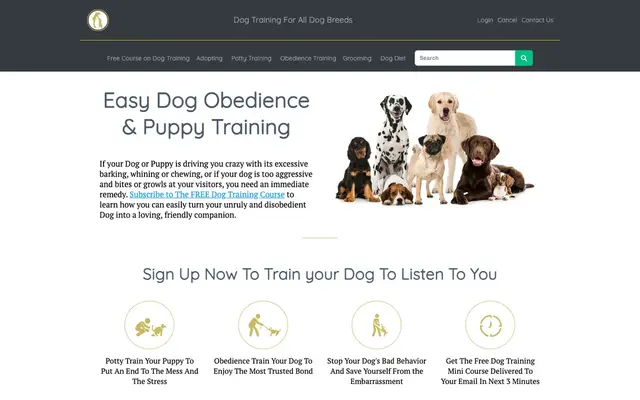
If you’re curious about a career but not ready to spend $2,000, the British College of Canine Studies sells CPD-accredited home-study diplomas, on sale from about $130 to $398 on our last check. If you only want to train your own dog, video courses like Success Dogs ($49.95 per course on our last check) or SpiritDog Training for leash reactivity cost a fraction of the price.
QC Pet Studies also teaches dog grooming. If grooming is the job you’re after, compare it with the grooming schools in our pet grooming courses ranking.
All the trainer programs are compared in our dog trainer certification ranking.
Before you enroll
Line up your practice dogs first: write down five dogs you could work with over the next three months. If you can’t find five, the Externship Track or volunteering at a shelter should come before the course. Then enroll when you can start right away, so the first assignments land inside the 14-day refund window.
14-day guarantee: review the course materials for 14 days and contact QC for a full refund if the course isn't right for you.
Pay in full, or a $99 deposit plus 18 monthly payments ($133.27 Online Track, $197.16 Externship Track)
No public discount was listed on the official site when we checked. We never publish unverified coupon codes.
QC Pet Studies (QC Career School) vs alternatives
How QC Pet Studies (QC Career School) stacks up against other dog training programs we reviewed, on the facts published by each provider.
Swipe sideways to compare all 4 programs →
| Criterion | This review | |||
|---|---|---|---|---|
| Our score | 8.6/10 | 8.5/10 | 8.4/10 | 8.4/10 |
| Price | $2,098 – $3,648 | $132 – $801 | — | $49.95 |
| Format | Self-paced | Self-paced | Self-paced | Self-paced |
| Duration | Self-paced, up to one year; QC says you can finish and start booking clients within about three months | Self-paced home study, about one unit a week on average; two years to finish from enrollment, extendable for GBP 50 a year | Self-paced: 7 modules with 21+ games, 7 trick videos and a bonus behavior course; online member's area | 25 to 37 short video lessons per course, with lifetime access; the school says a few minutes a day |
| Accreditation | — | Internationally accredited and CPD courses (per the college). | — | — |
| Best for | Aspiring dog trainers who want a structured, humane-methods course with mentor feedback and help starting a business. | Shelter volunteers, dog walkers and vet techs who want affordable, tutor-marked dog training or behaviour theory by home study. | owners of smart, under-occupied dogs who want short, force-free games and obedience exercises to do at home, from a certified trainer, at a one-time price. | pet owners with a puller, a new puppy or a bored dog who want short, positive-reinforcement video lessons for $49.95, with lifetime access. |
| Read more | You are here | British College of Canine Studies reviewHead-to-head → | Brain Training for Dogs reviewHead-to-head → | Success Dogs review |



“—” means the information was not published or not yet checked. See all 7 dog training programs.
Score breakdown
Structured dog-training curriculum with practical assignments.
BBB-accredited distance school; private credential.
About $2,100-$2,500 total.
Self-paced online.
One-on-one expert feedback.
Weighted average of five criteria. Read our methodology.
FAQ
How much does the QC Pet Studies dog training course cost?
On October 30, 2026, the Online Track was $2,098 paid in full, or a $99 deposit plus 18 monthly payments of $133.27 ($2,498 in total). The Externship Track, which adds in-person experience, was $3,448 paid in full or $3,648 on installments.
How long does QC's dog training course take?
You have up to a year. QC says students can complete it and start booking clients within about three months if they study steadily.
Is QC Pet Studies dog training certification recognized?
It gives you QC's International Dog Training Professional (IDTP) designation, which doesn't expire. Dog training isn't licensed in the US, but the independent CCPDT certification is the one many experienced trainers hold, and it requires logged training hours and an exam.
Head-to-head comparisons
Sources
Prices and offers can change; confirm on the official site before you enroll.