On this page · 15 sections5 min read
- 01Our verdict
- 02At a glance
- 03Pros & cons
- 04What you’ll learn
- 05Format, schedule and time commitment
- 06Accreditation and what the credential is worth
- 07Price, payment plans and refunds
- 08Who it’s best for — and who should skip it
- 09Pros and cons in detail
- 10How it compares
- 11School of Stitched Textiles vs alternatives
- 12How to enroll
- 13Score breakdown
- 14Key facts
- 15FAQ
Our verdict
Our verdict8.9/10The School of Stitched Textiles is a UK distance-learning school and one of the few worldwide offering City & Guilds accredited textile courses, which are respected internationally for their assessment standards.
Programs in embroidery, crochet, patchwork and quilting, stumpwork and related crafts are divided into progressive skill stages and can take up to one or two years each, studied at your own pace from anywhere. Beginner craft courses are available for those not ready for accredited study. Enrollment is unusual: it opens only every three to four months, by invitation to people who registered interest. Prices were not shown on the homepage. It suits dedicated textile artists seeking a formal qualification.
Best for: Serious textile artists who want an internationally recognized City & Guilds qualification by distance learning.
At a glance
School of Stitched Textiles is a UK distance-learning provider offering beginner craft courses, City & Guilds accredited textile courses, and advanced study. Its strongest appeal is a progressive, assessed route for textile artists who want more structure than a project video library. Online study is flexible, but entry to the accredited courses follows enrollment windows. It is a strong shortlist option for committed textile study, with tuition and the exact award still requiring course-level verification.
Pros & cons
- City & Guilds accredited distance-learning courses
- Embroidery, crochet, patchwork and quilting, stumpwork and more
- Study at your own pace from anywhere
- Progressive skill stages up to advanced
- Enrollment opens only every 3-4 months to registered-interest students
- UK-based, prices not shown on the homepage
What you’ll learn
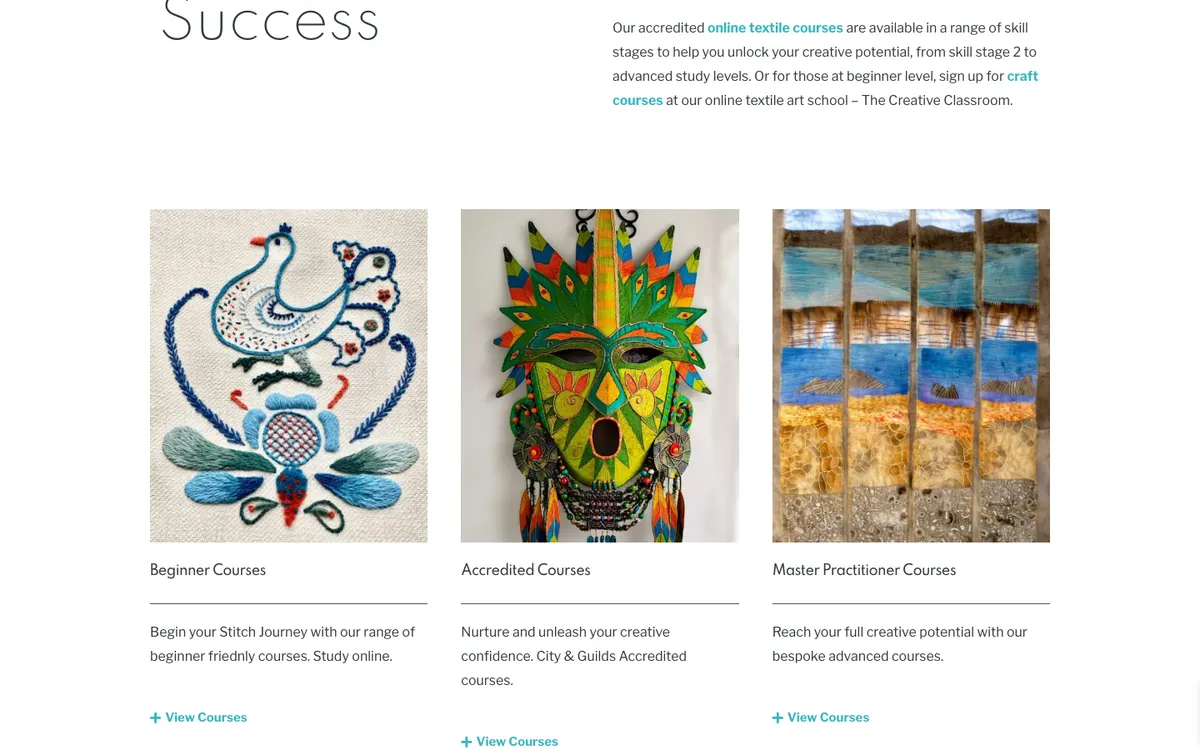
The official course directory includes hand knitting, crochet, patchwork and quilting, hand embroidery, machine embroidery, stumpwork, felt, and textiles. Subjects are divided into skill stages rather than collected as unrelated tutorials. The available stages vary by discipline, so selecting a subject and selecting a level are separate decisions.
The school distinguishes beginner learning through its Creative Classroom from accredited study beginning at skill stage 2. It also lists Master Practitioner courses separately. A new learner should use those distinctions to find an appropriate starting point instead of assuming that the most advanced-sounding title is the best purchase.
Format, schedule and time commitment
The course directory gives durations of up to one or two years for the listed textile pathways, depending on the course. This is substantially different from following a short quilting project over a weekend. Distance learning provides flexibility in where and when you study, but the course’s assessment and completion conditions still need to be understood.
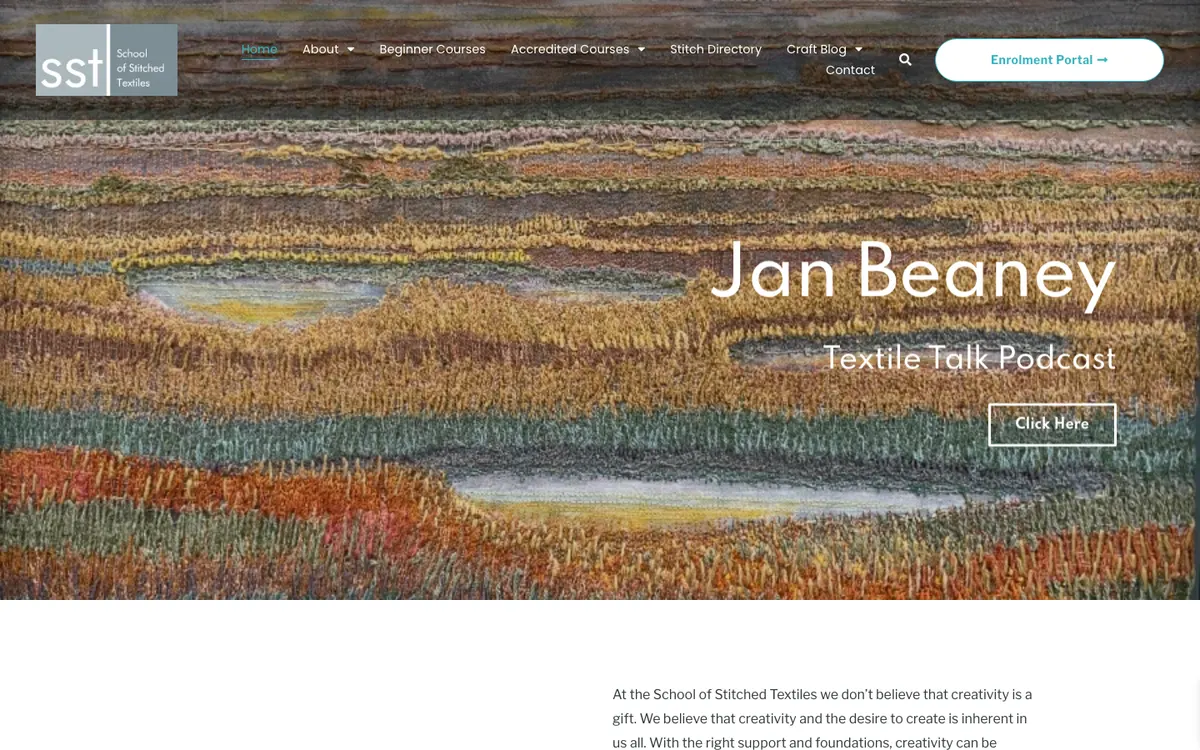
The homepage says new-student enrollment opens every three to four months and invitations go to people who have registered interest. Its homepage banner refers to October 24, while other page elements also use enrollment-day language. Verify the active window directly rather than treating every banner as proof that enrollment is open today.
Video: School of Stitched Textiles
Accreditation and what the credential is worth
The school states that its accredited textile courses have City & Guilds accreditation. That is a more specific credential claim than a general completion certificate from a craft-content website. However, the public course pages do not provide enough detail to assert US academic credit equivalence or universal employer acceptance.
The directory separately describes advanced bespoke courses as certificated by the School of Stitched Textiles. Do not transfer the City & Guilds claim to every course simply because it appears on the same site. Ask for the exact qualification or certificate title, issuing organization, assessment requirements, and documentation attached to your chosen subject and stage.
Price, payment plans and refunds
The homepage and course directory do not establish a current tuition amount. A Payment Options link exists, but its presence alone does not verify an installment schedule, interest terms, or total cost. Obtain the course brochure and the actual offer before budgeting for the program.
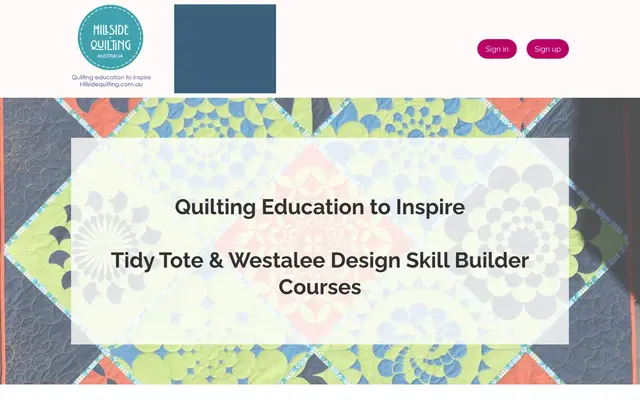
Hillside Quilting’s individual Australian-dollar project prices provide a useful contrast in scale and purpose, not a like-for-like qualification price. A longer assessed textile pathway and a short ruler-work lesson purchase different kinds of support and structure. Also confirm required materials, any submission expenses, and the refund policy rather than assuming they are covered by tuition.
Who it’s best for — and who should skip it
This school is best suited to someone who wants a sustained textile practice with progressive expectations and an identified accreditation route. It is especially relevant when the subject is embroidery, knitting, crochet, or another discipline explicitly listed in the directory. A learner who values assessment may prefer that structure to an ungraded membership.
Skip the accredited route if you only want one quick project or cannot commit to the course’s completion conditions. Beginners should consider the separate introductory offerings before selecting an advanced stage. US buyers who need a particular institutional recognition should settle that acceptance question before treating the UK credential as equivalent.
Pros and cons in detail
The main strengths are the breadth of textile disciplines and the staged progression within them. Distance delivery makes the courses accessible without relocating, while the City & Guilds claim gives buyers a specific credential question to investigate. The beginner and advanced pathways also make it possible to distinguish different ambitions within the same school.
The enrollment-window system is less convenient than immediate access to a video course. Price visibility is another limitation, particularly for a US shopper comparing international providers. Finally, the credential labeling requires care: accredited pathways and school-issued advanced certificates are distinct offers, and the most suitable choice depends on the exact learning and recognition goal.
How it compares
Hillside Quilting is the only other provider in our sewing category. Domestika offers a useful adjacent comparison between individual creative projects and a staged textile qualification. Neither alternative is presented as granting the City & Guilds award associated with the school’s accredited pathways.
Hillside Quilting Online Courses teaches ruler work and free-motion machine quilting with Westalee design templates. Anita Ellis leads self-paced videos with downloadable PDF patterns; one example contains 3 hours of video. Course examples cost A$30–A$65, and the Skill Builder Set bundle is A$100 against an A$120 list price. Plans of $15/$49/$65 are also reported, so establish which offer and currency apply before buying. The Hillside comparison distinguishes this niche project instruction from a longer assessed textile pathway.
Domestika Courses & Domestika Plus gives hobbyists and professionals access to working artists’ illustration, design, craft, and photography projects. Its self-paced video catalog adds 100-plus courses weekly, with teaching depth and production varying across instructors. Plus offers teacher-signed course certificates, displaying $13.79 per month on annual billing, $164.50 for the first year, and $329 at renewal. Alternatively, monthly Plus costs $33.90, and separate course purchases are available. Those completion certificates should be evaluated separately from the school’s specific accreditation claim.
Find the textile-focused options in Sewing & Textiles. The review methodology explains our attention to curriculum, recognition, total cost, flexibility, and support when comparing a sustained course with a project library.
School of Stitched Textiles vs alternatives
How School of Stitched Textiles stacks up against other sewing & textiles programs we reviewed, on the facts published by each provider.
| Criterion | This review | |
|---|---|---|
| Our score | 8.9/10 | 8.3/10 |
| Format | Self-paced | Self-paced |
| Duration | Up to 1-2 years per course, in progressive skill stages. | Video lessons with PDF patterns (e.g., 3 hours of video). |
| Accreditation | City & Guilds accredited textile courses. | — |
| Best for | Serious textile artists who want an internationally recognized City & Guilds… | Quilters who want ruler-work and free-motion quilting lessons using Westalee design… |
| Read more | You are here | Hillside Quilting reviewHead-to-head → |

“—” means the information was not published or not yet checked. See all 2 sewing & textiles programs.
How to enroll
Use Register Your Interest on the school site to select the subject and indicate your current level. The school says this provides a course brochure and an invitation to enrollment day. Read the brochure for the specific stage instead of relying solely on the general homepage.
Before accepting an enrollment offer, verify the total tuition, currency, payment schedule, materials, assessment process, completion limit, and cancellation terms. Ask which organization issues the final award. Confirm the current enrollment date directly, especially when the homepage contains both future-date and enrollment-day messages.
Score breakdown
Progressive City & Guilds textile curriculum.
City & Guilds accreditation.
Prices not shown; multi-year commitment.
Distance learning at your own pace.
Tutor assessment within accredited courses.
Weighted average of five criteria. Read our methodology.
Key facts
FAQ
Are the courses accredited?
Yes, the school offers City & Guilds accredited textile courses.
When can I enroll?
Enrollment opens every 3-4 months, by invitation to those who registered interest.
Head-to-head comparisons
Sources
Information checked on October 5, 2026. Prices and offers can change; confirm on the official site.