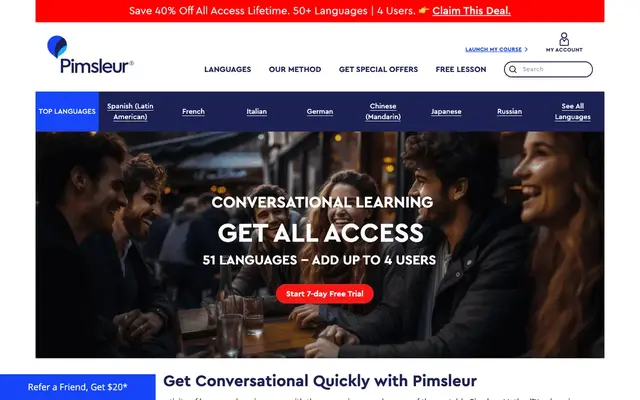

Pimsleur All Access
8.8/10Editorial score
- Price
- $20.95/mo or $164.95/yr (All Access)
- Best for
- Commuters who want to speak, not just recognize words.
Pimsleur is the better choice if your goal is to speak and understand: 30-minute audio lessons you answer out loud, usable hands-free. Rosetta Stone suits visual learners who want to read and see the language, at almost the same yearly price.
Choose Pimsleur if…your priority is speaking and listening, you have commute or walking time to fill, and you want 51 languages you can share with up to 3 household members.
 Choose Rosetta Stone if…
you learn better by seeing pictures and words on a screen, want reading and pronunciation practice in the same app, and like a 14-day money-back window.
What tips the choicewhere you will study. If your practice time is in the car, on a walk or while cooking, Pimsleur fits it and Rosetta Stone does not. If you will sit with your phone or laptop, Rosetta Stone's visual method gives you more to read and see for about the same yearly price.
We may earn a commission when you buy through links on this page. Our rankings are based on our editorial criteria; some partners may be featured more prominently. Affiliate disclosure.
| Criterion | Pimsleur | Rosetta Stone |
|---|---|---|
| Editorial scoreWeighted average of our five criteria | 8.8/10Higher score | 8.5/10 |
| PriceAs published on the official site | All Access (51 languages): $20.95 a month or $164.95 a year; Premium (one language): $19.95 a month (as of October 13, 2026) | $19.99 a month billed monthly, or $159 billed yearly ($13.25 a month), as of October 13, 2026Lower starting price |
| Payment plansHow the cost can be spread | Monthly or annual subscription; lifetime purchases offered per language | Billed monthly ($19.99) or yearly ($159); one subscription covers all 25 languages |
| FormatHow you study | App | App |
| DurationTime to finish or access period | Subscription. | Subscription. |
| Free trialWays to test before paying | 7-day free trial for new customers; cancel before it ends to avoid being charged | Not published |
| Refund policyYour way out if it is not a fit | No refunds on subscription charges; digital products bought outright have a 30-day money-back guarantee | 14 days from purchase for purchases made directly from Rosetta Stone (Terms of Service, July 28, 2026); no prorated refund after cancelling |
| Best forWho it suits | commuters and travelers who want to speak and understand everyday phrases, and who have 30 minutes a day with their hands busy and their ears free. | Visual, patient learners who want to build an ear and an accent through immersion, especially in more than one language on the same subscription. |
“Not published” means the provider did not state it or we could not confirm it. Program data checked October 5, 2026. Comparison updated October 13, 2026.
Pimsleur: Proven audio-based conversational method. · Rosetta Stone: Immersion method with speech recognition.
Pimsleur: Long-established language brand. · Rosetta Stone: Long-established language brand.
Pimsleur: Free trial and group discounts; price unverified. · Rosetta Stone: $159/year.
Pimsleur: Audio lessons usable anywhere. · Rosetta Stone: App-based.
Pimsleur: Self-study app. · Rosetta Stone: Self-study app.
Scores out of 10 from our published method; the overall score is the weighted average.
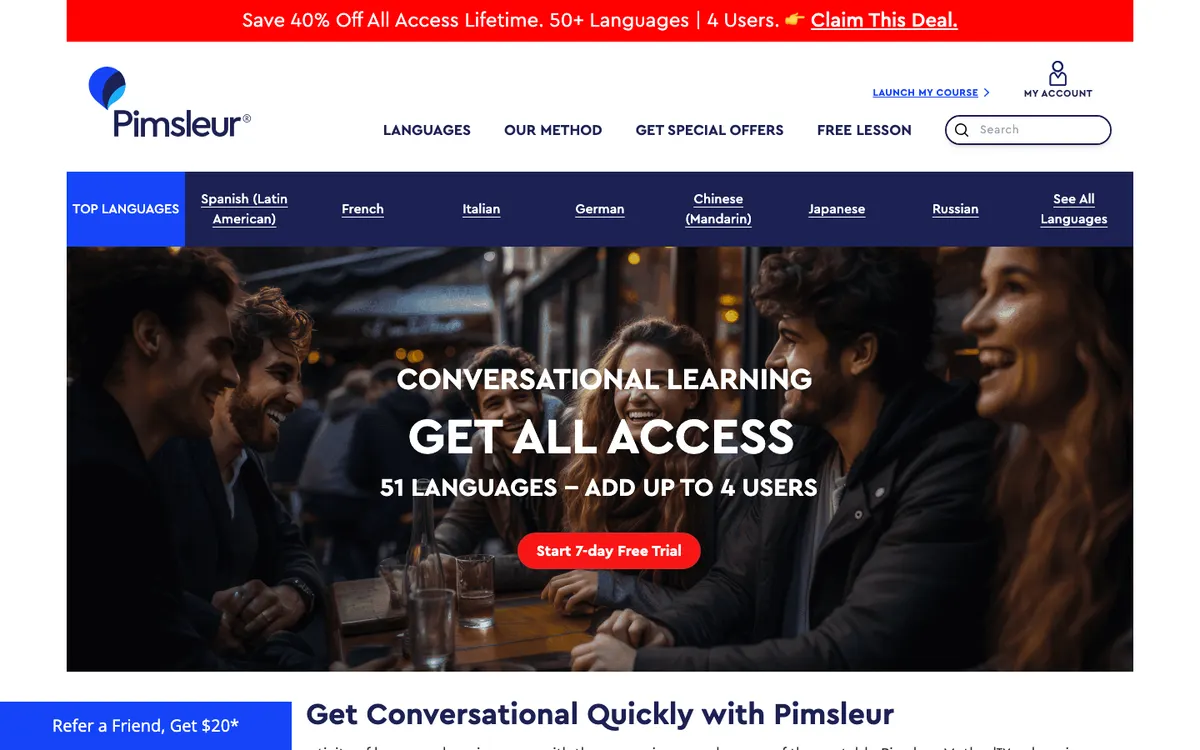
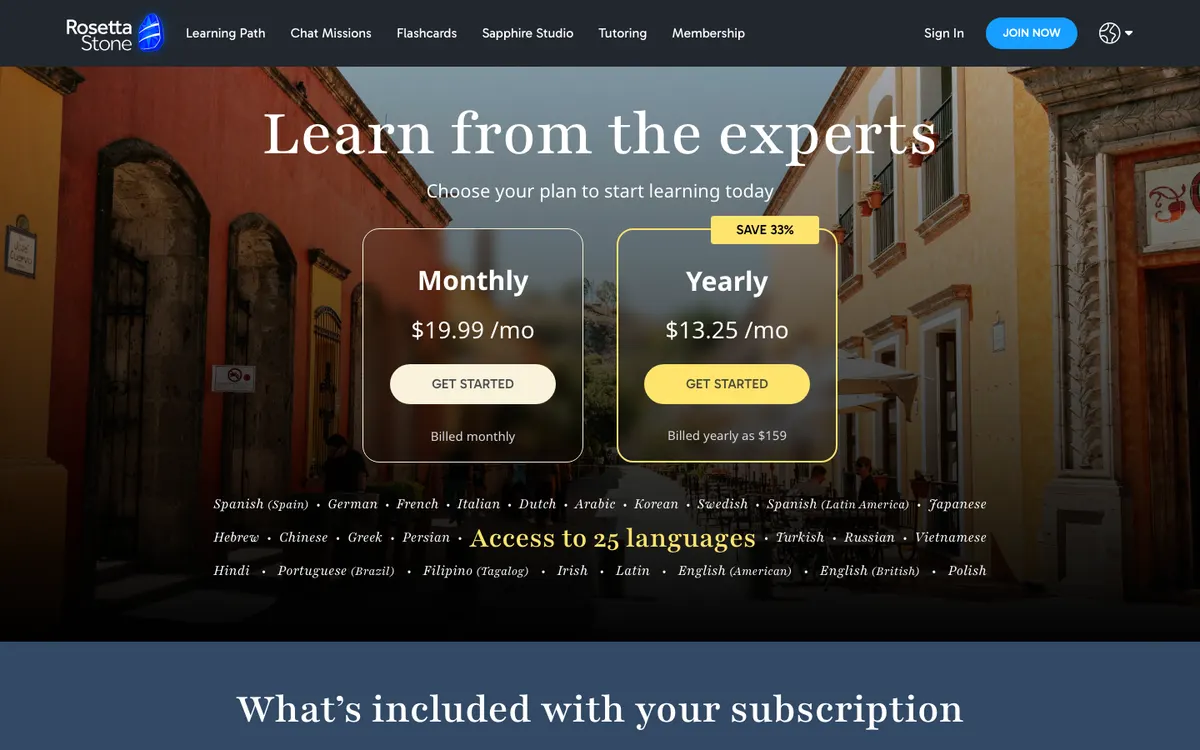
The two cost almost the same, but they package it differently. When we checked on October 13, 2026, Pimsleur sold All Access, which includes 51 languages, at $20.95 a month or $164.95 a year. Its single-language Premium plan cost $19.95 a month. Rosetta Stone’s subscription, which includes its 25 languages, cost $19.99 a month or $159 billed yearly.
| What you pay for | Pimsleur | Rosetta Stone |
|---|---|---|
| One month | $19.95 (one language) or $20.95 (51 languages) | $19.99 (25 languages) |
| One year | $164.95 (All Access) | $159 |
| People included | Up to 4 (you plus 3 household members) | One individual subscription |
Rosetta Stone’s year is $5.95 cheaper. Pimsleur’s covers more languages and can be shared at home, which changes the math for a couple or a family. Pimsleur also sells lifetime access to a single language, and a time-limited banner advertised 40% off All Access Lifetime when we checked; the lifetime price itself was not shown on the pages we read.
WinnerTie. Rosetta Stone is slightly cheaper for one person; Pimsleur is better value if you share it.
Neither app teaches grammar the classic way, but they replace it differently.
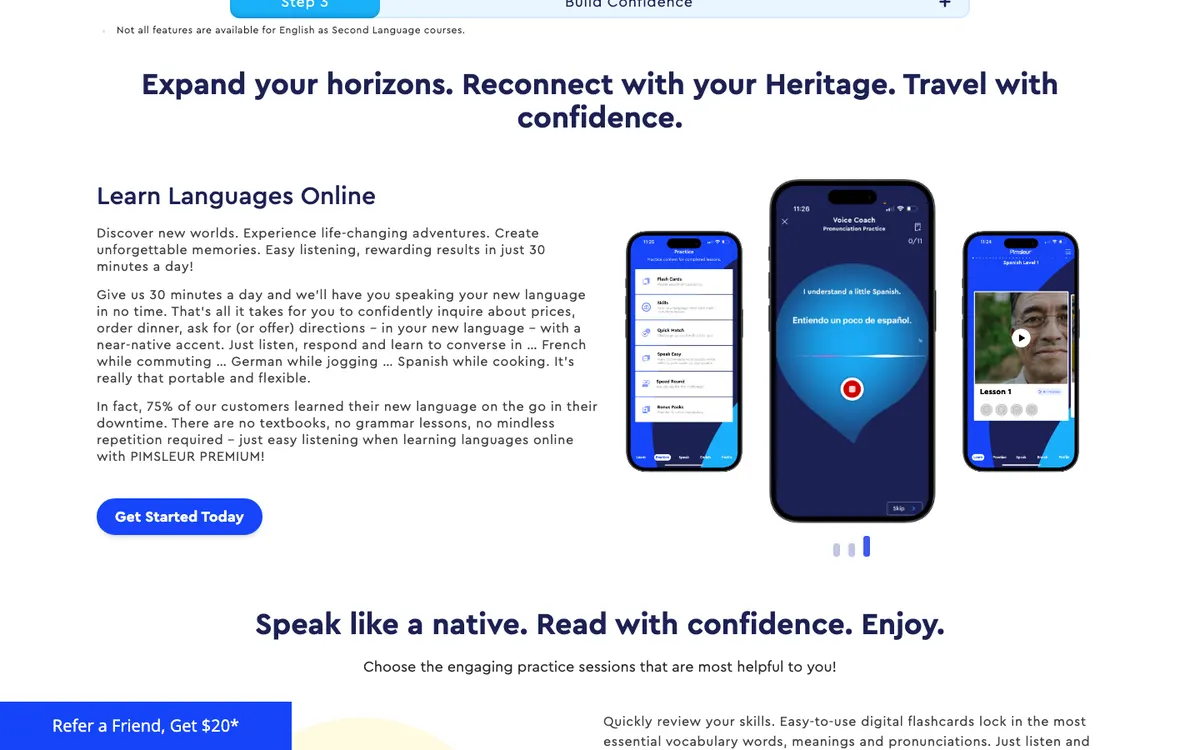
Pimsleur is audio-first. Each core lesson lasts 30 minutes: you hear a phrase, are prompted to answer aloud, and the lesson brings the phrase back at spaced intervals so it moves into long-term memory. Pimsleur states plainly that there are “no textbooks, no grammar lessons”. Around that core, the app adds shorter lessons, reading lessons for sound-letter recognition, Speak Easy role-play transcripts, flashcards and Voice Coach, which gives pronunciation feedback.
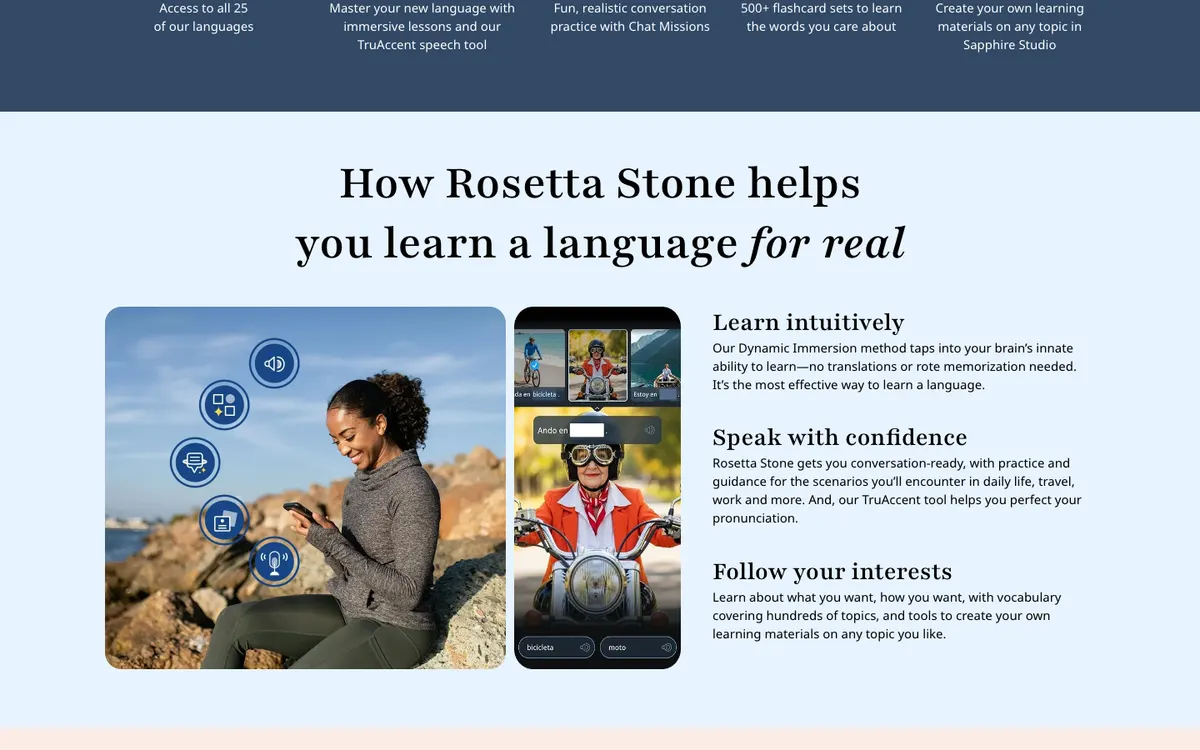
Rosetta Stone’s Dynamic Immersion method teaches through pictures, audio and written words with no translation. You work out meaning from context, then say it aloud while TruAccent checks your pronunciation. It is a visual method, and it puts more written language in front of you from the start.
If your goal is holding a spoken conversation, Pimsleur trains exactly that: recall under time pressure, out loud. That is why it scores 8.9/10 on curriculum against 8.4/10.
WinnerPimsleur.
Both are long-established names, and neither gives you an accredited language qualification.
Pimsleur says its method is used by the FBI, the State Department, the Marine Corps and the Navy, among others; that is the company’s own claim. If you score well in every Voice Coach lesson, you earn a Pimsleur certificate of proficiency, which is a provider-issued reward rather than an independent test. Rosetta Stone is part of the IXL Learning family of brands and has decades of history in language software. Its tutors are described as Rosetta Stone-certified, which is a description of the tutor, not something you earn.
If a school or employer needs proof of your level, plan to sit an external exam whichever app you use. Our credibility scores: 9.5/10 for Pimsleur, 8.9/10 for Rosetta Stone.
WinnerPimsleur.
Both are self-paced and both score 9.5/10 on flexibility, but they fit different parts of your day.
Pimsleur is built for time when your eyes are busy. Lessons download for offline use, the app has a hands-free driving mode for Apple CarPlay and Android Auto, and it works with Amazon Echo devices. The catch: it only works if you actually speak back, so a crowded train is a poor setting.
Rosetta Stone needs your attention on a screen. In exchange you get more variety: Chat Missions for scenario practice, more than 500 flashcard sets and Sapphire Studio for building material on topics you choose. Its buy page also separates Spanish from Spain and Latin American Spanish, so check you pick the variety you need.
WinnerTie. Pick the one that fits the time you actually have.
Here the two protect you in opposite ways. Pimsleur gives new customers a 7-day free trial with access to every lesson in the plan. After that, its FAQ is strict: no refunds on subscription charges, including unused parts of a term, so cancel before the trial or the next billing date. You can pause a subscription for one or two months instead of cancelling. Lessons bought outright as digital products fall under a 30-day money-back guarantee.
Rosetta Stone does not advertise a free trial on its buy page, though its homepage links to a sample lesson. Its Terms of Service, updated July 28, 2026, let you return a direct purchase within 14 days for a refund; tutoring add-ons are excluded, and cancelling later stops renewal without a prorated refund.
Both are self-study apps with no human teacher in the base plan, and both score 7.3/10 on support.
WinnerTie. Pimsleur lets you try free; Rosetta Stone lets you get your money back.
PimsleurRosetta StonePick PimsleurPimsleur's lessons are 30 minutes of listening and answering aloud, with offline playback and a CarPlay and Android Auto driving mode. Rosetta Stone's lessons need you to look at a screen.
Pick PimsleurAll Access lets you add up to 3 household members and switch between 51 languages. Rosetta Stone's buy page sells an individual subscription.
Pick Rosetta StoneRosetta Stone teaches through images, written words and audio, with 500+ flashcard sets. Pimsleur adds reading lessons, but its core is audio and it says it uses no textbooks.
Other language learning options we reviewed, ranked by editorial score.

Learners who want regular one-on-one speaking practice and are willing to try a few tutors to find the right one.

Travelers, heritage learners and anyone who needs key words and phrases in a less common language, at the lowest yearly price in this ranking.
Adults who want short, structured lessons with clear grammar explanations, for travel, work or a move abroad.
For speaking, yes. Pimsleur scores 8.8/10 against 8.5/10 in our review, ahead on curriculum and credibility and tied on value, flexibility and support. Rosetta Stone is the better fit if you learn visually and want to read the language from the start.
They are close. On October 13, 2026, Rosetta Stone cost $159 a year or $19.99 a month; Pimsleur All Access cost $164.95 a year or $20.95 a month, and single-language Premium $19.95 a month. Pimsleur includes 51 languages and up to 4 users; Rosetta Stone includes 25 languages.
Neither uses grammar lessons in the classic sense. Pimsleur says it has no textbooks and no grammar lessons: you absorb structure by listening and answering. Rosetta Stone teaches through pictures and context without translation. If you want rules explained, look at an app like Babbel.
Pimsleur offers a 7-day free trial to new customers, with access to all lessons in your plan; you must cancel before it ends to avoid a charge. Rosetta Stone's homepage links to a sample lesson, and its terms allow a refund within 14 days of a direct purchase.
Not on subscriptions. Pimsleur's FAQ says it cannot refund subscription charges or any unused part of a term, so cancel before the trial or the next billing date. Digital products bought outright fall under its 30-day money-back guarantee.
Yes. Once lessons are downloaded, Pimsleur says you do not need an internet connection to play them, and its apps include a hands-free driving mode for Apple CarPlay and Android Auto.
We score each program on curriculum, credibility, value, flexibility and support, using the provider’s official pages; see how we score. The comparison above was written from these sources and re-checked against the official sites on October 13, 2026. Prices and terms change: confirm them on the official site before you enroll.
PimsleurChecked October 5, 2026
We may earn a commission when you buy through links on this page. Our rankings are based on our editorial criteria; some partners may be featured more prominently. Read our affiliate disclosure.