On this page · 14 sections5 min read
Our verdict
Our verdict8.7/10Choose Lingoda when you need a real level, like B1 German for a visa or business English for a promotion, and you do better with a teacher and a schedule than with an app: 60-minute live classes in groups of 3 to 5, a CEFR-based curriculum, and about 50 classes per level.
If you mainly want conversation with one tutor at a low hourly rate, italki is cheaper and more flexible. One practical warning: classes must be booked into time slots, and plans renew every four weeks, so the value depends on actually showing up.
Best for: Learners with a concrete level goal (a move, a job, an exam) who want live small-group or private classes and a structured curriculum.
At a glance
Not published on the official pages we read: price.
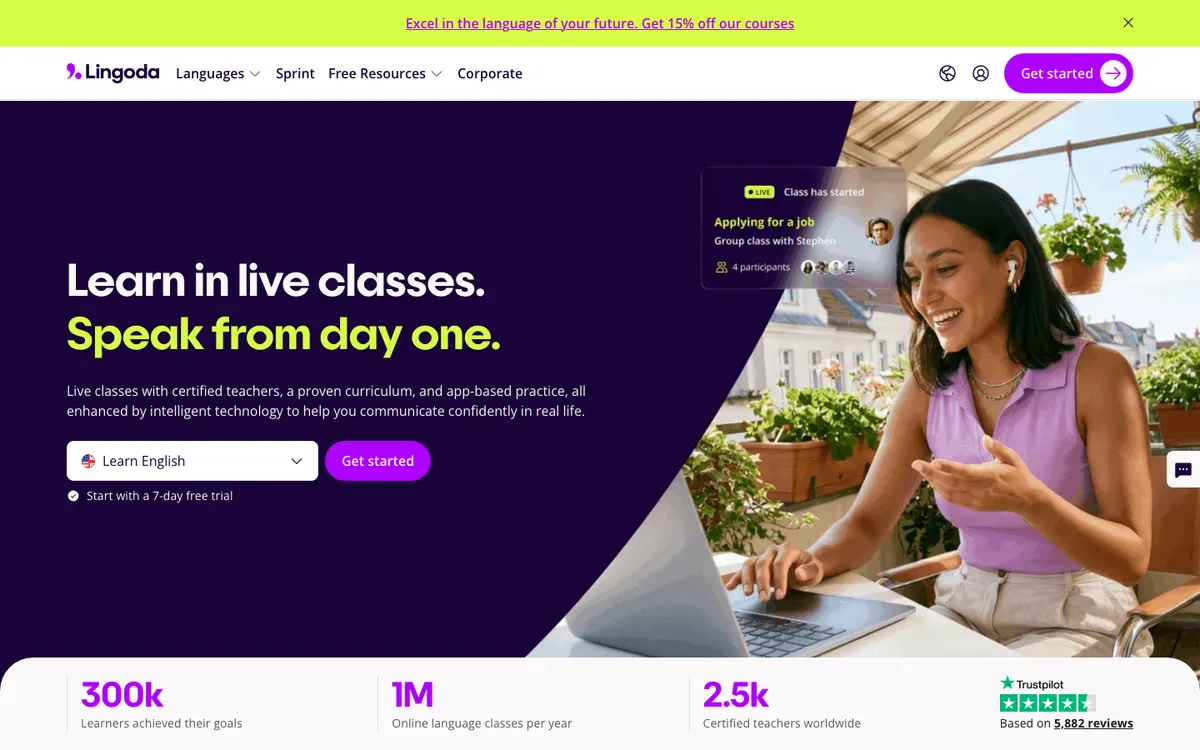
Munich, five months from now: the job offer is real, and the HR email mentions “B1 German preferred.” You’ve done a year of an app and can order a pretzel. Lingoda is built for that kind of deadline: live online language classes with certified teachers, organized by level, so you know what you’re working toward and roughly how long it will take.
Lingoda is a Berlin-based online language school. Classes last 60 minutes, in small groups of 3 to 5 students or one-on-one with a private teacher. On October 30, 2026, the pricing page offered plans of 5, 12, 20 or 40 classes, renewing every four weeks, with a 7-day free trial.
How we reviewed it: we read Lingoda’s homepage and pricing page, including the FAQ, on October 30, 2026, and compared it with the other language options on our site. We haven’t taken classes. Prices were shown to us in euros, so we don’t quote a US dollar price; check yours on the pricing page.
Some links on this site earn us a commission if you enroll. Your price stays the same. Our rankings are based on our editorial criteria; some partners may be featured more prominently. How we review
Pros & cons
- Live 60-minute classes in small groups of 3 to 5, or one-on-one
- CEFR-based curriculum: about 50 classes per level, with a certificate per level
- Classes bookable around the clock, and unused class credits roll over
- 7-day free trial (3 group classes or 1 private class) and a 14-day money-back window
- You have to book fixed time slots and show up; missed classes are lost value
- Plans renew every four weeks until you pause or cancel
- Group classes mix students from all over the world, so speaking time per person is limited
- Only six options: English, Business English, French, German, Italian and Spanish
How a level works
Lingoda’s curriculum follows the CEFR scale (A1 to C1 and so on), the standard used by employers, universities and many visa rules. Each level has about 50 classes plus practice exercises between them, and you get a certificate when you complete a level.
The pace is your choice. Lingoda’s own example: at one class a day, you could move up a level in just over seven weeks. At three classes a week, which is more realistic next to a job, it’s about four months. That kind of math makes it easier to plan around a real deadline.
A week of classes
You book classes from a calendar that runs around the clock, so a class at 6 a.m. before work or 10 p.m. after the kids are asleep is usually available. Picture a Tuesday: you join a group class on making appointments, with a teacher and three students from Brazil, Poland and Japan. You speak more in that hour than in a month of app lessons. Afterward, you do the practice exercises for the same topic on your phone during lunch.
The teachers are certified and native-level, and you’ll meet different teachers and classmates in each group class. Some learners like the variety. Others prefer the same face every week, which is what private classes are for.
Between classes
Every subscription includes 100+ hours of self-study material: exercises, vocabulary and practice lessons linked to the class topics, which the pricing page describes as personalized. They’re useful for the ten minutes on the bus, and for reviewing the words from Tuesday’s class before Thursday’s. They don’t replace the live classes; they make each one count for more.
Who it suits, and who it doesn’t
It suits people with an external reason and a date: a relocation, a job requirement, a partner’s family visit, a university program that asks for a CEFR level. It suits people who learn better in a group and want to hear how others make mistakes too.
It suits less well the casual learner who wants to practice whenever the mood strikes. Booking classes, showing up on time and paying every four weeks is a commitment. If that sounds like a chore rather than a structure, a tutor marketplace or an app will fit your life better.
Video: Lingoda
Choosing a plan
Plans are sold by the number of classes per four-week cycle. The price per class drops as the plan gets bigger, and private classes cost several times more per class than group classes. Unused class credits roll over to the next cycle, which takes some pressure off a busy month.
A sensible starting point is 12 group classes per cycle (about three a week). If after a month you’re keeping up easily, move to 20. If you’re skipping classes, drop to 5 rather than paying for credits you won’t use.
Sprint is a separate format: a two-month intensive for people who want to commit hard for a short period.
The catch: it only works if you show up
Lingoda’s strength is structure, and structure needs you to book a slot and attend. If your schedule changes week to week, or you tend to drop things when work gets busy, a plan that renews every four weeks can quietly cost you money. Set a reminder to review your plan at each renewal.
Group classes have another limit: with up to five students, your speaking time per hour is shared. That’s fine for practicing in a realistic setting, but if speaking is your main weakness, mix in private classes or a tutor.
And the language list is short: English, Business English, French, German, Italian and Spanish. If you need Japanese or Portuguese, look elsewhere.
Refunds and the trial
The trial lasts 7 days and lets you take 3 group classes or 1 private class. Lingoda reminds you a day before it ends; cancel during the trial and you won’t be charged. After you subscribe, you have 14 days to cancel for a refund, minus any classes you took. After that, you can cancel, pause or change your plan anytime, and you won’t be billed for the next cycle.
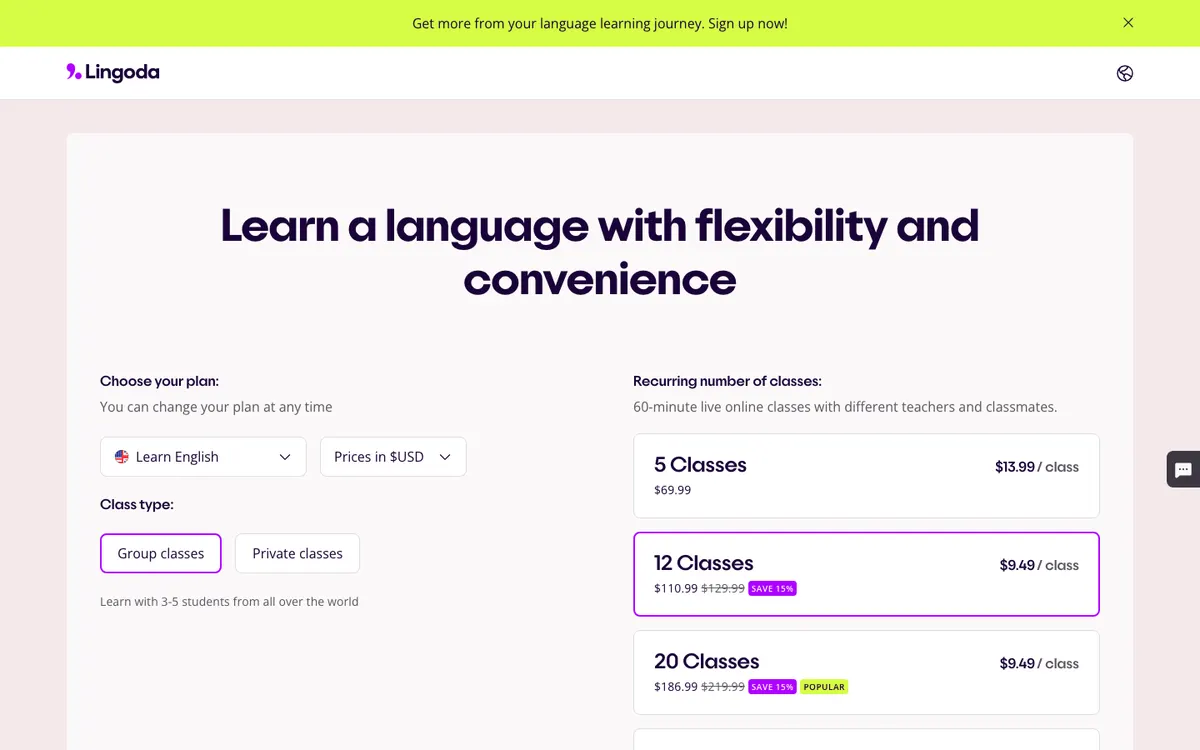
7-day free trial: try 3 group classes or 1 private class before the first payment, with a reminder one day before the trial ends (official pricing page, October 30, 2026).
↪See offer details and conditionsCancel within 14 days of subscribing for a refund, minus any classes taken; after that, cancel or pause anytime and you aren't charged for the next cycle.
Plans of 5, 12, 20 or 40 classes, renewing every four weeks; unused class credits roll over; Sprint is a separate intensive
Alternatives
italki is a tutor marketplace where you pick one teacher and pay per lesson. It’s cheaper per hour and more flexible, but has no shared curriculum. Preply works the same way. For practice on your own time, Babbel was $107.40 a year on our last check, and Pimsleur focuses on listening and speaking with a 7-day free trial.
All of them are compared in our language learning ranking.
Swipe sideways to compare all 4 programs →
| Criterion | This review | |||
|---|---|---|---|---|
| Our score | 8.7/10 | 8.8/10 | 8.8/10 | 8.8/10 |
| Price | — | $4 – $60 | $4.99 – $99.99 | $20.95 |
| Format | Live online | Live online | App | App |
| Duration | Ongoing classes; Sprint is a 2-month intensive. | Per lesson. | Subscription. 60+ topics per language, about 2 to 3 hours each according to uTalk, so up to 180 hours of material per language. | Subscription. |
| Accreditation | — | — | None: a consumer vocabulary app from EuroTalk Ltd (London, company no. 2674118). No CEFR level or certificate. | — |
| Free trial | 7-day free trial: 3 group classes or 1 private class before the first payment | Discounted trial lessons. | No | 7-day free trial. |
| Best for | Learners with a concrete level goal (a move, a job, an exam) who want live small-group or private classes and a structured curriculum. | Learners who want regular one-on-one speaking practice and are willing to try a few tutors to find the right one. | Travelers, heritage learners and anyone who needs key words and phrases in a less common language, at the lowest yearly price in this ranking. | commuters and travelers who want to speak and understand everyday phrases, and who have 30 minutes a day with their hands busy and their ears free. |
| Read more | You are here | italki reviewHead-to-head → | uTalk review | Pimsleur review |



“—” means the information was not published or not yet checked. See all 9 language learning programs.
Before you start
Work out the level you need and your deadline, then divide 50 classes by the weeks you have. If the answer is more than five classes a week, consider Sprint or private classes. Use the free trial to take three group classes at the times you’d really use, and only then choose a plan.
Score breakdown
CEFR-aligned live curriculum.
Established live-class language school.
Free trial and 15% offer; prices unverified.
Book class slots around your schedule.
Certified teachers in every class.
Weighted average of five criteria. Read our methodology.
FAQ
How much does Lingoda cost?
It depends on the language, the class type (group or private) and how many classes you buy per four weeks (5, 12, 20 or 40). The price per class falls as the plan gets bigger, and private classes cost several times more than group classes. Check the pricing page in your currency; plans renew every four weeks.
Does Lingoda have a free trial?
Yes, 7 days. You can try 3 group classes or 1 private class before the first payment, and Lingoda sends a reminder one day before the trial ends.
How long does it take to finish a level on Lingoda?
A level has about 50 classes. Lingoda says that at one class a day you could move up a level in just over 7 weeks; at three classes a week, plan on roughly four months.
Head-to-head comparisons
Sources
Prices and offers can change; confirm on the official site before you enroll.