On this page · 15 sections5 min read
- 01Our verdict
- 02At a glance
- 03Pros & cons
- 04What you’ll learn
- 05Format, schedule and time commitment
- 06Accreditation and what the credential is worth
- 07Price, payment plans and refunds
- 08Who it’s best for — and who should skip it
- 09Pros and cons in detail
- 10How it compares
- 11Musora (Pianote, Guitareo, Singeo, Drumeo) vs alternatives
- 12How to enroll
- 13Score breakdown
- 14Key facts
- 15FAQ
Our verdict
Our verdict8.7/10Musora bundles four music-lesson brands, Pianote, Guitareo, Drumeo and Singeo, into one membership app.
Members get structured video lessons plus officially licensed, professionally transcribed sheet music and tabs with practice tools to slow the tempo, loop sections and remove instruments. It costs $30 a month after a seven-day free trial, with an annual option, and the company backs memberships with a 90-day guarantee, which is longer than most. The price is higher than single-instrument apps, so it makes the most sense if you play, or want to learn, more than one instrument. It suits self-motivated musicians who like a polished video teaching style.
Best for: Musicians who want one membership covering piano, guitar, drums and voice lessons with licensed sheet music.
At a glance
Musora is a music lesson subscription combining Pianote, Guitareo, Drumeo, Singeo, and bass instruction in one account. Its strongest feature is the connection between guided video practice and licensed song transcriptions, rather than simply the size of its video library. It is a good fit for adults who want a structured practice routine or move between instruments. The tradeoff is that a broad subscription does not automatically provide a personal teacher watching every practice session.
Pros & cons
- One membership for Pianote, Guitareo, Drumeo and Singeo
- Officially licensed, note-for-note sheet music and tabs
- Practice tools: tempo control, loops, instrument removal
- 7-day trial and 90-day guarantee
- $30/month is higher than single-instrument apps
- Video-based; no personal teacher by default
What you’ll learn
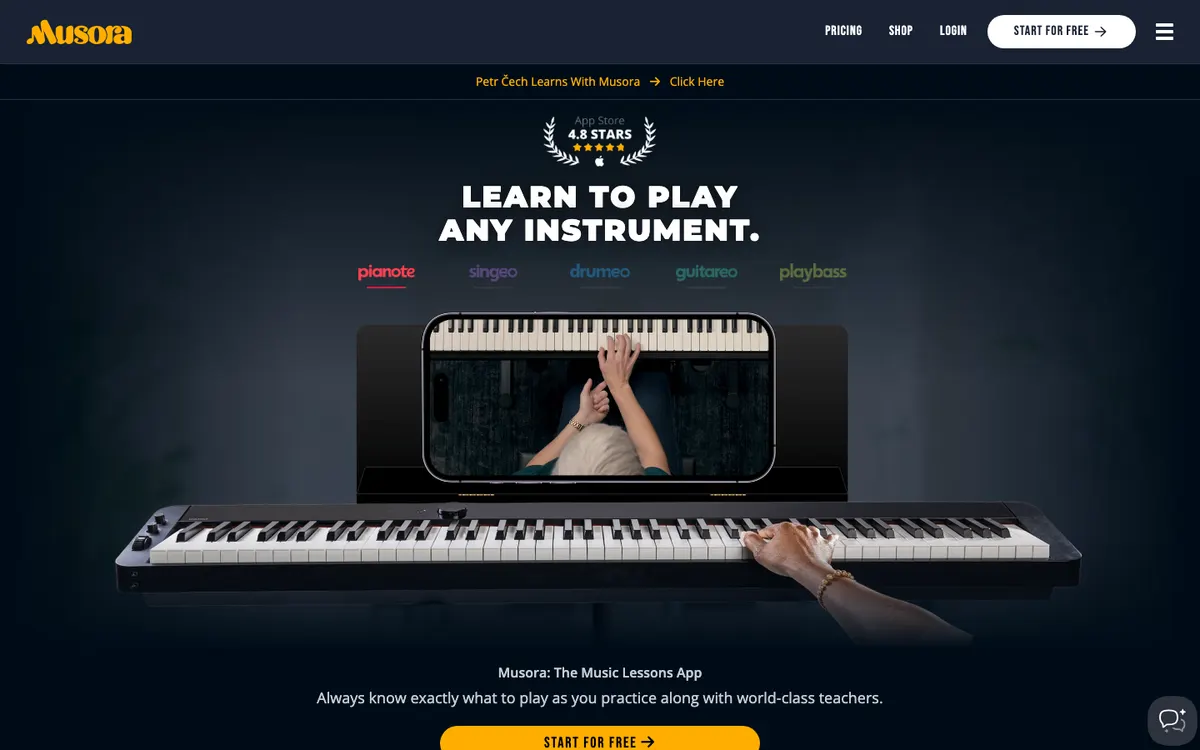
The Musora homepage organizes instruction into piano, singing, drums, guitar, and bass, with learning paths and artist courses for each. Examples include Lisa Witt’s music-reading course, Ayla Tesler-Mabé’s fretboard course, and Jesús Molina’s harmony instruction. Those examples show that the catalog covers both first steps and narrower topics such as chord substitutions and voice leading.
The song tools are especially relevant to independent practice. Musora describes licensed transcriptions, scrolling notation, tempo adjustment, section loops, and the ability to remove instrument tracks. That combination lets a guitarist or pianist isolate a difficult passage and then put it back into the arrangement, rather than repeatedly restarting an entire performance.
Format, schedule and time commitment
Lessons are available across web, tablet, and mobile, and the membership has no single graduation date. Individual challenges may use a 30-day structure, but that is the organization of those courses, not a promise that every instrument can be learned in a month. The site presents the videos as follow-along practice sessions.
Musora also advertises a practice tracker and streaks. These track engagement and help organize a routine, but they should not be confused with an independent assessment of musical proficiency. A useful trial would include a complete practice session with an instrument, not only watching a featured artist introduction.
Video: Musora (Pianote, Guitareo, Singeo, Drumeo)
Accreditation and what the credential is worth
The membership pages present Musora as practical music education, not an accredited degree or professional music-teaching qualification. Licensed sheet music refers to permission to distribute the musical material; it is not academic accreditation. Likewise, an artist’s professional background is evidence about that instructor, not a transferable student credential.
For a hobby pianist, the relevant outcome is being able to read, practice, and perform the chosen repertoire. Someone who needs academic credit or an assessed teaching award should obtain separate confirmation from the institution that would accept it. No such equivalence is established by the membership description.
Price, payment plans and refunds
As of October 5, 2026, the official homepage offers seven free days followed by $30 per month. An annual option is available, and the page says both billing choices include all instruments and the same core learning tools. The homepage does not specify an exact annual dollar total, so the annual discount should be checked at checkout.
Musora advertises a full 90-day guarantee and says trial cancellation avoids a charge. A paid refund and cancellation before the first charge are different actions: the former involves contacting support under the guarantee, while the latter stops trial conversion. Against a dedicated piano subscription such as Skoove, Musora’s case depends particularly on using its broader instrument coverage.

Full 90-day guarantee.
Monthly or annual.
No public discount was listed on the official site when we checked. We never publish unverified coupon codes.
Who it’s best for — and who should skip it
Choose Musora if your goals cross instruments—for example, accompanying your singing on piano—or if you value playing along with complete songs. Pianote’s named courses also make it relevant to an adult returning to piano who wants a specific reading, chord, or style pathway. You can focus on one instrument without needing to consume the rest of the catalog.
Skip the membership if your main requirement is a recurring private appointment with someone who observes technique. It is also less compelling if you only want a small set of piano songs and will not use the artist courses or practice tools. Breadth is valuable only when it changes what you actually practice.
Pros and cons in detail
The combined brands are a practical advantage because instrument switching does not require separate subscriptions. The licensed notation and tabs provide a concrete reference alongside the video, while looping and tempo controls support repeated work on a particular passage. The trial and guarantee allow more evaluation than a sales preview alone.
The main drawback is the recurring cost for a learner with a narrow goal. Musora’s support offering should also be distinguished from a standing one-to-one lesson: a question or community interaction is not continuous observation. Finally, a large artist catalog can distract from a beginner pathway, so selecting one sequence before browsing advanced material is a sensible way to use the product.
How it compares
For piano shoppers, Skoove and flowkey are more direct comparisons than another Musora listing under a different name. Skoove emphasizes an app that listens during step-by-step practice, while flowkey combines songs, hand videos, and notation. Musora’s distinguishing purchase is its cross-instrument video and song ecosystem.
Skoove Premium (Piano) is a subscription app for adult beginners who want step-by-step piano practice with listening feedback. It costs $29.99 per month on monthly billing, $19.99 per month on a 3-month plan ($59.99), or $12.49 per month on a 12-month plan ($149.99). A free tier lets you explore the approach before choosing a billing commitment.
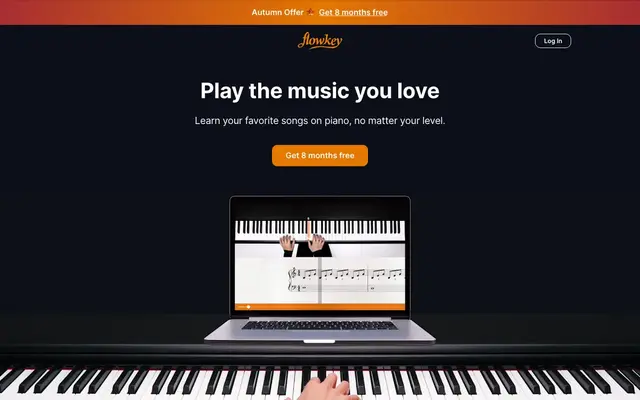
flowkey Premium is another subscription app aimed at piano beginners, with an emphasis on learning songs they enjoy. Its combination of hand demonstrations and notation offers a different practice experience from Musora’s cross-instrument video courses. Your choice depends partly on whether you want focused piano interaction or room to explore several instruments.
Browse the Piano Lessons category for more ways to build a piano routine. The review methodology explains how we weigh teaching content, credibility, cost, flexibility, and the support available when practice gets difficult.
Musora (Pianote, Guitareo, Singeo, Drumeo) vs alternatives
How Musora (Pianote, Guitareo, Singeo, Drumeo) stacks up against other piano lessons programs we reviewed, on the facts published by each provider.
Swipe sideways to compare all 3 programs →
| Criterion | This review | ||
|---|---|---|---|
| Our score | 8.7/10 | 8.5/10 | 8.4/10 |
| Price | $30 | $12.49 – $150 | — |
| Format | Subscription | App | App |
| Duration | Membership. | Subscription. | Subscription. |
| Free trial | 7-day free trial; cancel during the trial and you are not… | 7-day free trial. | — |
| Best for | Musicians who want one membership covering piano, guitar, drums and voice lessons with… | Adult beginners who want a structured piano app that listens as they play. | Piano beginners who want to learn songs they like with an interactive app. |
| Read more | You are here | Skoove reviewHead-to-head → | flowkey reviewHead-to-head → |

“—” means the information was not published or not yet checked. See all 3 piano lessons programs.
How to enroll
Use the official homepage’s Start for Free route, select the billing option, and check the amount and renewal date before confirming the trial. Open the instrument pathway you actually intend to follow and test a song’s notation and practice controls on your own device. The homepage links the mobile apps as well as web access.
Before the free period ends, decide whether you will keep the subscription and save the cancellation instructions. If the annual plan is attractive, compare its full charge with the monthly commitment rather than relying solely on a savings percentage. Keep the stated guarantee terms with your purchase confirmation.
Score breakdown
Four instruments with structured lessons and licensed transcriptions.
Established brands such as Drumeo and Pianote.
$30/month covers four instruments.
App on any device.
Video-based; community features.
Weighted average of five criteria. Read our methodology.
Key facts
FAQ
How much is Musora?
Free for 7 days, then $30 per month.
What is the Musora guarantee?
A full 90-day guarantee, per the site.
Head-to-head comparisons
Sources
Information checked on October 5, 2026. Prices and offers can change; confirm on the official site.