
Kajabi (Creator Business Platform)
8.4/10Editorial score
- Price
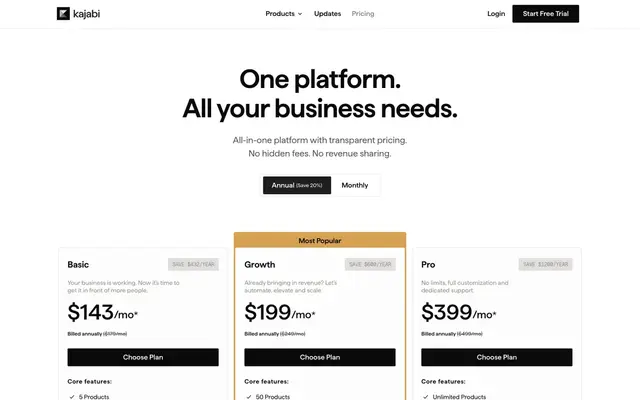
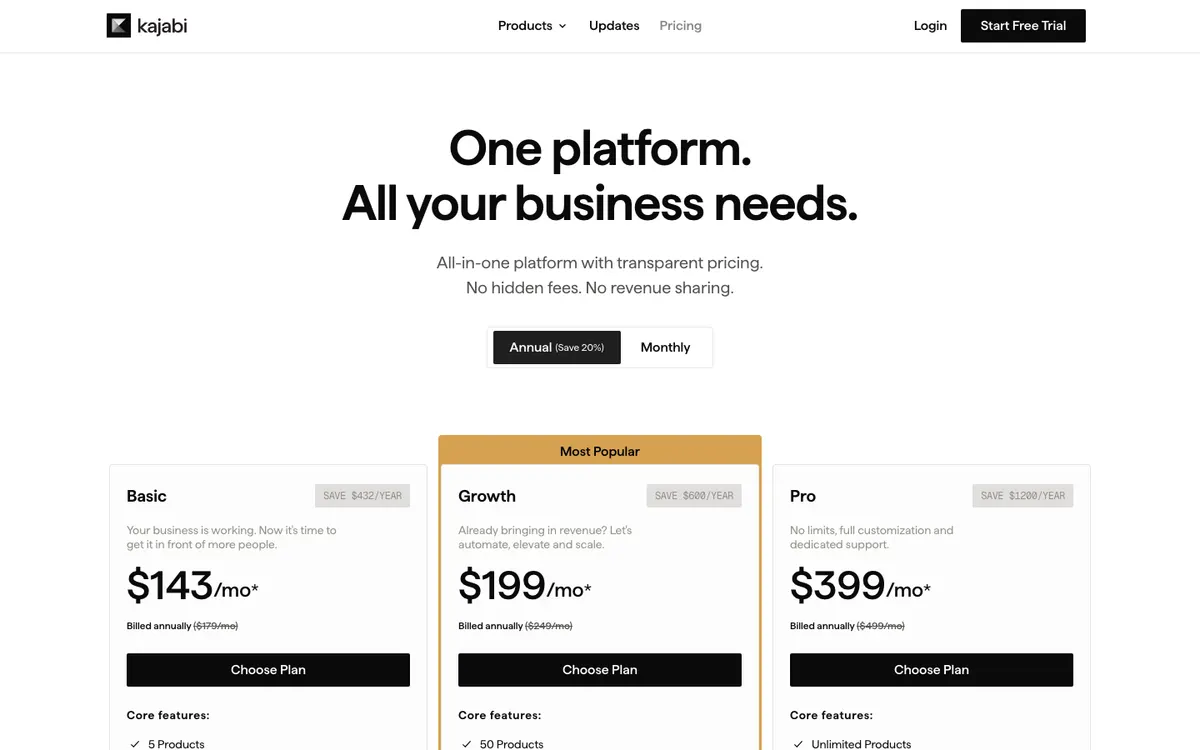
- From $143/mo billed yearly ($179 monthly)
- Best for
- Established creators who want marketing tools in one place.
Thinkific is the better choice for most course creators: it costs far less and allows unlimited courses on every plan. Kajabi earns its higher price only if you will use its email marketing, funnels and website instead of paying for separate tools.
Choose Kajabi if…you already have an audience, want email marketing, funnels, landing pages, a website and a community in one tool, and the $143-a-month entry price (billed annually) replaces software you would otherwise pay for.
 Choose Thinkific if…
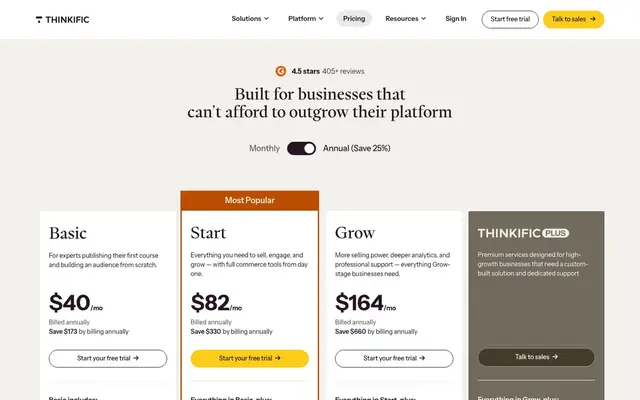
you want to publish courses at a lower cost (from $40 a month billed annually), need unlimited courses from the first plan, and are happy to connect your own email tool.
What tips the choicewhether you would pay for other tools anyway. Kajabi's entry plan costs about $1,236 more a year than Thinkific's. If that money would otherwise go to an email platform, a website builder and a funnel tool, Kajabi can make sense. If not, Thinkific is the better deal.
We may earn a commission when you buy through links on this page. Our rankings are based on our editorial criteria; some partners may be featured more prominently. Affiliate disclosure.
| Criterion | Kajabi | Thinkific |
|---|---|---|
| Editorial scoreWeighted average of our five criteria | 8.4/10 | 8.5/10Higher score |
| PriceAs published on the official site | Basic $179/mo ($143 billed annually); Growth $249/mo ($199 annually); Pro $499/mo ($399 annually). Prices checked October 13, 2026 | Basic $54/mo ($40 billed annually); Start $109/mo ($82 annually); Grow $219/mo ($164 annually). Prices checked October 13, 2026Lower starting price |
| Payment plansHow the cost can be spread | Monthly or annual (save 20%). | Monthly, or annual billing (save 25%); upgrade, downgrade or cancel at any time. |
| FormatHow you study | Subscription | Subscription |
| DurationTime to finish or access period | Subscription. | Monthly or annual subscription. |
| CertificateWhat you receive at the end | Not published | Completion certificates issued automatically to your learners. |
| Free trialWays to test before paying | Free trial; the Business Launch Kit offer on the pricing page lists 14 days, converting to Growth monthly at $249 unless cancelled | 30-day free trial; no free plan |
| Refund policyYour way out if it is not a fit | 30-day money-back guarantee on every plan; upgrade, downgrade or cancel anytime | No money-back guarantee stated on the pricing page; cancel anytime, including during the trial |
| Best forWho it suits | coaches and creators who already sell a course, coaching or membership and want to replace separate email, website, checkout and community tools with one subscription. | coaches, trainers and small businesses who already have an audience and want to sell courses, cohorts and memberships on their own branded site. |
“Not published” means the provider did not state it or we could not confirm it. Program data checked October 5, 2026. Comparison updated October 13, 2026.
Kajabi: Creator platform, no learner curriculum. · Thinkific: Creator platform, no learner curriculum.
Kajabi: Leading creator business platform. · Thinkific: Major course-hosting platform.
Kajabi: From $143/month annually. · Thinkific: From $40/month billed annually.
Kajabi: Change or cancel anytime. · Thinkific: Monthly or annual billing.
Kajabi: Premium support tiers. · Thinkific: SLA on higher tiers.
Scores out of 10 from our published method; the overall score is the weighted average.
The gap is large. On October 13, 2026, Thinkific cost $40, $82 or $164 a month billed annually ($54, $109 or $219 monthly). Kajabi cost $143, $199 or $399 a month billed annually ($179, $249 or $499 monthly).
| Tier, billed annually | Kajabi | Thinkific |
|---|---|---|
| Entry | $143/mo ($1,716/yr) | $40/mo ($480/yr) |
| Middle | $199/mo | $82/mo |
| Top | $399/mo | $164/mo |
Neither takes a share of your revenue. Kajabi charges card processing through Kajabi Payments (2.9% + $0.30 on Basic for US entities, slightly less on higher plans) and adds 2%, 1% or 0.5% if you use a third-party payment provider where Kajabi Payments is available. Thinkific notes that third-party gateways such as Stripe or PayPal can add a fee in some countries; Thinkific Payments avoids it.
On entry plans billed annually, Kajabi costs $1,236 more a year than Thinkific, or $2,472 more over two years. That is the budget Kajabi’s extra tools have to replace. Our value scores: 8.9/10 for Thinkific, 7.8/10 for Kajabi.
WinnerThinkific.
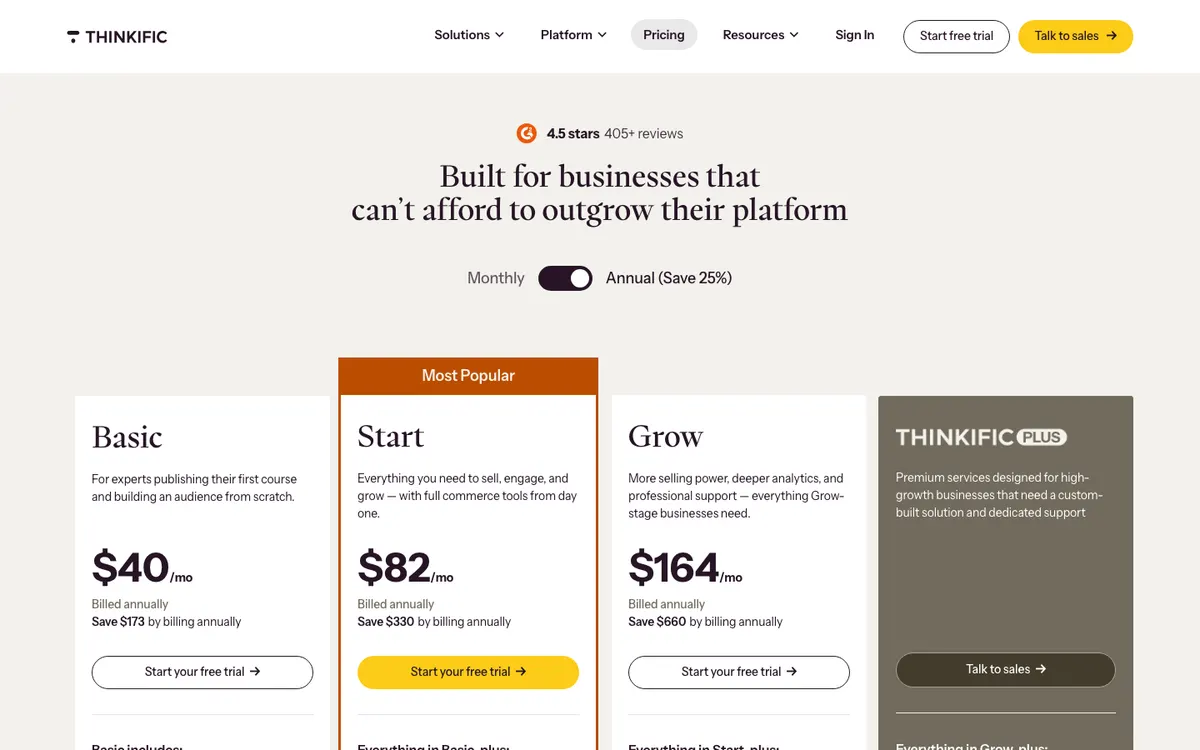
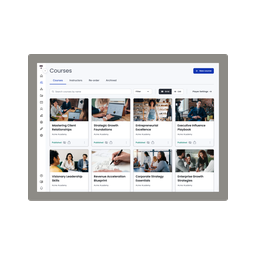
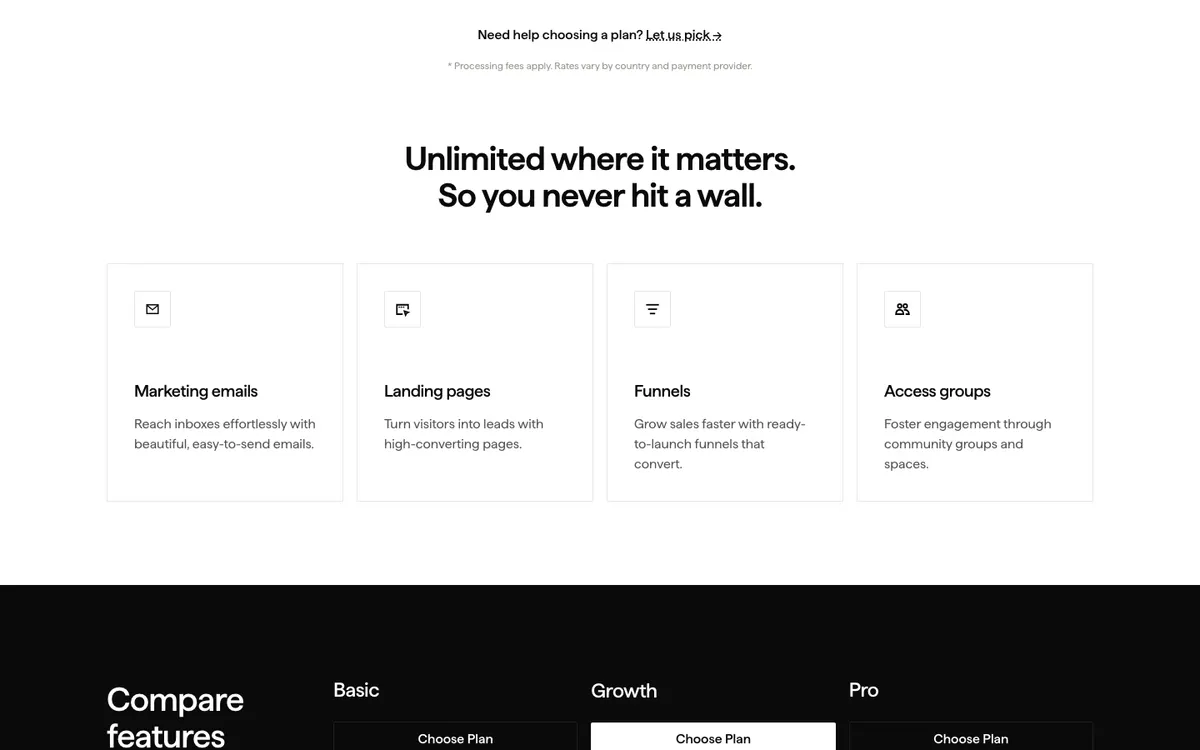
This is why Kajabi costs more. Every plan includes unlimited marketing emails, landing pages and funnels, a website, a community and checkout pages, with a contact list of 2,500 on Basic, 25,000 on Growth and 100,000 on Pro. Kajabi’s own pricing FAQ makes the argument: for a course platform alone it is expensive, but it is also your email tool, website, community and checkout. Pro adds a branded mobile app, which Kajabi values at $199 a month.
Thinkific covers the basics: a site builder, landing pages, email automation templates, coupons, order bumps and abandoned-cart emails. For regular newsletters, segmented campaigns or complex funnels, you will likely connect a separate email tool, at its own price.
The honest test is your current software bill. List what you pay today for email, a website and funnel pages. If the total comes near the price gap, Kajabi’s bundle is a fair deal and saves you from stitching tools together. If you have no list yet, you would be paying for capacity you cannot use.
WinnerKajabi.
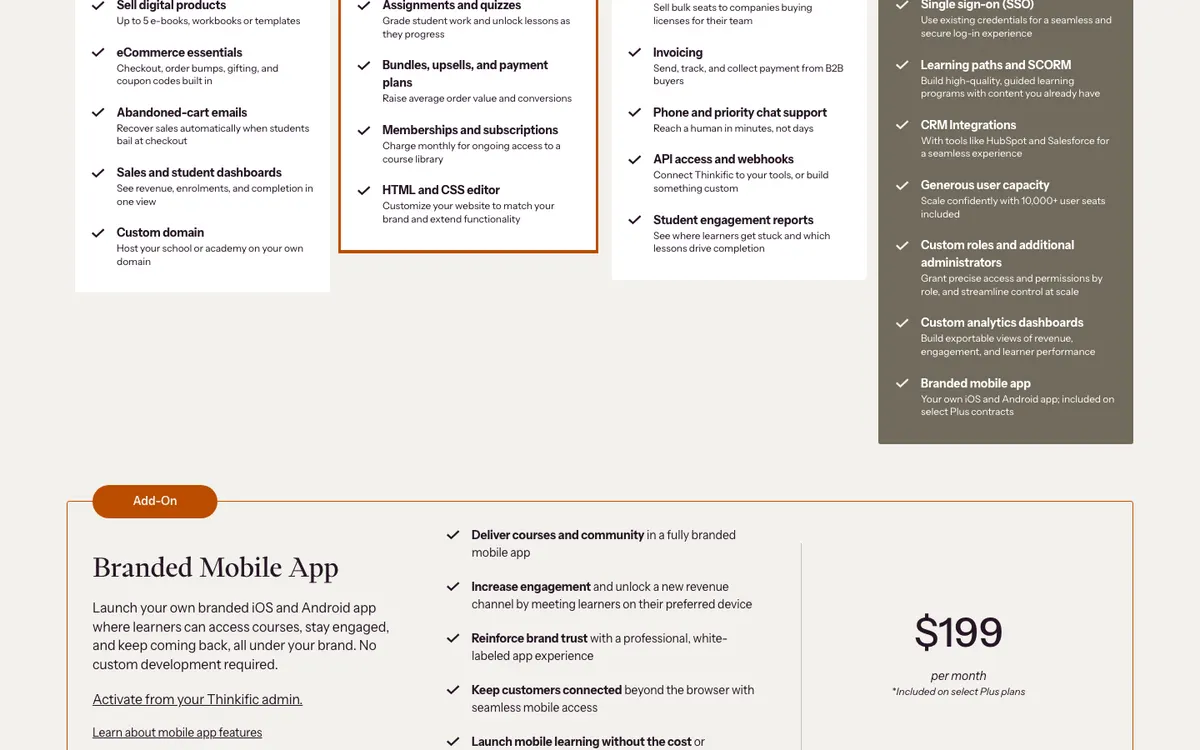
Thinkific is the more generous course platform. Every plan allows unlimited published courses and up to 10,000 current students. From the Start plan, you add live cohorts with unlimited Zoom sessions, assignments, graded quizzes, automatic completion certificates, bundles, payment plans and memberships.
Kajabi counts products: 5 on Basic, 50 on Growth and unlimited only on Pro. Its feature table also lists cohort courses, video transcriptions and translations, and a Kajabi customer app for your students. Thinkific sells its branded mobile app as a $199-a-month add-on, included only on some Plus plans. Kajabi’s own advice is to start on Basic if you have not sold anything yet, which means a five-product limit at $143 a month.
Both platforms score 7.3/10 on curriculum, because neither is a course itself: quality depends on what you build.
WinnerThinkific.
Kajabi gives you a safety net after paying: a free trial, then a 30-day money-back guarantee on every plan, and you can upgrade, downgrade or cancel anytime.
Thinkific gives you more time before paying: a 30-day free trial, no free plan, and you can cancel anytime, including during the trial. Its pricing page did not state a money-back guarantee. Both score 9.5/10 on flexibility.
WinnerKajabi, for the money-back guarantee.
Kajabi scores 8.9/10 on support against 8.4/10 for Thinkific. Kajabi runs a weekly live Q&A for prospective customers, and its Pro plan includes dedicated support. Thinkific offers email and chat support on Basic and Start, phone and priority chat on Grow, a dedicated customer success team on Plus, and access to Thinkific Academy courses for creators.
Team size is another difference. Kajabi includes 2 admin users on Basic, 11 on Growth and 26 on Pro; Thinkific includes 1, 2 and 6 site admins across Basic, Start and Grow. If an assistant or a small team runs your courses with you, Kajabi gives more seats at each level.
If you expect to need help often and can afford it, Kajabi’s higher plans are the more hands-on option. On entry plans, both rely mainly on chat and email.
WinnerKajabi.
 KajabiThinkificPick Thinkific
Thinkific Basic costs $40 a month billed annually and allows unlimited courses. Kajabi itself says Basic is for businesses that are already working, and it costs $143 a month.
Pick KajabiKajabi's Growth plan includes 25,000 contacts, unlimited marketing emails, funnels and landing pages, so email marketing lives in the same tool as your courses.
Pick ThinkificThinkific's Grow plan adds group orders for B2B sales, invoicing, API access and phone support, at $164 a month billed annually.
Other online course platforms options we reviewed, ranked by editorial score.

Career changers with a concrete plan of two or more Coursera certificates, such as a Google certificate followed by a specialization, who can study steadily for a year.
Working photographers, designers and video editors who want a big on-demand library plus live classes they can ask questions in.
Self-directed learners who want one specific course from a named university, and who want to try it free before paying for the certificate.
For most course creators, yes: Thinkific scores 8.5/10 against 8.4/10 for Kajabi in our review, mainly on value (8.9 vs 7.8). Kajabi scores higher on support (8.9 vs 8.4) and includes more marketing tools. They tie on the other criteria.
Thinkific. On October 13, 2026 its plans cost $40, $82 and $164 a month billed annually. Kajabi's cost $143, $199 and $399 a month billed annually, or $179, $249 and $499 billed monthly.
Kajabi says it takes no revenue share. Card processing through Kajabi Payments costs 2.9% + $0.30 on Basic, less on higher plans, for US entities. If you use a third-party payment provider where Kajabi Payments is available, Kajabi adds 2%, 1% or 0.5% depending on the plan.
Both. Kajabi offers a free trial, and every plan has a 30-day money-back guarantee. Thinkific offers a 30-day free trial but did not state a money-back guarantee on its pricing page.
Unlimited on every Thinkific plan. Kajabi counts products: 5 on Basic, 50 on Growth and unlimited on Pro.
That is its main argument. Every Kajabi plan includes unlimited marketing emails, landing pages and funnels, with contact limits of 2,500, 25,000 or 100,000 depending on the plan. Extra contacts cost $125 a month per block of 25,000.
We score each program on curriculum, credibility, value, flexibility and support, using the provider’s official pages; see how we score. The comparison above was written from these sources and re-checked against the official sites on October 13, 2026. Prices and terms change: confirm them on the official site before you enroll.
We may earn a commission when you buy through links on this page. Our rankings are based on our editorial criteria; some partners may be featured more prominently. Read our affiliate disclosure.