On this page · 15 sections6 min read
- 01Our verdict
- 02At a glance
- 03Pros & cons
- 04What you’ll learn
- 05Format, schedule and time commitment
- 06Accreditation and what the credential is worth
- 07Price, payment plans and refunds
- 08Who it’s best for — and who should skip it
- 09Pros and cons in detail
- 10How it compares
- 11Kerala Ayurveda Academy (US) vs alternatives
- 12How to enroll
- 13Score breakdown
- 14Key facts
- 15FAQ
Our verdict
Our verdict8.4/10Kerala Ayurveda Academy is a US-based school that presents itself as rooted in 80 years of Kerala Ayurvedic teaching, and it offers a ladder of certifications.
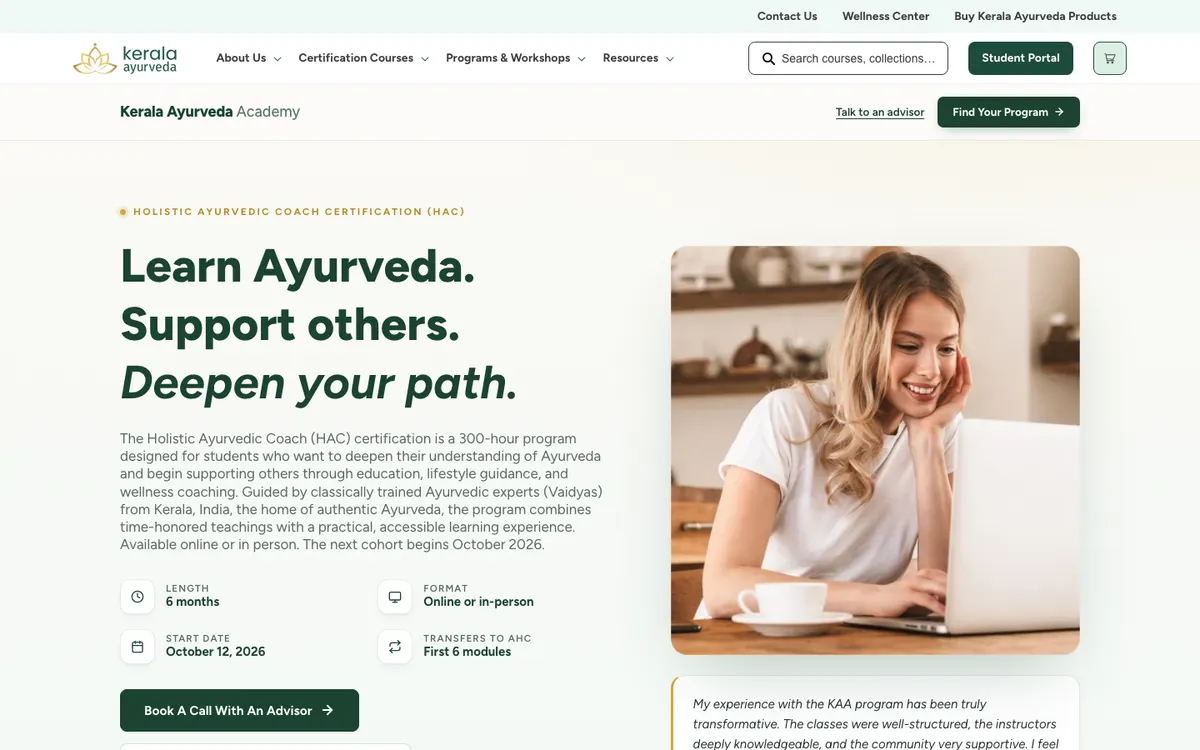
Its entry program, the Holistic Ayurvedic Coach, is a six-month, 300-hour course priced at $3,850, with plans from $667 a month, and can be attended by live stream or in person, with the next cohort starting October 12, 2026. Its modules transfer into the 600-hour Ayurvedic Health Counselor program ($8,950), which the academy presents as a pathway to NAMACB accreditation. Self-paced short courses start at $95. It suits learners committed to a structured, long-term Ayurveda path. Those just exploring may prefer one of the short courses first.
Best for: Beginners who want a structured, cohort-based entry into professional Ayurveda with a path to counselor-level study.
At a glance
Kerala Ayurveda Academy is a US-based school that presents itself as rooted in 80 years of Kerala Ayurvedic teaching, and it offers a ladder of certifications. Its entry program, the Holistic Ayurvedic Coach, is a six-month, 300-hour course priced at $3,850, with plans from $667 a month, and can be attended by live stream or in person, with the next cohort starting October 12, 2026. Its modules transfer into the 600-hour Ayurvedic Health Counselor program ($8,950), which the academy presents as a pathway to NAMACB accreditation. Self-paced short courses start at $95.
Pros & cons
- Clear progression from coach (300 h) to counselor (600 h) to advanced practitioner
- Live streaming or in-person attendance options
- HAC credits transfer to the first 6 modules of AHC
- Monthly payment plans published
- Large catalog of self-paced short courses from $95
- Significant cost for the longer certifications
- Cohort start dates are fixed
- Accreditation is described as a pathway rather than a completed credential
What you’ll learn
HAC teaches Ayurveda through six connected modules. The curriculum names foundational principles, Ayurvedic physiology, psychology, and nutrition and cooking; descriptions include doshas, the five elements, constitution, daily routines, meditation, and breathing practices. These subjects are taught within the school’s Ayurvedic framework rather than as a conventional medical curriculum.
The practical objective is lifestyle and wellness coaching. The program page explicitly distinguishes that scope from clinical practice and discusses food, sleep, stress, seasonal routines, and habit change. That boundary matters for readers who might otherwise mistake the broader catalog’s health terminology for permission to diagnose or treat disease.
Format, schedule and time commitment
The next HAC cohort starts October 12, 2026, with 300 hours of study spread across six months. Weekend intensives, virtual classes, group mentoring, lesson replays, and guided assignments support the six-module sequence. According to the academy, graduates keep access to the lesson videos and eLearning library, giving them reference material after their cohort finishes.
Remote participation follows the same cohort calendar, so live streaming does not mean you can set every deadline yourself. Sessions run on US Pacific Time, with replays available when time zones make attendance difficult. Ask which activities you must attend live and when assignments fall due; the six-month duration alone cannot tell you how many evenings and weekends to reserve.
Video: Kerala Ayurveda Academy (US)
Accreditation and what the credential is worth
Kerala presents the program as a pathway to NAMACB accreditation and says HAC study transfers into the first six modules of its Ayurvedic Health Counselor program. That transfer arrangement gives graduates a defined next educational step. It does not mean the entry-level HAC coaching award is itself a completed NAMACB credential.
The most useful boundary is the program page’s own statement that HAC prepares for coaching rather than clinical practice. Existing nurses, therapists, and other professionals should assess how the material fits their current work. The certificate does not itself establish authority to expand another profession’s scope, and a learner seeking an external designation should request its separate eligibility requirements.
Price, payment plans and refunds
The catalog lists HAC at $3,850, while the detailed HAC page shows $3,750 for a single upfront payment, two payments from $1,925, or six payments from $667. These are the published figures observed for the October 5, 2026 review; the inconsistency deserves clarification before purchase.
For refund and withdrawal rules, the academy points applicants to its current catalog and enrollment agreement. Bring those documents to the advising call and ask how the terms apply to your cohort. The public descriptions discussed here do not specify a refund period that applies to every enrollment.
Six payments of $667 total $4,002, while two payments of $1,925 total $3,850. Those are arithmetic comparisons of displayed options, before any additional conditions. Ask the advisor which total is binding for your cohort.
The catalog prices AHC at $8,950 and advanced practitioner study at $12,950, making a longer certification path a significant financial decision. Although HAC modules transfer, the academy’s information does not specify the exact additional balance an HAC graduate would owe to advance. If you want to explore Ayurveda before making that commitment, its self-paced short courses start at $95.
Payment plans starting at $667/month (HAC), $776/month (AHC), $1,122/month (AAP)
No public discount was listed on the official site when we checked. We never publish unverified coupon codes.
Who it’s best for — and who should skip it
It suits learners committed to a structured, long-term Ayurveda path. Those just exploring may prefer one of the short courses first. HAC fits someone seeking organized Ayurvedic study, faculty contact, and a possible route into counselor-level education. The school also describes participants studying for themselves and their families, so a planned coaching business is not the only reason to enroll.
It is a substantial purchase for a person seeking only an introduction. A short course can test interest at a lower total cost. An aspiring massage practitioner should also recognize that lifestyle coaching differs from a hands-on massage diploma, even when both programs use Ayurvedic concepts.
Pros and cons in detail
- A visible study path: Training progresses from the 300-hour coach program to the 600-hour counselor program and then advanced practitioner study.
- Two attendance options: Join by live stream or study in person.
- Transferable modules: HAC credits cover the first six AHC modules.
- Published installments: Monthly payment options help you compare the timing and total cost of payment.
- Smaller starting points: The large self-paced catalog includes short courses from $95.
- A substantial tuition bill: Longer certifications require a much larger budget than introductory courses.
- Fixed entry dates: Cohorts start on set dates rather than whenever you are ready.
- An accreditation pathway: The academy describes future progression, not a completed external credential at HAC graduation.
The progression through coach, counselor, and advanced study makes later options visible without requiring the longest commitment immediately. Module transfer is a concrete benefit, while short courses provide a different starting point. Obtain the transfer arrangement in writing rather than assuming every fee or assessment carries over.
Live streaming reduces travel requirements, but fixed cohorts limit scheduling freedom. Published installments improve price transparency only when their totals and the conflicting upfront figures are reconciled. The accreditation language deserves equally careful reading: a pathway into further study describes future possibilities, whereas the credential earned at HAC graduation is the immediate product being purchased.
How it compares
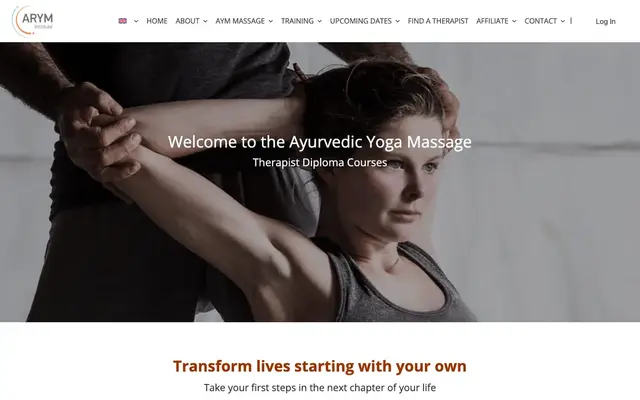
Ananta ARYM Ayurvedic Yoga Massage Therapist Training focuses on immersive massage practice. Its Ubud, Bali therapist course covers Levels 1-4 in 56 hours over about 10 days for €1,380 standard or €1,180 early bird; 28-hour sections start at €820, excluding accommodation and meals. The wider progression spans seven levels and 14 masterclasses totaling more than 500 hours. ARYM states IICT accreditation through the International Institute for Complementary Therapists, with insurance recognition in 38-40+ countries; its physical curriculum and travel commitment serve a different goal from HAC coaching.
Lando Medical Reiki Academy (Harmony Life Ayurveda and Reiki Academy) offers individual courses from free to $35, including $5 mini-courses, $10 Ayurveda guides, and $35 workshop replays. Most on-demand courses contain under an hour of video, with live classes also available. Course pages describe the instructor as approved by the National Certification Board for Therapeutic Massage & Bodywork (NCBTMB). These shorter purchases make more sense as exploratory or supplemental study than as replacements for HAC’s six-month sequence.
You can explore the broader Reiki Certification category while deciding whether coaching or hands-on practice better fits your interests. Our review methodology sets out the curriculum, credibility, value, flexibility, and support criteria used to assess HAC.
Kerala Ayurveda Academy (US) vs alternatives
How Kerala Ayurveda Academy (US) stacks up against other reiki certification programs we reviewed, on the facts published by each provider.
Swipe sideways to compare all 4 programs →
| Criterion | This review | |||
|---|---|---|---|---|
| Our score | 8.4/10 | 8.7/10 | 8.6/10 | 8.3/10 |
| Price | $3,850 – $12,950 | $149 | — | — |
| Format | Hybrid | Self-paced | Self-paced | In-person |
| Duration | HAC: 6 months, 300 hours; next cohort starts October 12, 2026 | On-demand courses; annual membership | Self-paced; 12 months of access on specialist courses (site also… | 56-hour therapist certification (Levels 1-4) over about 10 days; full… |
| Accreditation | Presented as a pathway to NAMACB accreditation; HAC transfers into the first 6 modules of… | NCBTMB Approved CE Provider (National Certification Board for Therapeutic Massage &… | CPD Group accredited; recognised by insurers including Towergate, Westminster and Balens | Accredited by the International Institute for Complementary Therapists (IICT), recognised… |
| Free trial | — | One free massage therapy CE course (limited to one per… | — | — |
| Best for | Beginners who want a structured, cohort-based entry into professional Ayurveda with a… | Licensed massage therapists who need affordable, on-demand continuing education hours for… | Qualified massage therapists who want to specialize in clients with neurological… | Massage therapists, yoga teachers and beginners who want hands-on Ayurvedic Yoga Massage… |
| Read more | You are here | Continued (continued.com/massage-therapy) reviewHead-to-head → | Neuro Massage Training School reviewHead-to-head → | Ananta (ARYM Ayurvedic Yoga Massage) review |

“—” means the information was not published or not yet checked. See all 6 reiki certification programs.
How to enroll
Use the HAC page’s advising-call or enrollment controls and select the payment option for the stated cohort. Request the current catalog, enrollment agreement, live-session schedule, and a written explanation of the upfront-price discrepancy.
If eventual AHC study is the goal, ask for a staged plan showing transferred modules and remaining requirements. Review withdrawal and sabbatical provisions before paying, especially if a fixed six-month calendar could conflict with work or caregiving.
HAC curriculum, tuition, and alternative-program references, consulted October 5, 2026: source 1, source 2, source 3, source 4, source 5, source 6, source 7.
Score breakdown
Tiered 300- to 600-hour programs plus a large short-course catalog.
Long-established Ayurveda brand; programs framed as a NAMACB pathway.
$3,850 for 300 hours is reasonable, but higher tiers are expensive.
Live-stream or in-person options, but fixed cohort dates.
Cohort format with advisors and weekly virtual classes mentioned.
Weighted average of five criteria. Read our methodology.
Key facts
FAQ
How much is the Holistic Ayurvedic Coach program?
The site lists $3,850, with payment plans starting at $667 per month.
How long does it take?
HAC runs 6 months and 300 hours; the next cohort begins October 12, 2026.
Does HAC lead to further certification?
Yes. The page says HAC transfers to the first 6 modules of the Ayurvedic Health Counselor program.
Head-to-head comparisons
Sources
- https://keralaayurveda.us/
- https://keralaayurveda.us/collections/all?filter.p.m.custom.course_type=Short+Course&filter.p.m.custom.course_type=Workshops
- https://keralaayurveda.us/collections/all?filter.p.m.custom.course_type=Long+course
- https://keralaayurveda.us/products/holistic-ayurvedic-coach-hac-fall
- https://keralaayurveda.us/collections/certificates
- https://www.anantamassage.com/
- https://lando-medical-reiki-academy.thinkific.com/
Information checked on October 5, 2026. Prices and offers can change; confirm on the official site.