
On this page · 15 sections6 min read
- 01Our verdict
- 02At a glance
- 03Pros & cons
- 04What you’ll learn
- 05Format, schedule and time commitment
- 06Accreditation and what the credential is worth
- 07Price, payment plans and refunds
- 08Who it’s best for — and who should skip it
- 09Pros and cons in detail
- 10How it compares
- 11LawShelf (Crestpoint University) vs alternatives
- 12How to enroll
- 13Score breakdown
- 14Key facts
- 15FAQ
Our verdict
Our verdict8.7/10LawShelf, a project of National Paralegal College, offers legal-studies video courses whose exams can earn college credit for $80 per credit.
The courses have been evaluated and recommended by NCCRS, may transfer to more than 1,300 colleges as determined by each school, and are guaranteed to transfer to LawShelf's regionally accredited partner colleges. Much of the video content is free to study, so you only pay when you want credit. That makes it one of the cheapest routes to credit in subjects like contracts, torts or business law. The trade-off is a self-study, exam-based model with little interaction, and you should confirm transfer with your own college before paying.
Best for: Adult learners who want low-cost, transferable college credit in legal subjects.
At a glance
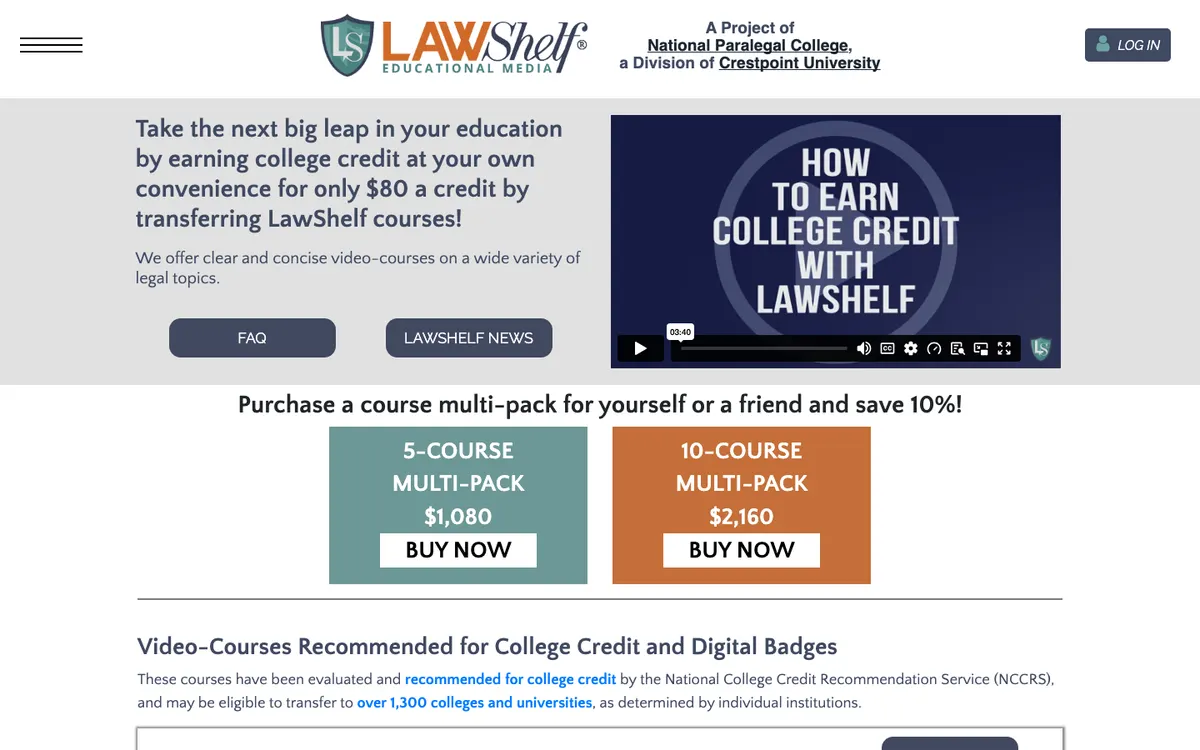
LawShelf, a project of National Paralegal College, offers legal-studies video courses whose exams can earn college credit for $80 per credit. The courses have been evaluated and recommended by NCCRS, may transfer to more than 1,300 colleges as determined by each school, and are guaranteed to transfer to LawShelf’s regionally accredited partner colleges. Much of the video content is free to study, so you only pay when you want credit. That makes it one of the cheapest routes to credit in subjects like contracts, torts or business law.
Pros & cons
- Only $80 per credit
- NCCRS-recommended courses
- May transfer to 1,300+ colleges; guaranteed at partner colleges
- Free video content to study first
- Credit acceptance depends on each institution
- Exam-based model with little instructor interaction
What you’ll learn
LawShelf offers full legal-studies video courses, shorter videos, and a Foundations of Law section. Subjects include contracts, torts, and business law. Its official overview emphasizes concise instruction, giving you a way to explore legal topics before deciding whether to pursue credit through a course assessment.
The educational use can differ by learner. Someone seeking general legal literacy can study the free material, while someone pursuing credit needs a course whose assessment and recommendation match a receiving college’s requirements. Do not assume every short video or digital-badge course carries the same credit recommendation as a full course identified for transfer.
Format, schedule and time commitment
Study is self-paced, and free videos let you inspect the subject and teaching before paying for credit. The overview does not establish a shared course duration, weekly schedule, or examination window across all offerings. Check those details for the particular credit-bearing course you intend to use.
For a degree plan, work backward from the receiving institution’s transfer and enrollment deadlines. The time to study, complete an assessment, and have credit recognized may involve separate steps. Obtain those details before relying on LawShelf to fill a requirement immediately before graduation or another academic deadline, rather than assuming on-demand lessons make transfer processing instantaneous.
Video: LawShelf (Crestpoint University)
Accreditation and what the credential is worth
NCCRS, the National College Credit Recommendation Service, has evaluated the courses and recommended them for college credit. That recommendation does not require every college to accept them. LawShelf guarantees transfer to its partner regionally accredited colleges, while its broader transfer claim depends on each receiving school’s decision.
That distinction is central to the value of the product. Ask the receiving school to confirm the exact course equivalency, number of credits, and degree requirement satisfied before paying. A general willingness to consider NCCRS recommendations does not establish that a particular course will count toward your major, residency requirement, or remaining electives. The paid assessment is useful only when its intended academic use is clear.
Price, payment plans and refunds
Course exams for transfer credit cost $80 per college credit. Video courses and shorter videos are available free, so you can study before deciding to purchase the credit route. Paying is relevant when you want an assessment-backed academic outcome, not simply access to much of the instructional content.
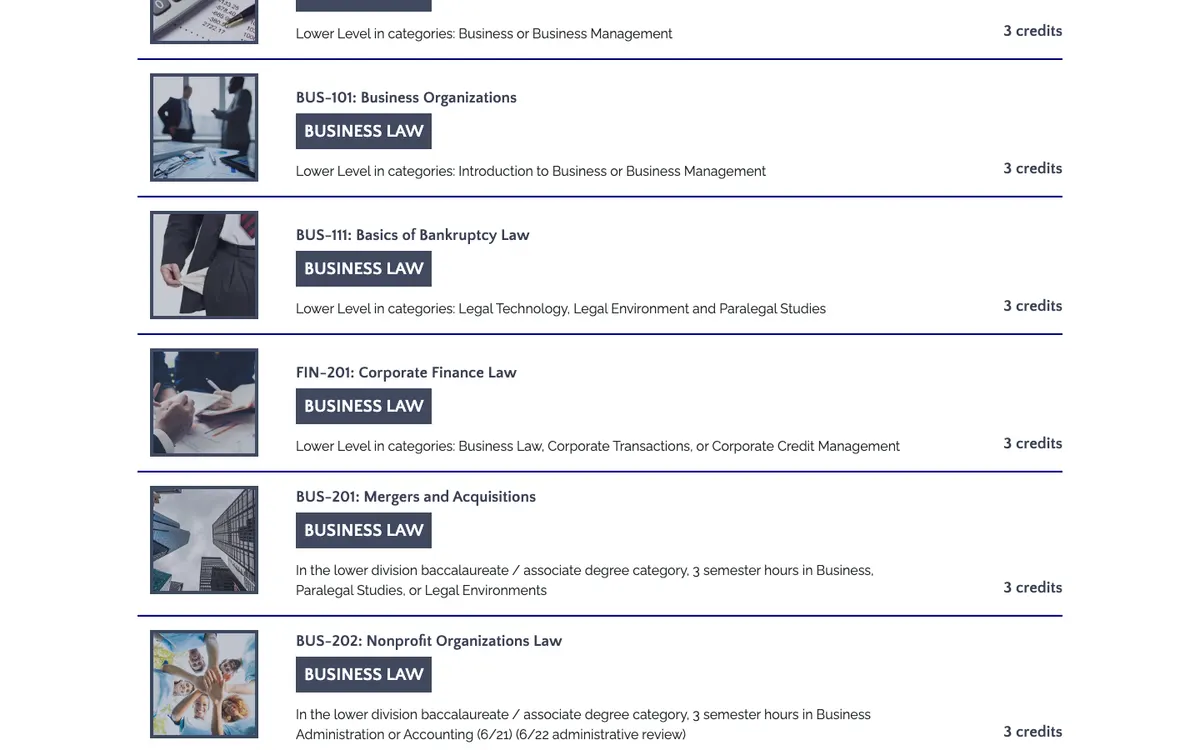
The published $80 amount is per credit, not necessarily the price of an entire course. Multiply by the credits attached to the specific course only after confirming that amount and the receiving school’s acceptance. The review does not assume every course carries the same number of credits.
Free instruction makes it inexpensive to assess the teaching before paying for credit. The overview did not establish refund rules, retake charges, or administrative fees, however. Ask for the full assessment and transfer-documentation cost instead of assuming the per-credit headline rules out every additional expense.
Who it’s best for — and who should skip it
LawShelf fits a self-directed adult who has identified a legal-studies course their college will accept for transfer. Free videos also make it useful for exploring a subject without immediately pursuing credit. The trade-off is an exam-based self-study model with little interaction, making both teaching fit and receiving-college acceptance worth resolving before payment.
Skip the paid route until the receiving college has confirmed acceptance. A working paralegal who mainly needs practical workflow instruction may find a targeted boot camp more relevant than an exam-based credit course. Someone requiring regular instructor interaction should also investigate support before assuming the self-study format provides the same guidance as a scheduled college class.
Pros and cons in detail
- A low per-credit rate: Paid credit is advertised at $80 per credit.
- NCCRS evaluation: Courses have recommendations for college credit.
- Potential transfer reach: More than 1,300 colleges may accept credit, with transfer guaranteed at partner colleges.
- Free instruction first: Videos let you study before paying for assessment.
- College-specific acceptance: Each institution determines how credit applies.
- Limited interaction: The exam-based model depends heavily on independent study.
The combination of free instruction and a clearly stated per-credit price makes exploratory study accessible. NCCRS recommendations and identified partner arrangements provide more concrete academic context than an ordinary completion badge. The potential transfer network is useful as a starting point for inquiries.
Potential transfer is not universal acceptance. The advertised number of colleges does not guarantee a place for every course in every degree plan, and even partner arrangements need to be checked for the exact program. Independent learning is another trade-off: the overview does not establish a standard amount of individual teaching support to accompany the exams.
How it compares
Paralegal Boot Camp sells self-paced workplace-skills videos rather than recommended college credit. Individual courses run $297-$697, with Litigation at $697, Billable Hours Mastery at $597, and Trial Prep at $297; the Ann AI tool is a separate $14.95 monthly item. Its catalog also covers e-discovery and other legal-support tasks. As the only other provider covered in this site’s paralegal category, it offers a useful contrast in the side-by-side comparison.
There are no additional same-category providers covered here beyond Paralegal Boot Camp. The comparison therefore focuses on the difference in purpose, not a long ranking of similar schools. Accepted academic credit and targeted professional development can each be useful, but they solve different problems.
If a college has confirmed LawShelf equivalency for a required course, its credit route may solve a specific educational need. If a supervisor expects better management of litigation files or discovery workflows, Paralegal Boot Camp may address the task more directly. The two products should not be ranked solely by a certificate label or by comparing a per-credit amount with a complete boot-camp price.
LawShelf’s own free and paid uses are also worth separating. A reader can learn from the videos without buying credit, while a degree-seeking learner should pay only after confirming the relevant assessment and transfer arrangement. That avoids purchasing an academic outcome that the intended institution will not recognize.
The Paralegal Certificate category places both options in context. Our review methodology explains the curriculum, credibility, value, flexibility, and support criteria behind this assessment of LawShelf’s free-study and paid-credit routes.
LawShelf (Crestpoint University) vs alternatives
How LawShelf (Crestpoint University) stacks up against other paralegal certificate programs we reviewed, on the facts published by each provider.
| Criterion | This review | |
|---|---|---|
| Our score | 8.7/10 | 8.4/10 |
| Price | $80 | $297 – $697 |
| Format | Self-paced | Self-paced |
| Duration | Self-paced. | Self-paced video courses. |
| Accreditation | Courses evaluated and recommended for college credit by NCCRS (National College Credit… | — |
| Free trial | Free video courses to study before paying for credit. | — |
| Best for | Adult learners who want low-cost, transferable college credit in legal subjects. | Working paralegals who want practical, job-ready skills (litigation, e-discovery,… |
| Read more | You are here | Paralegal Boot Camp reviewHead-to-head → |

“—” means the information was not published or not yet checked. See all 2 paralegal certificate programs.
How to enroll
Use LawShelf’s Video-Courses or Earn College Credit navigation to identify a course, then inspect the course-equivalency information. The official overview also provides login and contact links for questions about the credit route.
Before paying for an assessment, obtain written acceptance from the receiving college and confirm credits, prerequisites, exam rules, retakes, and documentation. Try the free teaching material first. Keep the college’s acceptance decision with the exact course and evaluation details, separately from LawShelf’s general transfer claims.
LawShelf credit information and Paralegal Boot Camp comparison pages consulted October 5, 2026: source 1, source 2, source 3, source 4.
Score breakdown
Legal-studies video courses tied to credit exams.
NCCRS-recommended with partner-college transfer guarantee.
$80 per credit with free study content.
Fully self-paced.
Self-study model.
Weighted average of five criteria. Read our methodology.
Key facts
FAQ
How much does LawShelf credit cost?
$80 per credit, per the site.
Will my college accept LawShelf credits?
Courses are NCCRS-recommended and may transfer to 1,300+ colleges at each school's discretion; transfer is guaranteed at LawShelf's partner colleges.
Head-to-head comparisons
Sources
- https://www.lawshelf.com/
- https://www.lawshelf.com/faq
- https://www.lawshelf.com/courses
- https://lawshelf.com/
- https://lawshelf.com/faq
- https://lawshelf.com/courses
- https://paralegal-bootcamp.thinkific.com/
Information checked on October 5, 2026. Prices and offers can change; confirm on the official site.