
Kajabi (Creator Business Platform)
8.4/10Editorial score
- Price
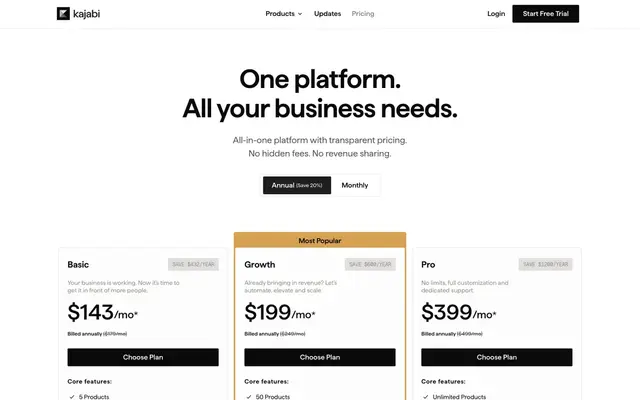
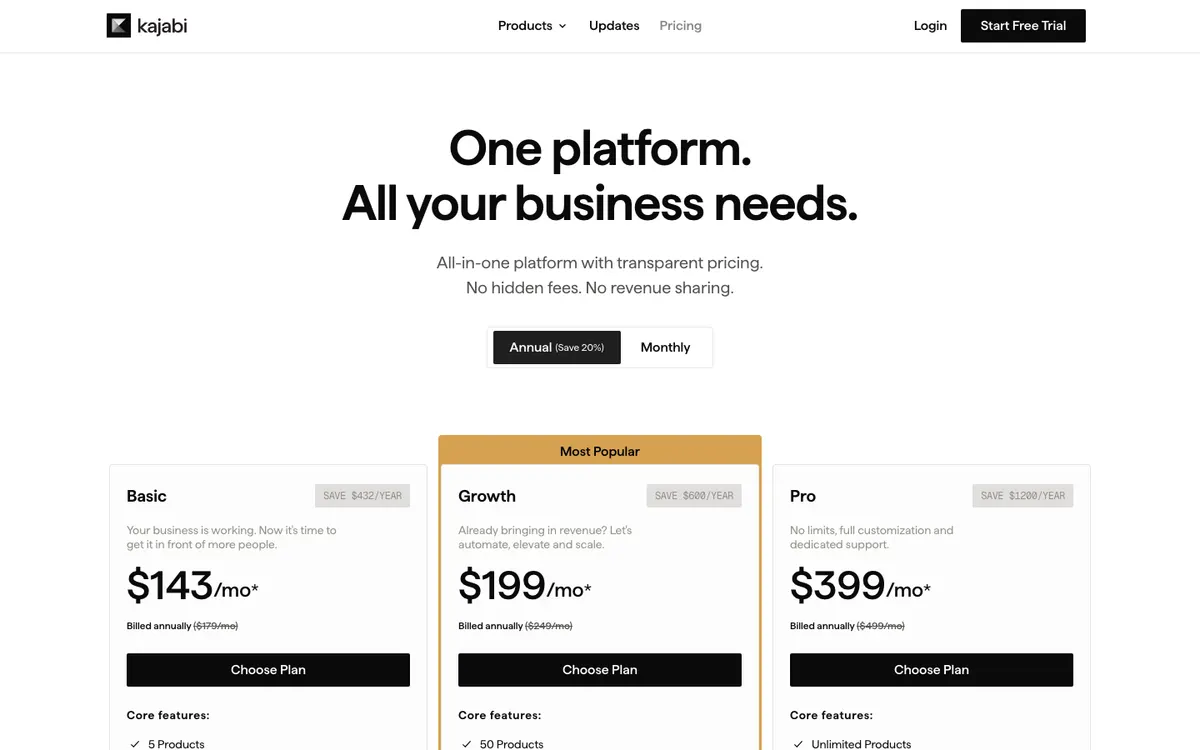
- From $143/mo billed yearly ($179 monthly)
- Best for
- Creators with an audience who want to own the business.
Kajabi is the better home for a course business: you set the prices, own the marketing and keep your revenue, for a monthly fee. Udemy costs nothing upfront and brings buyers to you, but on its own marketplace sales you keep 37% of the net amount.
Choose Kajabi if…you already have an audience (email list, YouTube, social), want to set your own prices and sell courses, coaching and memberships under your brand, and can pay from $143 a month billed annually.
 Choose Udemy if…
you have no audience yet, want to publish a video course without a monthly fee, and accept that Udemy runs the marketplace, its promotions and a 63% cut of the sales it brings you.
What tips the choicewho brings the buyers. If they come from your own channels, Kajabi lets you keep nearly all of the revenue for a fixed fee. If you need Udemy's marketplace to find them, you pay for that reach with most of each sale.
We may earn a commission when you buy through links on this page. Our rankings are based on our editorial criteria; some partners may be featured more prominently. Affiliate disclosure.
| Criterion | Kajabi | Udemy |
|---|---|---|
| Editorial scoreWeighted average of our five criteria | 8.4/10Higher score | 8.2/10 |
| PriceAs published on the official site | Basic $179/mo ($143 billed annually); Growth $249/mo ($199 annually); Pro $499/mo ($399 annually). No revenue share; card processing fees apply. Checked October 13, 2026 | For instructors: no plan fee in the instructor terms; revenue share of 37% of the net amount on marketplace sales, 97% with your own coupon or referral link (terms updated July 29, 2026). For learners: Personal Plan from $13 a monthLower starting price |
| Payment plansHow the cost can be spread | Monthly or annual (save 20%). | Instructor payouts within 45 days of the end of the month, once you reach $25; PayPal, Payoneer or bank account |
| FormatHow you study | Subscription | Self-paced |
| DurationTime to finish or access period | Subscription. | Self-paced; course length set by each instructor. Bought courses come with lifetime access to the content; Personal Plan access ends when you cancel |
| CertificateWhat you receive at the end | Not published | Certificate of completion (not an accredited credential). |
| Free trialWays to test before paying | Free trial; the Business Launch Kit offer on the pricing page lists 14 days, converting to Growth monthly at $249 unless cancelled | Personal Plan may start with a free trial; its length is shown at sign-up and you're charged when it ends unless you cancel |
| Refund policyYour way out if it is not a fit | 30-day money-back guarantee on every plan; upgrade, downgrade or cancel anytime | Most course purchases can be refunded within 30 days, as a refund to your card or as Udemy credit, at Udemy's discretion. Personal Plan fees, coaching and exam vouchers aren't refundable; cancelling a subscription keeps access until the end of the billing period (Udemy Terms of Use, October 30, 2026). |
| Best forWho it suits | coaches and creators who already sell a course, coaching or membership and want to replace separate email, website, checkout and community tools with one subscription. | Self-directed learners who know which certification exam they're sitting and want a low-cost video course or practice-test set from an instructor they've vetted. |
“Not published” means the provider did not state it or we could not confirm it. Program data checked October 5, 2026. Comparison updated October 13, 2026.
Kajabi: Creator platform, no learner curriculum. · Udemy: Varies by instructor; strong options exist for major exams.
Kajabi: Leading creator business platform. · Udemy: Marketplace model with uneven quality control.
Kajabi: From $143/month annually. · Udemy: Single courses are usually inexpensive.
Kajabi: Change or cancel anytime. · Udemy: Self-paced with lifetime access.
Kajabi: Premium support tiers. · Udemy: Instructor Q&A only.
Scores out of 10 from our published method; the overall score is the weighted average.
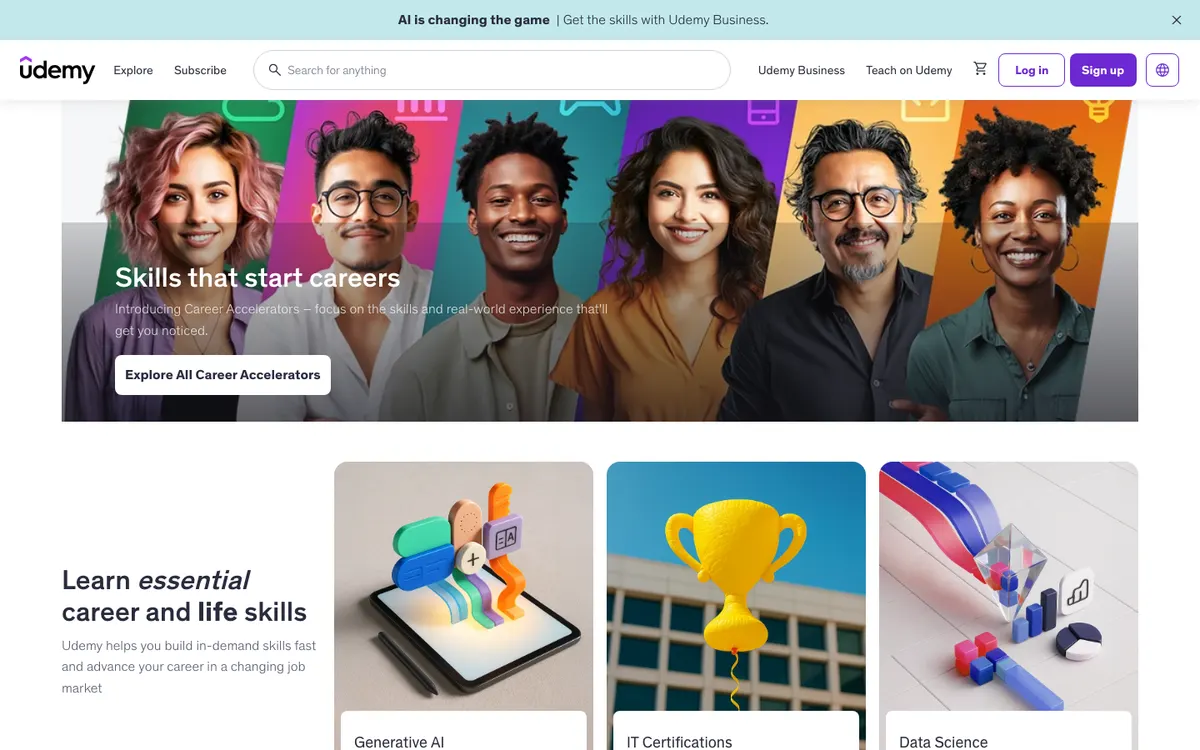
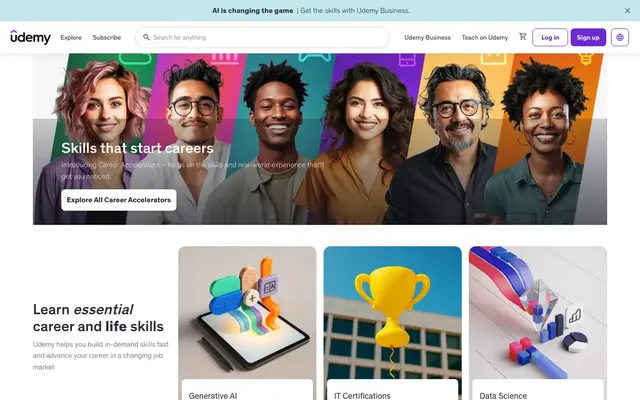
This is what Udemy’s share pays for. Your course sits in a marketplace where learners browse, search and buy, and Udemy runs its own promotions and sitewide sales; on October 13, its banner advertised courses from $11.99. Its Personal Plan subscription gives learners access to more than 28,000 courses selected for the plan.
Kajabi brings no buyers. It gives you the tools to attract them: unlimited marketing emails, landing pages and funnels, with 2,500 contacts on Basic, 25,000 on Growth and 100,000 on Pro. If you have no audience, those tools will sit idle.
WinnerUdemy.
On Kajabi, the site, the price, the offer and the customer list are yours. You can sell courses, coaching, memberships and communities, run your own promotions and affiliate programs, and, depending on the plan, remove Kajabi branding.
On Udemy, you choose a base price, for some content from a list of price tiers, and Udemy lists the course at least at that price unless you opt into its promotional programs, in which case Udemy may set a different discounted price. Foreign-currency and mobile prices follow Udemy’s price tables. The terms also restrict using Udemy to promote your off-site business in ways that break its policies, and they include instructors in Udemy’s Generative AI Program automatically unless you opt out during the designated periods; read that policy before you publish.
Our credibility scores: 8.9/10 for Kajabi as a creator platform, 7.8/10 for Udemy, rated as a marketplace for learners.
WinnerKajabi.
Kajabi is an all-in-one platform: website, courses, community, email marketing, funnels, checkout and analytics, plus affiliate programs and, on Pro, a branded mobile app. Its pricing FAQ argues that it replaces separate email, website and checkout tools.
Udemy gives you a course page, Q&A with students, coupon codes and referral links, and coaching services paid at an 80% share. Everything else, from email to your own website, happens elsewhere. Both are flexible to start and leave, scoring 9.5/10 on flexibility.
WinnerKajabi.
Udemy pays within 45 days of the end of the month in which it receives the payment, once you are owed at least $25, in US dollars to PayPal, Payoneer or a bank account in select countries. Student refunds are deducted from your share.
Kajabi has a free trial and a 30-day money-back guarantee on every plan, and you can change or cancel anytime. It runs a weekly live Q&A for people deciding, and Pro includes dedicated support. Our support scores: 8.9/10 for Kajabi, 7.3/10 for Udemy.
WinnerKajabi.
KajabiUdemyPick KajabiYour buyers come from your list, so a fixed fee beats a revenue share. Kajabi's Growth plan includes 25,000 contacts, unlimited marketing emails and funnels.
Pick UdemyUdemy charges no plan fee in its instructor terms and lists your course in its marketplace. You keep 37% of the net amount on those sales, but you pay nothing until you sell.
Pick KajabiKajabi sells courses, coaching, memberships and communities from one site. Udemy offers coaching services too, at an 80% share, but inside its own marketplace.
Other online course platforms options we reviewed, ranked by editorial score.

Career changers with a concrete plan of two or more Coursera certificates, such as a Google certificate followed by a specialization, who can study steadily for a year.
Working photographers, designers and video editors who want a big on-demand library plus live classes they can ask questions in.
Self-directed learners who want one specific course from a named university, and who want to try it free before paying for the certificate.
For a course business, yes: Kajabi scores 8.4/10 against 8.2/10 for Udemy in our review, ahead on credibility and support. Udemy scores higher on value, and our Udemy scores rate it mainly as a place to learn. For a creator, the deciding factors are revenue share and who finds the buyers.
Under its instructor terms updated July 29, 2026, Udemy first deducts taxes, mobile platform fees and a 3% service and processing fee to reach the net amount. You then receive 37% of that on marketplace sales, 97% when the buyer uses your coupon or referral link, and 80% for coaching sessions.
Kajabi says it takes no revenue share. Card processing through Kajabi Payments costs 2.9% + $0.30 on Basic for US entities, less on higher plans, and Kajabi adds a fee of 2%, 1% or 0.5% if you use a third-party payment provider where Kajabi Payments is available.
Udemy's instructor terms let you remove your content at any time, though students who already bought it keep their access. The terms also restrict promoting your off-site business through Udemy against its policies, so read the full terms and Trust & Safety rules before you cross-promote.
Within 45 days of the end of the month in which Udemy receives the payment, once you are owed at least $25. Payouts go to PayPal, Payoneer or a bank account in select countries, in US dollars.
Yes. Kajabi offers a free trial, and every plan has a 30-day money-back guarantee. You can upgrade, downgrade or cancel anytime.
We score each program on curriculum, credibility, value, flexibility and support, using the provider’s official pages; see how we score. The comparison above was written from these sources and re-checked against the official sites on October 13, 2026. Prices and terms change: confirm them on the official site before you enroll.
We may earn a commission when you buy through links on this page. Our rankings are based on our editorial criteria; some partners may be featured more prominently. Links marked as sponsored are affiliate links. Read our affiliate disclosure.