On this page · 11 sections5 min read
Our verdict
Our verdict8.2/10Udemy's best use is narrow: one exam, one instructor you've checked, and $19.99 to $199.99 for a course you keep (official prices, October 30, 2026).
That suits a self-taught learner who already knows the certification they want and needs videos plus practice tests to get there. If you'd rather have a structured program from a named company or university, Coursera Plus is the better buy, and if you'll take several courses this year, Udemy's own Personal Plan from $13 a month beats buying them one by one. The catch: Udemy is a marketplace, so the quality is whoever made the course, and the 30-day refund can come back as Udemy credit instead of cash.
Best for: Self-directed learners who know which certification exam they're sitting and want a low-cost video course or practice-test set from an instructor they've vetted.
At a glance
Search “Security+” on Udemy and you’ll get pages of results: video courses, practice-test bundles, cram guides, all with star ratings and a sale price. Somewhere in there is the course that gets you through the exam in six weeks. A few others are out of date, thin, or mostly someone reading slides. Udemy is an open marketplace for certification prep, and the whole job of buying there is telling those apart.
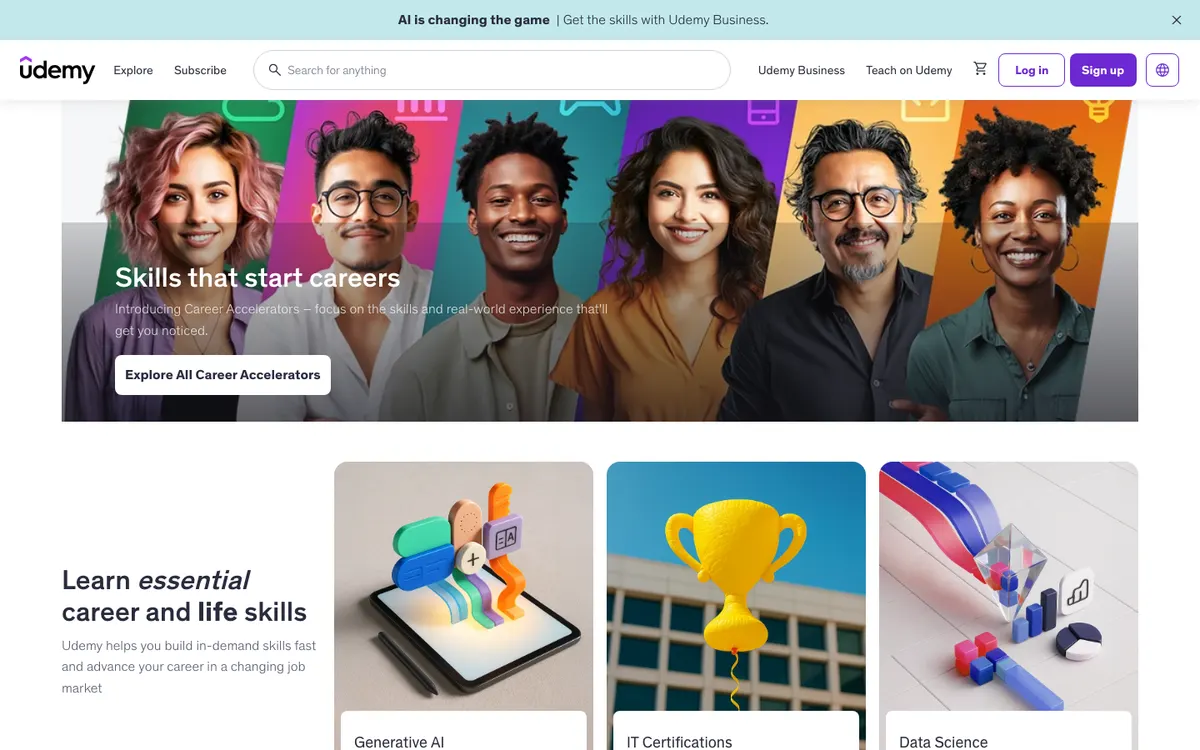
The money side is simple. On October 30, 2026, Udemy’s official page listed individual courses at $19.99 to $199.99 as a one-time purchase, with lifetime access to that course. Its subscription, Personal Plan, started at $13.00 a month, billed monthly or annually, and opened a library of more than 28,000 courses, including over 12,000 cert prep courses and practice tests. Prices in the mobile apps can differ from the website, Udemy’s terms say, so check the price where you’ll actually pay.
How we reviewed it: we read Udemy’s Personal Plan page and its Terms of Use on October 30, 2026, and compared Udemy with the other course platforms on our site. We haven’t bought or taken a course for this review.
Some links on this site earn us a commission if you enroll. Your price stays the same. Our rankings are based on our editorial criteria; some partners may be featured more prominently. How we review
Pros & cons
- One course, one payment: $19.99 to $199.99, and the course content stays in your account
- A very large cert prep shelf: Udemy counts more than 12,000 cert prep courses and practice tests in Personal Plan alone
- Most purchases can be refunded within 30 days if the course isn't what you expected
- Personal Plan, from $13 a month, lets you switch between instructors until one style clicks
- Quality depends entirely on the instructor; two courses for the same exam can be worlds apart
- The 30-day refund may be paid as Udemy credit rather than back to your card, at Udemy's choice
- Lifetime access covers the videos, not the instructor: Q&A help can stop at any time
- Completion certificates are not industry credentials, and the real exam fee is separate
Who gets the most from it
Udemy works best for someone who already knows the destination. You’ve picked the exam (CompTIA A+, AWS Cloud Practitioner, the PMP), you’ve downloaded the official exam objectives, and what you need now is a teacher who walks through them and a few hundred practice questions to show you where you’re weak. That’s a $20 to $200 problem, and Udemy solves it well.
It’s also handy as a second opinion. Plenty of people study from an official guide or a bootcamp and buy one Udemy practice-test set the month before the exam, just to see questions written by somebody else. That use costs little and carries little risk.
It’s a poor fit if you want someone to build the path for you. Udemy has no single curriculum, no adviser and no cohort. If you don’t know yet whether you want cloud, security or project management, you’ll spend more time browsing than learning.
What you actually buy
When you buy a course, you get a license to watch it on Udemy, for as long as Udemy can keep it online. The Terms of Use are careful here: lifetime access applies to the course content, not to the instructor. An instructor can stop answering questions in the Q&A at any time, and Udemy can pull a course for legal or policy reasons, such as a copyright complaint.
Picture it six months later. You passed Security+, and now you want to revisit a module before a job interview. The videos are still in your account. The instructor, though, may have moved on, and the exam itself may have changed version since you studied. Lifetime access means the files stay; it doesn’t mean they stay current.
At the end you get a certificate of completion. It proves you watched the course. It isn’t the certification. CompTIA, AWS and PMI award their credentials only when you pass their exams, which you book and pay for separately. Udemy may also sell exam vouchers for some exams; its terms say voucher purchases are final, with no refund.
Personal Plan or one course?
Personal Plan changes the deal. For a monthly fee (from $13.00 on our check), you can open any course in the plan’s library, move between instructors and use extras that single courses don’t have: skills assessments, labs and coding exercises. The page lists more than 600 skills assessments and over 180 labs and coding exercises.
The trade-off is ownership. Courses you open through the plan don’t come with lifetime access, and when you cancel, access ends on the last day of your billing period. Udemy’s terms also say there’s no refund of subscription fees already paid. A free trial is sometimes offered; its length is shown at sign-up, and you’re charged when it ends unless you cancel first.
The math is easy. One exam, one course you’ve already picked: buy it. Three or four courses over the next few months, or you don’t know yet which instructor suits you: the plan usually wins, provided you cancel when you’re done.
The catch: you’re buying a person, not a brand
Every Udemy course is made by an independent instructor. Udemy hosts and sells it; it doesn’t write the syllabus. That’s why two courses with nearly the same title can be worlds apart: one updated for the current exam version with labs and explanations, the other a recorded slide deck from three years ago. The star rating helps, but it averages people who finished the course with people who watched ten minutes.
Before you pay, check four things on the course page: the exam code it targets (match it to the official exam guide), the last-updated date, what’s actually included (videos, practice tests, both), and two or three preview lectures. If the instructor’s voice or pace bugs you in the preview, it’ll bug you for 20 hours.
The refund is a real safety net, with conditions. Udemy says most content purchases can be refunded within 30 days if the course isn’t what you expected. But Udemy decides whether that refund goes back to your card or into your account as credit, which you can only spend on Udemy. Subscriptions, coaching and exam vouchers are excluded. If cash back matters, buy on the website, keep your receipt and ask early.
How it compares
Coursera Plus costs $399 a year or $59 a month in our data, with a 7-day free trial and a 14-day money-back guarantee on the annual plan. You pay more, but programs come from named companies and universities, with a fixed sequence and graded work. If you want structure more than choice, that’s the safer bet.
LinkedIn Learning offers a free first month and says more than 2,000 of its courses prepare for over 120 external credentials, with certificates that show up on your LinkedIn profile. The library is broad but mostly short videos, so it’s better for filling gaps than for a full exam plan, and many public libraries give free access. Skillshare is built for creative skills rather than exams; we wouldn’t use it for certification prep.
All of these are compared in our online course platforms ranking.
Swipe sideways to compare all 4 programs →
| Criterion | This review | |||
|---|---|---|---|---|
| Our score | 8.2/10 | 9.2/10 | 8.7/10 | 8.7/10 |
| Price | $19.99 – $200 | $59 – $399 | $299 | — |
| Format | Self-paced | Subscription | Hybrid | Self-paced |
| Duration | Self-paced; course length set by each instructor. Bought courses come with lifetime access to the content; Personal Plan access ends when you cancel | 12 months of unlimited access. | 2,300+ on-demand classes; 100+ live classes a year. | Varies by course or program. |
| Free trial | Personal Plan may start with a free trial; its length is shown at sign-up and you're charged when it ends unless you cancel | 7-day free trial. | — | Most courses can be audited for free, with temporary access and no certificate |
| Best for | Self-directed learners who know which certification exam they're sitting and want a low-cost video course or practice-test set from an instructor they've vetted. | Career changers with a concrete plan of two or more Coursera certificates, such as a Google certificate followed by a specialization, who can study steadily for a year. | Working photographers, designers and video editors who want a big on-demand library plus live classes they can ask questions in. | Self-directed learners who want one specific course from a named university, and who want to try it free before paying for the certificate. |
| Read more | You are here | Coursera reviewHead-to-head → | CreativeLive reviewHead-to-head → | edX reviewHead-to-head → |

“—” means the information was not published or not yet checked. See all 15 online course platforms programs.
Before you buy
Download the official exam objectives from the certifying body first. Then shortlist two Udemy courses for that exact exam code, watch two preview lectures of each, and compare their last-updated dates. Buy the one that matches the objectives, start it the same week, and decide within 30 days whether it’s working, while the refund window is still open.
Video: Udemy
Most course purchases can be refunded within 30 days, as a refund to your card or as Udemy credit, at Udemy's discretion. Personal Plan fees, coaching and exam vouchers aren't refundable; cancelling a subscription keeps access until the end of the billing period (Udemy Terms of Use, October 30, 2026).
Pay per course once, or subscribe to Personal Plan (monthly or annual billing, auto-renews, cancel anytime)
No public discount was listed on the official site when we checked. We never publish unverified coupon codes.
Score breakdown
Varies by instructor; strong options exist for major exams.
Marketplace model with uneven quality control.
Single courses are usually inexpensive.
Self-paced with lifetime access.
Instructor Q&A only.
Weighted average of five criteria. Read our methodology.
FAQ
Are Udemy certificates worth anything?
Not as credentials. A Udemy certificate of completion shows you finished a course; it isn't the CompTIA, AWS or PMI certification the course prepares you for. Those are only awarded when you pass the official exam with the certifying body. On a résumé, list the certification you earned, not the Udemy course.
Can I get a refund on a Udemy course?
Usually, yes, within 30 days of purchase if the course isn't what you expected, according to Udemy's Terms of Use (read October 30, 2026). Udemy decides whether the money goes back to your payment method or into your account as credit. Personal Plan subscriptions, coaching and exam vouchers are excluded.
Is Udemy Personal Plan cheaper than buying courses?
It depends on how many courses you'll use. Personal Plan started at $13 a month on October 30, 2026, and adds practice labs and skills assessments, but you lose access when you cancel. If you need one course for one exam, buying it once is simpler; if you'll take three or four this year, the plan usually comes out ahead.
Head-to-head comparisons
Sources
- https://www.udemy.com/affiliate/
- https://www.udemy.com/personal-plan/
- https://www.udemy.com/terms/terms-of-use/
- https://www.coursera.org/courseraplus
- https://www.linkedin.com/learning/
Prices and offers can change; confirm on the official site before you enroll.