On this page · 8 sections6 min read
What a herbalist does
Herbalism includes several distinct activities: learning to identify plants, growing and preparing herbs, teaching traditional uses, and offering consultations within applicable boundaries. The American Herbalists Guild’s education guidance describes multiple learning routes rather than one standardized occupational entry program. Choose the activity you want to pursue before comparing certificates.
An aspiring grower needs plant identification and cultivation knowledge; a product maker must also understand the requirements for the product being sold. Someone interested in consultations needs a different level of preparation in client communication, limitations, and referral. A short home-apothecary course should not be represented as complete preparation for all three activities.
A useful learning record is a carefully sourced plant monograph. Identify the botanical name, the part discussed, the preparation being studied, and the source behind each statement. Keep historical or traditional uses separate from claims supported by clinical evidence instead of allowing the word “natural” to stand in for a safety assessment.

Do you need a license or certification?
The American Herbalists Guild states that there is no US licensure or legal recognition specifically for professional clinical herbalists. It also warns that school-awarded titles such as Certified Herbalist or Master Herbalist are not recognized by state or federal entities and are not endorsed by the Guild. That is a statement about those credentials, not permission to practice medicine without a license. AHG education FAQs
AHG’s Registered Herbalist membership is a separate voluntary recognition of education and experience. A course certificate does not automatically confer that membership. Review the Guild’s registration information if that is your goal, and ask how a school documents the learning you would need to present.
The legal questions change with the activity. Teaching a class about botanical traditions, selling a packaged product, and making disease-treatment claims are not the same service. Before consulting or selling, obtain guidance from the relevant state and product regulators about your proposed wording, preparation, and distribution method.
Do not assume that a foreign school’s professional terminology creates a US license. This selection includes providers operating in different countries and programs with incomplete details. Ask what the credential means in the jurisdiction where you will work rather than importing the provider’s local professional assumptions.
A responsible educational pathway should also make room for uncertainty. If a course cannot explain how it handles interactions, vulnerable populations, or referral, that is a question to resolve before enrollment. This guide does not supply herbal treatment instructions or claim that any listed certificate authorizes diagnosis.
Step-by-step: how to become a herbalist
- Choose your immediate learning objective. Decide whether the first goal is gardening, personal study, product education, or eventual professional consultation. A defined objective helps you avoid buying an extensive clinical-style program when you mainly want to understand plants in your garden.
- Build reliable identification skills. Learn botanical naming and practice checking more than one identifying feature. Use supervised local learning for unfamiliar plants rather than treating a photograph or an app suggestion as sufficient evidence for harvesting.
- Compare curriculum depth and prerequisites. Check whether anatomy, research literacy, preparation methods, and supervised application are included where relevant. An intermediate course may assume introductory knowledge, so inspect the starting level before judging it only by price.
- Create a source-based study notebook. Record the distinction between traditional use, instructor opinion, and evidence from a cited reference. When sources disagree, preserve the disagreement and ask the instructor how it should affect a practical decision.
- Practice preparation only within appropriate guidance. Follow the course’s documented methods and keep records of ingredients, identity, and process. Do not sell experimental products or recommend them to other people merely because a lesson demonstrated a preparation.
- Arrange qualified feedback for professional ambitions. If consultations are your goal, ask about supervised case learning and the instructor’s review process. Keep fictional exercises and real client experience clearly distinguished in any application or portfolio.
- Verify the rules for your intended service. Before launching a class, consultation business, or product line, identify the relevant business and professional boundaries. Have a qualified adviser assess marketing claims for the actual activity rather than assuming the course’s certificate resolves the legal questions.
How long it takes and what it costs
Herbal Academy’s $395 intermediate course and Chestnut’s $3,749 immersion illustrate the spread in confirmed course prices here. The former is a defined intermediate sequence; the latter is a much larger study commitment. Price only becomes useful after you compare the subject depth and preparation each course offers.
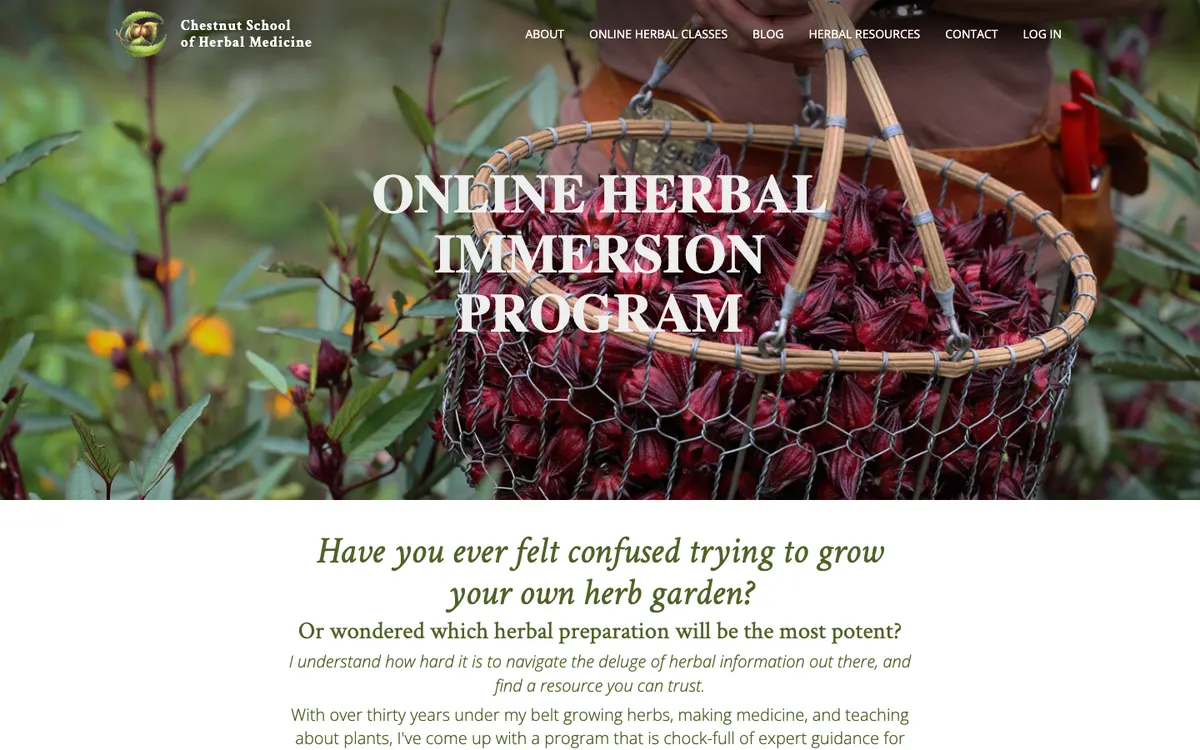
Chestnut School Online Herbal Immersion Program opens full access on enrollment to a 1,200-hour program. Tuition is $3,749 paid in full, or 24 monthly payments ordinarily listed at $169 and advertised on sale at $139 (20% off).
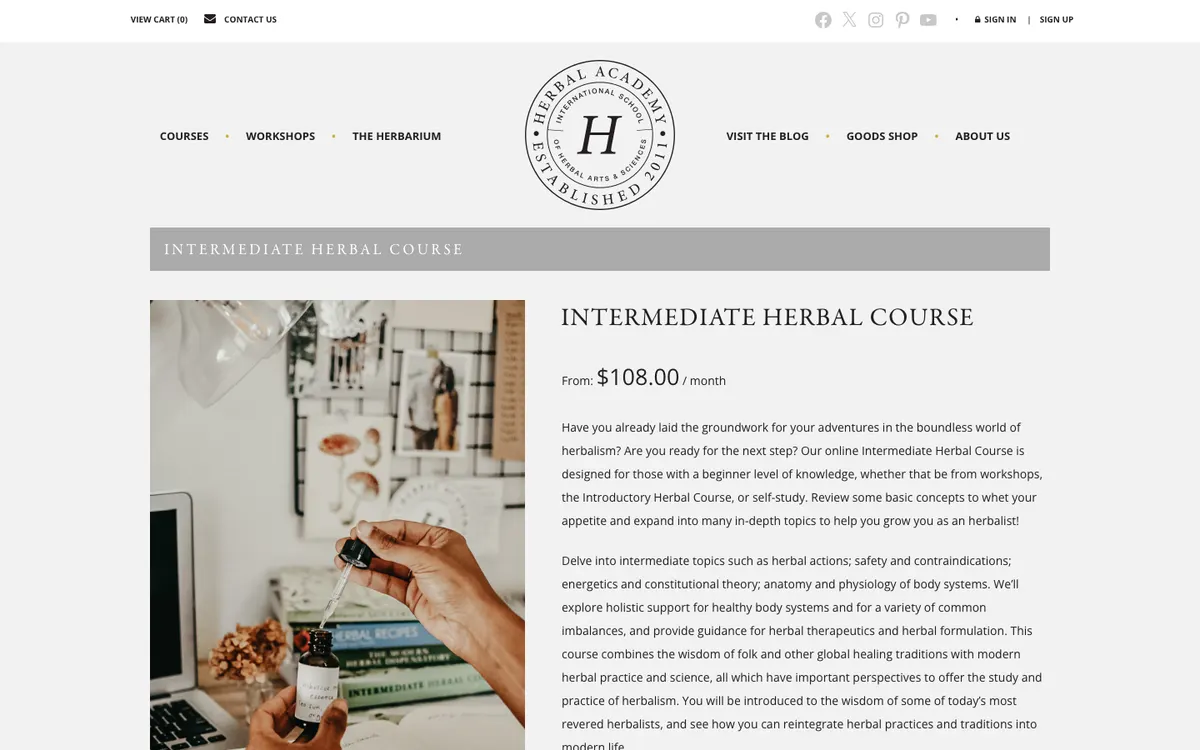
The official affiliate page prices Herbal Academy Intermediate Herbal Course at $395 paid at once, with installments from $108/month. Its self-paced curriculum has 10 units and 59 lessons. For a different starting level, the Introductory course has payments from $58.50/month.
Matthew Wood Institute of Herbalism Year One Program is a year-long foundation priced at $2,995 on the official affiliate page, with about $200 extra for supplies. Separate memberships start at $25/month for Herbs A-Z and $35/month for Home Apothecary.
A live cohort distinguishes Ecoversity 100-Hour Herbalism Program: its 100 hours run over 6 months. Payment choices are $3,497 once, 6 × $616.20, or 10 × $370.
For Wild Rose College of Herbal Medicine, neither tuition nor a completion timetable is confirmed here. Request a written quote and schedule for the exact course; without them, you cannot judge its budget or calendar commitment alongside the other schools.
A program described in hours cannot be converted automatically into a fixed number of calendar months. Plant observation may also depend on the growing season where you live, and practical supplies can be separate from tuition. Ask what can be completed remotely and what requires access to plants, ingredients, or local instruction.
Payment plans deserve a full-total comparison. A monthly installment can look easier to afford while producing a different total from paying once. Obtain current terms, including any extension or refund conditions, and do not rely on an October 2026 promotion as a permanent price.
Best online programs for aspiring herbalists
In rank order, these schools offer different starting levels and study formats; Wild Rose requires further information before a meaningful comparison.
- Chestnut School Online Herbal Immersion Program uses a self-paced format.
- Herbal Academy Intermediate Herbal Course uses a self-paced format.
- Matthew Wood Institute of Herbalism Year One Program uses a self-paced format.
- Ecoversity 100-Hour Herbalism Program uses a live online format.
- Wild Rose College of Herbal Medicine has incomplete public program information here, so its training scope needs confirmation before enrollment.
The Herbalism comparison links to each school’s review and helps distinguish intermediate study from longer foundational programs.
Top programs compared
The 4 highest-scored online herbalism programs in our ranking, side by side.
Swipe sideways to compare all 4 programs →
| Criterion | ||||
|---|---|---|---|---|
| Our score | 8.7/10 | 8.6/10 | 8.6/10 | 8.1/10 |
| Price | $3,336 – $4,056 | $395 | $25 – $2,995 | $3,497 – $3,700 |
| Format | Self-paced | Self-paced | Self-paced | Live online |
| Duration | 1,200-hour program; full access on enrollment | Self-paced, 10 units and 59 lessons | Year-long foundational program; supplies cost about $200 extra | 6-month live cohort, 100 hours |
| Best for | Dedicated students who want one of the most comprehensive self-paced online herbalism… | Home herbalists who want a structured, self-paced course on body systems, energetics and… | Serious herbal students who want to learn the traditional, energetics-based approach of a… | Beginners who want a mentored, cohort-based introduction to herbalism with live sessions… |
| Full review | Chestnut School of Herbal Medicine review | Herbal Academy review | Matthew Wood Institute of Herbalism review | Ecoversity review |

Scores from our editorial method. See the full ranking of 5 programs.
Common mistakes to avoid
Do not equate a long hour count with supervised professional competence. Ask what those hours include and how work is assessed. Video lectures, independent reading, practical preparation, and consultations with feedback answer different learning needs.
Avoid identifying a plant by a common name alone. Your notes should make clear which species and plant part the lesson discusses. A useful course should help you recognize when identification is uncertain and when local expert confirmation is needed.
Do not turn historical use into an unsupported treatment promise. If you plan to teach, explain the source and limits of the material; if you plan to sell, investigate the rules for that product and its claims. A certificate cannot supply evidence that the underlying claim lacks.
Be careful with a provider whose current details are missing. The available Wild Rose information does not establish usable tuition, schedule, or delivery information. Keep it as an option to investigate rather than filling the gaps with assumptions about a similarly named course.
FAQ
Is Certified Herbalist a government license?
AHG says school-awarded herbalist titles are not recognized as state or federal qualifications. Read its education FAQs before interpreting a certificate’s authority.
Does a course automatically make me an AHG Registered Herbalist?
No. AHG Registered Herbalist membership is a separate recognition process. Ask the school how its education is documented rather than assuming automatic registration.
Which listed course assumes prior learning?
The Herbal Academy intermediate course is described as building on introductory knowledge. Check the syllabus against what you already understand before enrolling.
Can I get a verified price for every listed school?
Not every school has a confirmed price here. Use the herbalism comparison to identify the gaps, then request a written quote for the particular course you want.