On this page · 15 sections5 min read
- 01Our verdict
- 02At a glance
- 03Pros & cons
- 04Who teaches
- 05A Wednesday in the program
- 06Mentorship and lab hours
- 07What you’ll be able to do
- 08The catch: the price and the sales tactics
- 09Safety is part of the course
- 10Paying for it
- 11Who should look elsewhere
- 12Before you enroll
- 13Ecoversity vs alternatives
- 14Score breakdown
- 15FAQ
Our verdict
Our verdict8.1/10Six months, once a week, live with some of the best-known names in American herbalism (Rosemary Gladstar teaches every medicine-making lesson): Ecoversity's 100-Hour Herbalism Program, $3,497 on October 30, 2026, is a fine choice for a complete beginner who wants a class to show up to, a mentor who learns their name and a shelf of homemade tinctures and salves by spring.
If you study well alone, Herbal Academy's self-paced courses cost a fraction of that. Worth knowing before you enroll: the page runs constant countdowns, and the refund window is only 7 days.
Best for: Complete beginners who want to learn herbalism live, in a weekly class with a mentor and a cohort, and make their own home remedies.
At a glance
Not published on the official pages we read: accreditation.
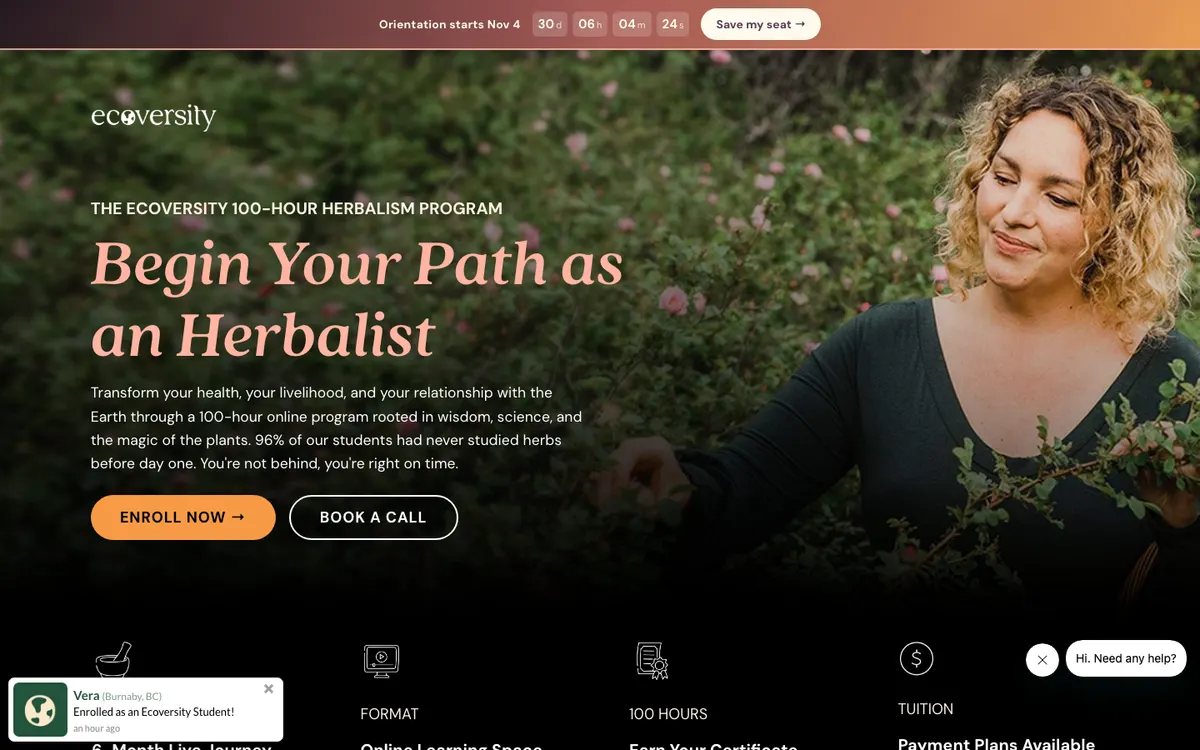
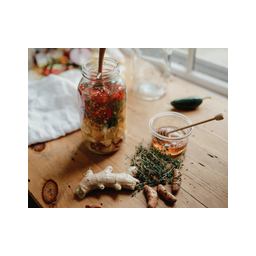
Grandma always had something for it. Ginger for an upset stomach, sage tea for a sore throat, a salve she made every summer from the calendula by the fence. Nobody wrote it down, and now you’d like to know it properly: which plant, which preparation, how much, and when not to. Ecoversity’s 100-Hour Herbalism Program is built for that beginner, and it teaches live, in a group, over six months.
Ecoversity says 96% of its students had never studied herbs before starting. On October 30, 2026, the program cost $3,497 in one payment, or six payments of $616.20, or ten of $370. The page also advertised $1,000 off for paying in full until October 31, 2026, and listed the Fall 2026 cohort orientation for November 4.
How we reviewed it: we read the program page, its curriculum, FAQ and enrollment terms on October 30, 2026, and compared Ecoversity with the other herbalism courses on our site. We haven’t taken the program.
Some links on this site earn us a commission if you enroll. Your price stays the same. Our rankings are based on our editorial criteria; some partners may be featured more prominently. How we review
Pros & cons
- Taught live by more than 16 herbalists, including Rosemary Gladstar, Kat Maier and Herb Pharm founder Sara Katz
- A weekly rhythm that suits beginners: one 90-minute class on Wednesdays, recorded within 24 hours if you miss it
- A named mentor (Celia Hale) and weekly Herbal Lab Hours to bring a stuck formula or an unknown plant
- Hands-on scope: 30+ preparations and 112 plants, and every lesson and recording stays yours for life
- $3,497 is several times the price of self-paced herbal courses
- Countdown banners and rotating offers make the regular price hard to judge
- Refund window is only 7 days after purchase
- The certificate of completion is educational; Ecoversity itself says it isn't a license or clinical certification
Who teaches
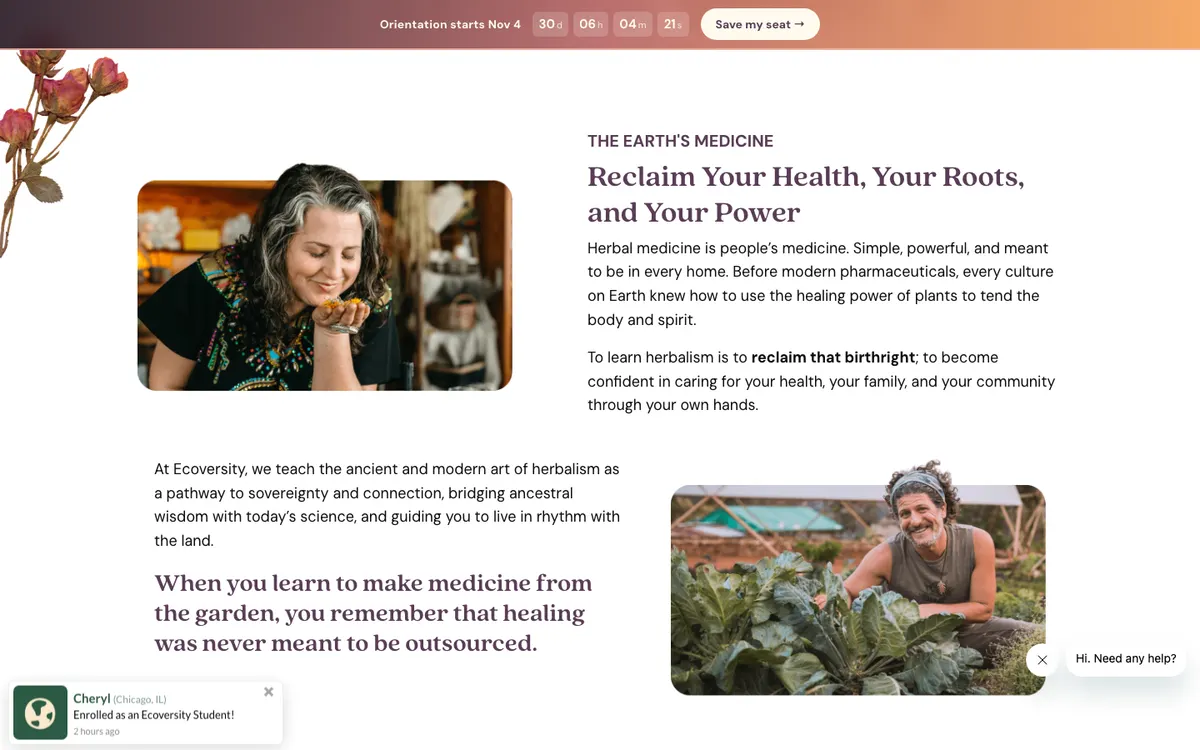
This is the program’s strongest card. More than 16 educators teach in it. Rosemary Gladstar, one of the best-known figures in American herbalism, teaches every medicine-making lesson. Kat Maier covers energetics, botany and body systems. Sara Katz, founder of Herb Pharm, and Adriana Ayales of Anima Mundi teach the business side. Mimi Hernandez handles plant constituents and herb-drug safety, Emily Ruff the nervous, immune and respiratory systems, and Dr. Jody E. Noé endocrine health and herbs for elders.
For a beginner, that range matters. You hear different traditions and ways of working, not one teacher’s method repeated for six months.
A Wednesday in the program
Every week has the same shape. On Wednesday at 3pm Pacific (6pm Eastern), you join a live class of about 90 minutes with the teachers themselves. If you’re at work, the recording is posted within 24 hours. Then you spend two to four hours during the week on lessons and making medicine at home.
Picture week ten: you watch Rosemary make a syrup on screen, then spend Saturday morning doing the same in your kitchen, labeling the jar and writing down what you’d change next time. On Tuesday you bring a question to Herbal Lab Hours. That loop, watch, make, ask, is how the program works.
The calendar includes Integration Weeks with no live class, to catch up or rest.
Mentorship and lab hours
Herbal Lab Hours run live every week for the full six months, alternating Tuesdays and Thursdays. You bring a formula that isn’t working, a plant you can’t identify or a question you’re stuck on, and herbalists help you. Your personal mentor, Celia Hale, appears in class, in Lab Hours and in the online community hub.
That’s what separates this program from a video course. A mentor who knows your name will notice if you’ve gone quiet in week eight, the kind of week when people learning alone tend to drift away.
What you’ll be able to do
By the end, Ecoversity says you’ll have made more than 30 preparations at home (tinctures, teas, syrups, salves) and know 112 plants by sight, taste and use. Module 5 spends 14 weeks on herbs by body system. Every lesson and recording stays yours for life, and you graduate with a 100-Hour Certificate of Completion.
You don’t need land. A windowsill and a few pots are enough to start, and many students live in apartments.
The catch: the price and the sales tactics
At $3,497, Ecoversity costs several times more than self-paced programs. What you pay for is live teaching, the names and the mentorship. If you don’t need those, it’s an expensive way to learn.
The sales page is also heavy on urgency: countdown timers, “last chance” banners, extended deadlines and offers that change with each phase of the enrollment period. That makes the regular price hard to judge. Look at the total you’ll pay, not the timer.
The money-back guarantee is short: 7 days after purchase. Ecoversity’s advice is to step inside the learning space and see how it feels. Do exactly that during the first week.
And the certificate is educational. Ecoversity says so clearly: it isn’t a license or clinical certification. In the US, there’s no state license for herbalists, so this prepares you for home and community care, not clinical practice.
$1,000 off the 100-Hour Herbalism Program when you pay in full by Oct 31, 2026 (official page), plus 10% off payment plans with the exclusive code PICKMYCERT until Nov 11, 2026 (code provided by Ecoversity on Oct 22, 2026).
↪See offer details and conditions7-day money-back guarantee: full refund if you ask within 7 days of purchase (official page, October 30, 2026).
6 or 10 monthly payments
Safety is part of the course
Herbs aren’t harmless because they’re natural. St. John’s wort interacts with common medications, and several plants aren’t suitable in pregnancy or for young children. The curriculum gives this real space: Mimi Hernandez teaches herb-drug safety, and Dr. Mary Bove’s lessons, kept in the program in her memory, cover pregnancy, postpartum and children’s health. Ecoversity states that the program is educational and doesn’t provide medical advice. If you or someone in your family takes prescription drugs, keep your doctor or pharmacist in the loop before adding herbs.
Paying for it
Paying in full is cheapest. Six payments of $616.20 add up to $3,697.20, and ten payments of $370 to $3,700, so about $200 more than the one-time price. Some offers on the page apply only to paying in full.
Who should look elsewhere
If you learn well alone, Herbal Academy sells its Introductory course for $349 and its intermediate course for $647, self-paced. Chestnut School of Herbal Medicine is the self-paced option with the most hands-on depth, on sale at $2,999 on our last check. If you’re drawn to a single teacher’s deep tradition, the Matthew Wood Institute of Herbalism offers memberships from $25 a month. All are in our herbalism courses ranking.
Video: Ecoversity
Before you enroll
Check your Wednesdays: can you attend at 3pm Pacific most weeks, or at least watch the replay within a few days? Ask for the free program guide to see the full curriculum. If you enroll, use the first 7 days actively: attend orientation, open the first module and post in the community, so you know whether it fits before the refund window closes.
Ecoversity vs alternatives
How Ecoversity stacks up against other herbalism programs we reviewed, on the facts published by each provider.
Swipe sideways to compare all 4 programs →
| Criterion | This review | |||
|---|---|---|---|---|
| Our score | 8.1/10 | 8.7/10 | 8.6/10 | 8.4/10 |
| Price | $3,497 – $3,700 | $2,999 – $4,056 | $25 – $2,995 | $647 |
| Format | Live online | Self-paced | Self-paced | Self-paced |
| Duration | Six-month live cohort, about 100 hours: a 90-minute live class every Wednesday at 3pm PT (recorded within 24 hours), plus 2 to 4 hours a week of lessons and home medicine-making; Fall 2026 orientation on November 4 | 1,200-hour program; full access on enrollment | Year-long guided program: 10 months of curriculum plus a catch-up month and a review month; at least 10 hours of study a week (158 hours of video, 2,232+ pages of reading) | Self-paced, 10 units and 59 lessons |
| Best for | Complete beginners who want to learn herbalism live, in a weekly class with a mentor and a cohort, and make their own home remedies. | Gardeners and home herbalists who want a long, self-paced program on growing, identifying and making herbal medicine, with strong botany content. | Studious herbal learners with some background who want Matthew Wood's traditional Western, energetics-based approach in depth. | Home herbalists who've finished an introductory course and want to learn formulation and body-system support for their family, at their own pace. |
| Full review | You are here | Chestnut School of Herbal Medicine review | Matthew Wood Institute of Herbalism review | Herbal Academy review |

“—” means the information was not published or not yet checked. See all 5 herbalism programs.
Score breakdown
100 hours of foundational herbalism with practical application.
Established nature-based school; no accreditation stated.
$3,497 is high for 100 hours compared with self-paced options.
Online but tied to a six-month cohort.
Mentorship and live cohort sessions included.
Weighted average of five criteria. Read our methodology.
FAQ
Is Ecoversity worth it?
For a beginner who wants live teaching and a mentor, yes: 25 live classes with well-known herbalists, weekly lab hours and lifetime recordings for $3,497 (October 30, 2026). If you're comfortable learning alone from text and video, self-paced programs such as Herbal Academy cost far less.
How much time does Ecoversity's herbalism program take?
About 90 minutes of live class on Wednesdays at 3pm PT, plus 2 to 4 hours a week of lessons and medicine-making, for six months. The calendar includes Integration Weeks without a class, and every class is recorded.
Will I be a certified herbalist after Ecoversity?
You'll get a 100-Hour Certificate of Completion. Ecoversity says it's educational, not a license or clinical certification. There's no state license for herbalists in the US; the program prepares you to care for your household and start community work, not to practice clinically.
Sources
- https://www.ecoversity.org/
- https://www.ecoversity.org/herbalism?utm_source=kajabi&utm_medium=landing_page&utm_campaign=herbv5_phase1&utm_content=sticky_header
- https://www.ecoversity.org/herbalism
- https://www.ecoversity.org/medicine-making-summit?utm_source=kajabi&utm_medium=landing_page&utm_campaign=herbv5_summit&utm_content=midpage_cta
- https://www.ecoversity.org/all-programs
Prices and offers can change; confirm on the official site before you enroll.