On this page · 15 sections5 min read
- 01Our verdict
- 02At a glance
- 03Pros & cons
- 04The approach in one paragraph
- 05A school that tells you when not to enroll
- 06What a year looks like
- 07Live, but optional
- 08The catch: access and downloads
- 09Paying for it
- 10The cheap way in
- 11Who should look elsewhere
- 12Before you enroll
- 13Matthew Wood Institute of Herbalism vs alternatives
- 14Score breakdown
- 15FAQ
Our verdict
Our verdict8.6/10Few herbalism schools are this honest about who shouldn't enroll, and that honesty is a good reason to trust it: Matthew Wood's Year One Program ($2,995 paid once on October 30, 2026) is for a studious learner who already knows some herbs, loves his energetics-and-tissue-states approach and has 10 or more hours a week for a year of video and reading.
Complete beginners, and anyone who wants live classes or hands-on kitchen teaching, should start with the $25-a-month Herbs A-Z membership or a beginner cohort like Ecoversity. Be aware of the limits: the course content isn't yours for life, and most of the 2,232 pages can't be downloaded.
Best for: Studious herbal learners with some background who want Matthew Wood's traditional Western, energetics-based approach in depth.
At a glance
Tissue states, energetics, the idea that a plant’s taste and texture tell you something about what it does. If those words make you lean in rather than roll your eyes, you’ve probably read Matthew Wood already. You’ve made tinctures, you know your yarrow from your Queen Anne’s lace, and you’d like to study his way of thinking from the source, in order, with a certificate he signs at the end. That’s what his institute’s Year One Program sells.
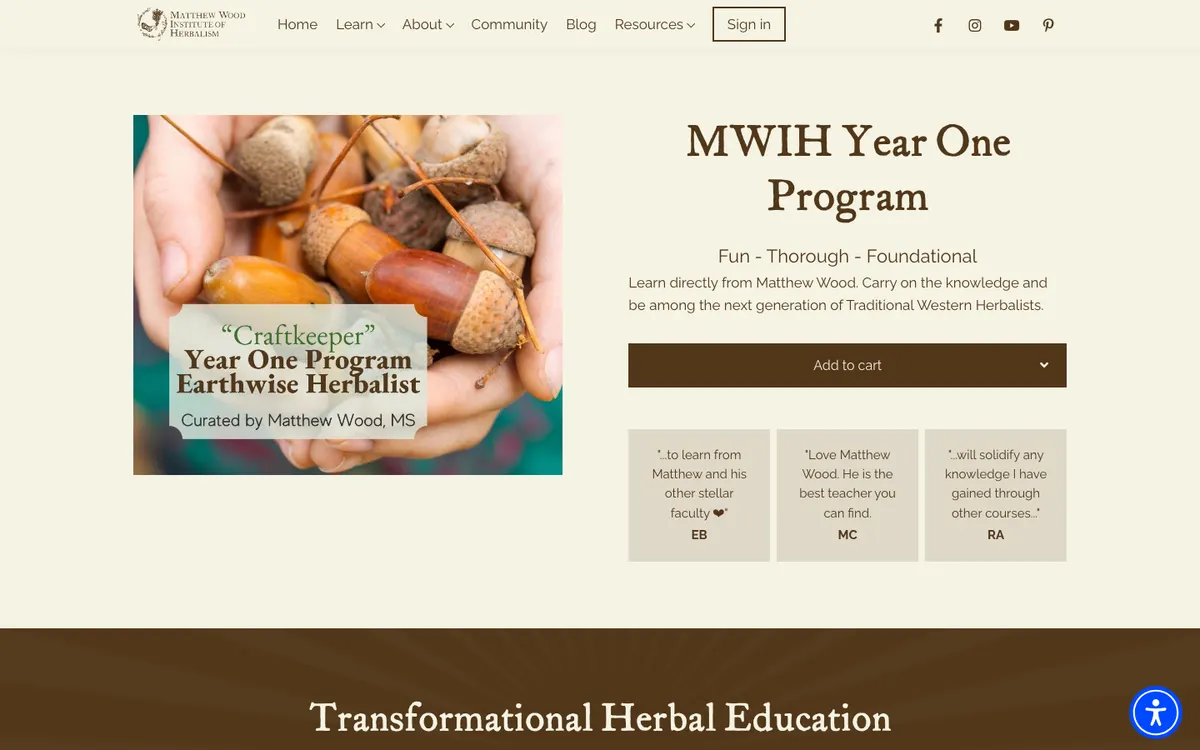
Matthew Wood has practiced herbalism for more than 40 years and written over ten books. On October 30, 2026, the official Year One page showed $2,995 paid once, against a listed $4,125, or 11 payments of $300. Plan about $200 more for required books and medicine-making supplies. Monthly memberships start at $25.
How we reviewed it: we read the Year One page, its long FAQ, the Herbs A-Z membership page and the certificate programs page on October 30, 2026, and compared the institute with the other herbalism programs on our site. We haven’t taken the program.
Some links on this site earn us a commission if you enroll. Your price stays the same. Our rankings are based on our editorial criteria; some partners may be featured more prominently. How we review
Pros & cons
- Direct line to one of the best-known traditional Western herbalists, with a certificate he signs
- Serious depth: 158 hours of video, 2,232+ pages of documents and 157 tests over the year
- A cheap way in: Herbs A-Z membership at $25 a month includes a Starting Path for newcomers
- 30-day refund on Year One, a $300 coupon for passing the prep test, and a transfer program for 100+ hours from other schools
- Course content isn't lifetime access, and 82% of the documents can't be downloaded without a separate purchase
- The whole curriculum is prerecorded; live Q&As and study groups are optional extras
- Heavy workload: 10 hours a week minimum, often 15 to 20 for newer students
- The approach is openly spiritual (plants as living beings), which won't suit every student
The approach in one paragraph
Wood’s school teaches traditional Western herbalism built on energetics, tissue states and the doctrine of signatures, as the Herbs A-Z page puts it, combined with phytochemistry and modern science. Instead of “this herb for that condition,” you learn to read the person in front of you (hot or cold, dry or damp, tense or relaxed) and match the plant to the pattern. Long documents by Matthew Wood and Phyllis D. Light, much of it material written for future books, form a large part of the reading.
A school that tells you when not to enroll
The Year One page has a section titled, plainly, “This is NOT for you if.” It lists: you prefer one-on-one or in-person teaching; you need more check-ins than the school provides; seeing plants as living beings or herbalism as a spiritual practice doesn’t fit your beliefs; reading 2,232 pages of online documents sounds impossible; or you’re very new to herbal studies and not a very studious person.
That’s rare, and useful. Read it twice. If two of those lines describe you, save your money for something else.
What a year looks like
The program runs as a guided year: ten months of curriculum, a catch-up month at month six and an academic review month at month twelve. The school estimates at least 10 hours of study a week, often five to ten more, depending on your background.
Across the year, that adds up to about 158 hours of video, more than 2,232 pages of documents covering the core curriculum and materia medica, and 157 multiple-choice tests. Videos come with closed captions and searchable transcripts, which helps when you’re hunting for the three minutes on one plant you need to review.
Picture a typical week: two evenings watching lessons with a notebook, a Saturday morning reading materia medica pages, a short test on Sunday. On a good month, you also join a live Q&A with a teacher.
Live, but optional
The curriculum itself is prerecorded. Live Q&As and study groups happen at least twice a month, on different days and times to suit different time zones, and recordings are posted within two business days. There’s a private Year 1 community you keep access to for life, and (bi)weekly guidance e-mails to keep you on track.
So think of it as a deep, structured self-study program with live support, not a live class.
The catch: access and downloads
Two limits are worth knowing before paying. First, course content isn’t lifetime access. The FAQ explains that classes are continually reviewed and updated, and that interaction and support cost money to provide. Second, 82% of the documents aren’t downloadable within the program; most are available to download as a separate purchase.
For a $2,995 program, that’s a real cost. If you like to keep your study materials for the rest of your practice, ask how long access lasts after the year ends and what the document download costs.
Paying for it
Paying once costs $2,995. The payment plan, 11 payments of $300, totals $3,300. Payments start the day you enroll and recur on the same date each month; a missed payment can cancel enrollment, so contact the school right away if one fails.
Two ways to pay less: pass the Year One Prep Test with 70% or better for a $300 coupon, or, if you already have 100 or more hours from another school, look at the Transfer Program. The refund policy is clear: e-mail within 30 days of purchase, or of your first plan payment, for a refund.
The cheap way in
If you’re newer, or just curious about this approach, start with the Herbs A-Z membership: $25 a month, or $275 a year. It includes the Starting Path, a ground-level collection for newcomers and for experienced herbalists new to Wood’s way of working, plus new live classes every month on featured herbs. Three months cost $75. That’s enough to know whether the Year One commitment makes sense.
Who should look elsewhere
If you’re a beginner who wants live teaching and a mentor, Ecoversity runs a six-month live cohort with weekly classes for $3,497. If you learn well alone and want more hands-on, kitchen-based instruction, Chestnut School of Herbal Medicine was on sale at $2,999 on our last check. For a cheaper self-paced start, Herbal Academy sells its Introductory course for $349. All are compared in our herbalism courses ranking.
Video: Matthew Wood Institute of Herbalism
Before you enroll
Take the Year One Prep Test. It tells you whether you’re ready and, at 70% or better, saves you $300. Then look at your calendar honestly: can you find 10 to 15 hours every week for a year? If yes, enroll and use the first 30 days to test the workload, while the refund is still open.
Published on the official site: pass the Year One Prep Test with 70% or better to receive a $300 coupon for the Year One Program
↪See offer details and conditionsYear One: refund if you e-mail within 30 days of purchase (or of the first payment-plan payment) (official FAQ, October 30, 2026).
Year One: pay once ($2,995) or 11 monthly payments of $300 ($3,300); memberships monthly or yearly
Matthew Wood Institute of Herbalism vs alternatives
How Matthew Wood Institute of Herbalism stacks up against other herbalism programs we reviewed, on the facts published by each provider.
Swipe sideways to compare all 4 programs →
| Criterion | This review | |||
|---|---|---|---|---|
| Our score | 8.6/10 | 8.7/10 | 8.4/10 | 8.1/10 |
| Price | $25 – $2,995 | $2,999 – $4,056 | $647 | $3,497 – $3,700 |
| Format | Self-paced | Self-paced | Self-paced | Live online |
| Duration | Year-long guided program: 10 months of curriculum plus a catch-up month and a review month; at least 10 hours of study a week (158 hours of video, 2,232+ pages of reading) | 1,200-hour program; full access on enrollment | Self-paced, 10 units and 59 lessons | Six-month live cohort, about 100 hours: a 90-minute live class every Wednesday at 3pm PT (recorded within 24 hours), plus 2 to 4 hours a week of lessons and home medicine-making; Fall 2026 orientation on November 4 |
| Best for | Studious herbal learners with some background who want Matthew Wood's traditional Western, energetics-based approach in depth. | Gardeners and home herbalists who want a long, self-paced program on growing, identifying and making herbal medicine, with strong botany content. | Home herbalists who've finished an introductory course and want to learn formulation and body-system support for their family, at their own pace. | Complete beginners who want to learn herbalism live, in a weekly class with a mentor and a cohort, and make their own home remedies. |
| Read more | You are here | Chestnut School of Herbal Medicine reviewHead-to-head → | Herbal Academy reviewHead-to-head → | Ecoversity review |

“—” means the information was not published or not yet checked. See all 5 herbalism programs.
Score breakdown
In-depth foundational program from a leading traditional herbalist.
Highly regarded teacher; certificate is unaccredited.
$2,995 for a year with live Q&As; cheaper memberships available.
Online, self-paced with optional live sessions.
Live Q&As and study groups at least twice monthly.
Weighted average of five criteria. Read our methodology.
FAQ
How much does the Matthew Wood Institute Year One Program cost?
On October 30, 2026, the official program page showed $2,995 paid once, against a listed $4,125, or 11 payments of $300. Plan about $200 more for books and supplies. Passing the Year One Prep Test with 70% or better earns a $300 coupon.
Is the Matthew Wood Institute good for beginners?
Not Year One, by the school's own account: its page says the program isn't for you if you're very new to herbal studies or don't consider yourself studious. Beginners are pointed to the Herbs A-Z membership ($25 a month), which includes a Starting Path.
Do I keep access to the Year One course forever?
No. The FAQ explains that content isn't lifetime access because classes are continually updated, and most documents aren't downloadable within the program. You do keep lifetime access to the private Year 1 community.
Head-to-head comparisons
Sources
- https://www.matthewwoodinstituteofherbalism.com/
- https://www.matthewwoodinstituteofherbalism.com/herbalism-certificate-programs
- https://www.matthewwoodinstituteofherbalism.com/program/the-vital-herbalist-year-one
- https://www.matthewwoodinstituteofherbalism.com/program/herbs-a-z-monthly-class-monthly-subscription
- https://www.matthewwoodinstituteofherbalism.com/program/build-your-home-apothecary-alberto
- https://www.matthewwoodinstituteofherbalism.com/affiliate-registration
Prices and offers can change; confirm on the official site before you enroll.