On this page · 14 sections5 min read
- 01Our verdict
- 02At a glance
- 03Pros & cons
- 04The garden is part of the classroom
- 05From foundations to body systems
- 06How it’s delivered
- 07What 1,200 hours means in a real week
- 08Who it suits best
- 09The catch: one week to decide, and a big total
- 10If Chestnut isn’t the right fit
- 11Before you enroll
- 12Chestnut School of Herbal Medicine vs alternatives
- 13Score breakdown
- 14FAQ
Our verdict
Our verdict8.7/10Chestnut is the program to choose if you want to grow, identify and make your own herbal medicine, and you're ready for a long, self-paced course: 1,200 hours across 17 modules, with a 1,500-page manual.
On October 30, 2026, it was on sale at $2,999 paid in full (regular $3,749), or 24 payments of $139. If you're after clinical herbalism to work one-on-one with clients, Herbal Academy's Clinical Herbalist Path is closer to that goal; if you just want to try herbalism, start with a cheaper intro course. Mind the short refund window: you have one week after enrolling to change your mind.
Best for: Gardeners and home herbalists who want a long, self-paced program on growing, identifying and making herbal medicine, with strong botany content.
At a glance
The calendula you planted in spring took over half the bed. You’ve made one batch of infused oil from a blog recipe and wondered if you did it right, and there’s a stack of herb books on the nightstand you keep starting over. The Chestnut School of Herbal Medicine’s Online Herbal Immersion Program is built for someone at that point who wants to go the whole way, from seed to tincture.
Chestnut has been teaching herbalism since 2007, through courses created by Juliet Blankespoor. The Herbal Immersion is its flagship: a 1,200-hour, self-paced program with videos, audio and a 1,500+ page manual. On October 30, 2026, the official page showed a sale: $2,999 paid in full instead of $3,749, or 24 monthly payments of $139 instead of $169. No end date was given.
How we reviewed it: we read the program page, its full outline and FAQ on October 30, 2026, and compared Chestnut with the other herbalism programs on our site. We haven’t taken the course.
Some links on this site earn us a commission if you enroll. Your price stays the same. Our rankings are based on our editorial criteria; some partners may be featured more prominently. How we review
Pros & cons
- 1,200 hours over 17 modules, from botany and soil to medicine making, body systems and herbal careers
- 1,500+ page manual, printed and shipped free when you pay in full (continental US, a $249 value)
- Lifetime access to videos, audio downloads and the manual
- Moderators answer questions, in most cases within 24 hours, and there's a student community
- Refund window is only one week after enrolling, short for a program this size
- Payment-plan students don't get the printed manual and pay more in total ($3,336 on sale, $4,056 at the regular price)
- Garden-heavy: budget $200 to $600 for tools and ingredients, and some modules assume you have space to grow
The garden is part of the classroom
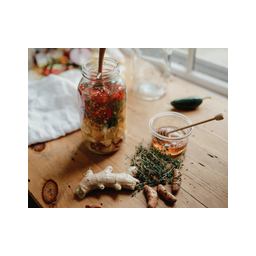
What sets Chestnut apart is how much of the program happens outside. Two of the 17 modules are on soil (organic gardening, then permaculture), one covers common useful garden weeds, another is about propagation and germinating stubborn herb seeds, and the last is a reference guide with regional profiles and habitat lists. You don’t just learn what lemon balm does; you learn how to grow it, when to harvest it and what to make from it.
So picture a Saturday in May: in the morning you follow a propagation lesson and pot up cuttings, in the afternoon you watch the medicine-making video on infusions and decoctions and finally get your ratios right. If you have a balcony at most, you’ll still learn a lot, but you’ll skip part of what you’re paying for.
From foundations to body systems
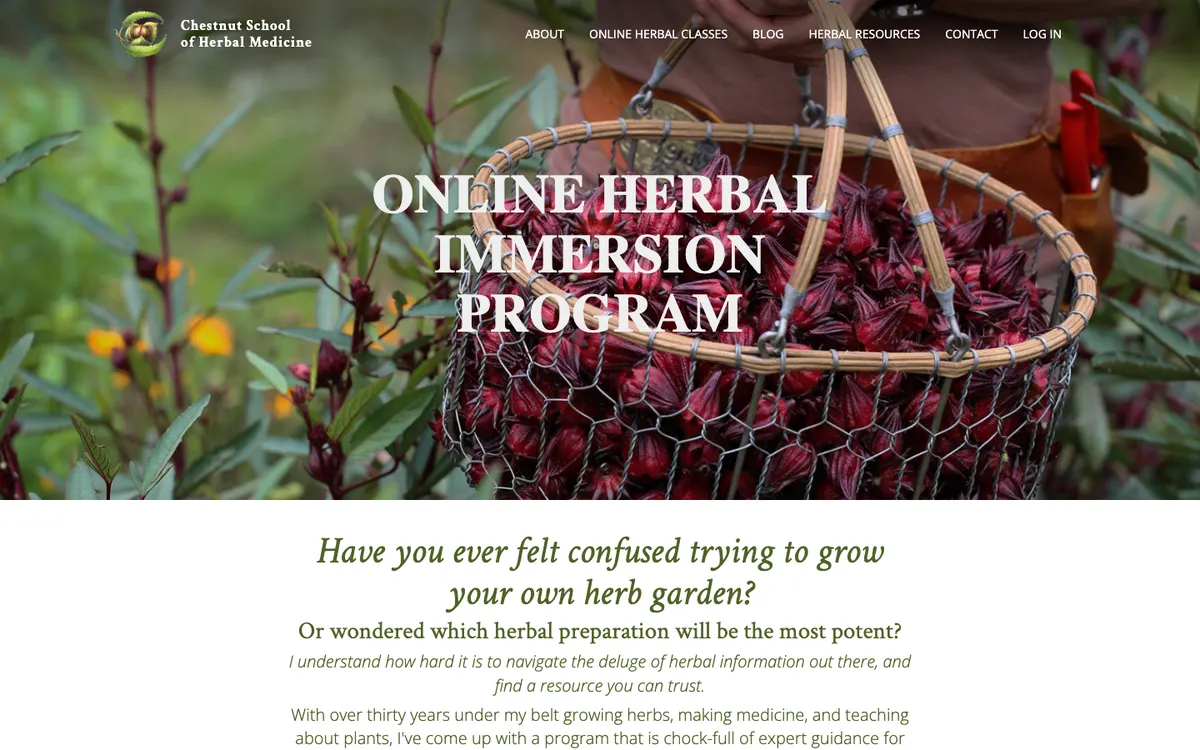
The medical side is solid too. After a foundations module (botany, plant families, herbal actions, ethical wildcrafting), the program works through tonic herbs and adaptogens, then herbs for the immune, digestive, respiratory and nervous systems, and one on the ovarian and reproductive system. Medicine making gets its own modules: core preparations, food as medicine (meads included, which is a nice touch), and topical preparations and natural body care such as infused oils and salves.
Module 16 is about herbal livelihoods and career paths. It won’t hand you a business, but it helps if you’re wondering whether herbs could become part of your income, for example selling plant starts or teaching local classes.
How it’s delivered
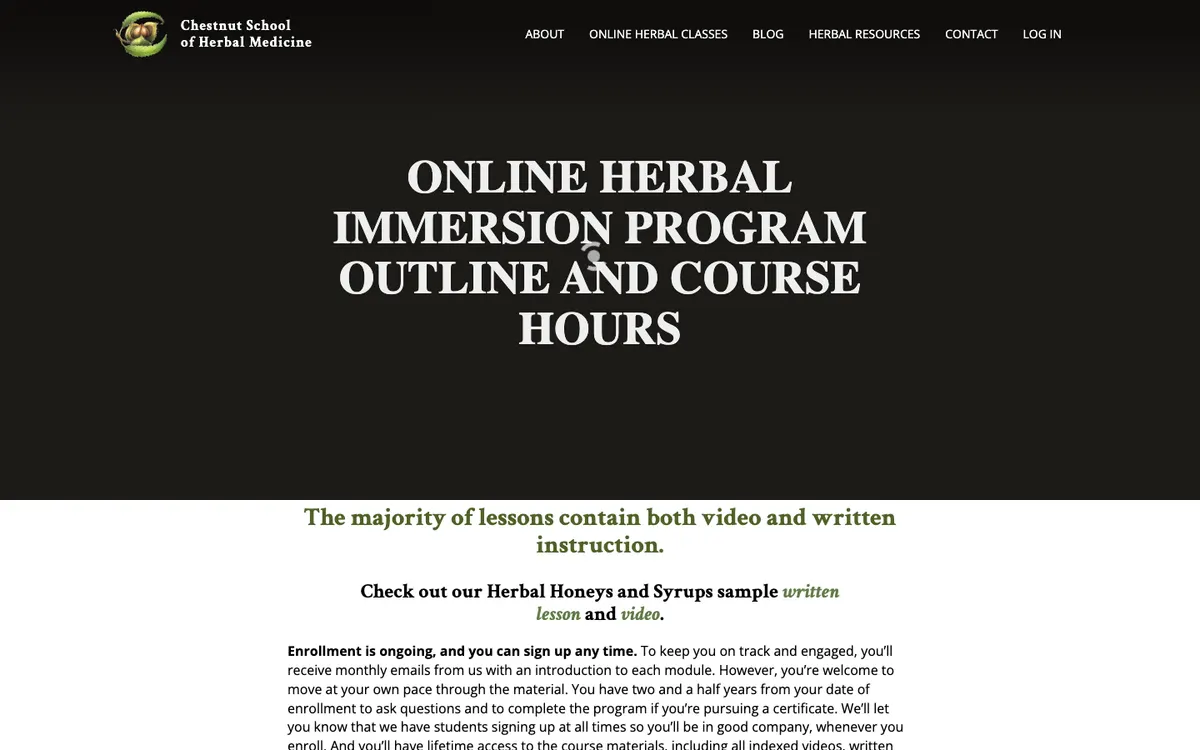
Everything opens on enrollment, and you go at your own pace. The course materials are yours for life: videos, audio downloads of those videos and an interactive 1,500+ page electronic manual. Pay in full and the school also ships the printed manual (five volumes, a $249 value), free in the continental US, once the refund week is over.
Support comes from a team of moderators. The page says most questions are answered within 24 hours, and there’s a community of students to ask as well. The writing, photography and video are original work by the school’s herbalists, which shows in the production quality.
What 1,200 hours means in a real week
Numbers like 1,200 hours are easy to skim past. Spread over a year, that’s about 23 hours a week, close to a part-time job. Over two years, matching the payment plan, it’s roughly 11 or 12 hours a week: a couple of evenings plus a few hours in the garden on the weekend.
Most students will land somewhere in between, and that’s fine, since access never runs out. But be realistic when you enroll. If you can give it four hours a week, you’re looking at five or six years to cover everything, and a shorter Chestnut course might serve you better.
Who it suits best
A home gardener who already grows vegetables and wants to add a medicine garden. A parent who wants to make the family’s teas, syrups and salves with some confidence. Someone thinking about a small herbal business (plant starts, farmers’ market products, local workshops) who wants a foundation before investing. All three get value from both the growing and the medicine-making halves of the program.
Video: Chestnut School of Herbal Medicine
The catch: one week to decide, and a big total
The refund window is short: a complete refund up to one week after you enroll. For a 1,200-hour program, that’s barely enough to finish the first lessons.
The cost adds up too. Even on sale, the payment plan totals $3,336 over two years, and at the regular $169 it’s $4,056, without the printed manuals. Add the school’s own estimate of $200 to $600 for tools and ingredients. Herbalism isn’t licensed in the US, so there’s no accreditation that turns this into a credential; you’re paying for knowledge and skills.
Two ways to bring the price down: the school offers need-based scholarships, and a $200 per-student discount when three or more people enroll together (not combinable with a sale).
If Chestnut isn’t the right fit
For a clinical path aimed at working with clients, Herbal Academy sells a Clinical Herbalist Path package (4 courses, 900 study hours), which was $3,249 on sale on our last check. Its introductory course was $349, a cheaper way to test the waters.
Ecoversity was $3,497 one-time on our last check, with installment plans. If you prefer a more traditional, energetic approach, the Matthew Wood Institute of Herbalism has memberships from $25 a month.
Compare all of them in our herbalism courses ranking.
Before you enroll
Read the full outline and the list of plants covered, and check how many grow where you live. Look at the course comparison chart too, since Chestnut has shorter programs. If you go for the Immersion, enroll on a week when you can actually start, so you’ve seen enough before the 7-day refund window closes.
Sale shown on the official page on October 30, 2026: 'Save 20% today', $2,999 paid in full instead of $3,749, or $139 a month instead of $169 for 24 months. No end date shown.
↪See offer details and conditionsFull refund up to 1 week after you enroll (official program page, October 30, 2026); printed manuals ship after that week.
24 monthly payments ($139 on sale on October 30, 2026; $169 regular)
Chestnut School of Herbal Medicine vs alternatives
How Chestnut School of Herbal Medicine stacks up against other herbalism programs we reviewed, on the facts published by each provider.
Swipe sideways to compare all 4 programs →
| Criterion | This review | |||
|---|---|---|---|---|
| Our score | 8.7/10 | 8.6/10 | 8.4/10 | 8.1/10 |
| Price | $2,999 – $4,056 | $25 – $2,995 | $647 | $3,497 – $3,700 |
| Format | Self-paced | Self-paced | Self-paced | Live online |
| Duration | 1,200-hour program; full access on enrollment | Year-long guided program: 10 months of curriculum plus a catch-up month and a review month; at least 10 hours of study a week (158 hours of video, 2,232+ pages of reading) | Self-paced, 10 units and 59 lessons | Six-month live cohort, about 100 hours: a 90-minute live class every Wednesday at 3pm PT (recorded within 24 hours), plus 2 to 4 hours a week of lessons and home medicine-making; Fall 2026 orientation on November 4 |
| Best for | Gardeners and home herbalists who want a long, self-paced program on growing, identifying and making herbal medicine, with strong botany content. | Studious herbal learners with some background who want Matthew Wood's traditional Western, energetics-based approach in depth. | Home herbalists who've finished an introductory course and want to learn formulation and body-system support for their family, at their own pace. | Complete beginners who want to learn herbalism live, in a weekly class with a mentor and a cohort, and make their own home remedies. |
| Read more | You are here | Matthew Wood Institute of Herbalism reviewHead-to-head → | Herbal Academy reviewHead-to-head → | Ecoversity review |

“—” means the information was not published or not yet checked. See all 5 herbalism programs.
Score breakdown
1,200 hours across foundations, botany and medicine making.
Respected school and instructors; no formal accreditation exists for herbalism.
High price, but very large curriculum and materials.
Full access at enrollment; self-paced.
Instructor-made content; limited live interaction described.
Weighted average of five criteria. Read our methodology.
FAQ
How much does the Chestnut Herbal Immersion Program cost?
On October 30, 2026, the official page showed a sale: $2,999 paid in full instead of $3,749, or 24 monthly payments of $139 instead of $169. No end date was given for the sale. The school also estimates $200 to $600 for tools and ingredients.
What is Chestnut's refund policy?
A complete refund up to 1 week after you enroll, according to the program page on October 30, 2026. The printed manuals for pay-in-full students ship once that week has passed.
Is there a discount for groups?
Yes. Chestnut takes $200 off tuition for each student when three or more enroll together. It can't be combined with other offers or used during a sale, so compare it with the current sale price.
Head-to-head comparisons
Sources
- https://chestnutherbs.com/
- https://chestnutherbs.com/online-herbal-classes/online-herbal-immersion-program/
- https://chestnutherbs.com/about/instructors/
- https://chestnutherbs.com/sustainable-herbalism/
Prices and offers can change; confirm on the official site before you enroll.