On this page · 15 sections6 min read
- 01Our verdict
- 02At a glance
- 03Pros & cons
- 04What you’ll learn
- 05Format, schedule and time commitment
- 06Accreditation and what the credential is worth
- 07Price, payment plans and refunds
- 08Who it’s best for — and who should skip it
- 09Pros and cons in detail
- 10How it compares
- 11Peltier Photo Courses vs alternatives
- 12How to enroll
- 13Score breakdown
- 14Key facts
- 15FAQ
Our verdict
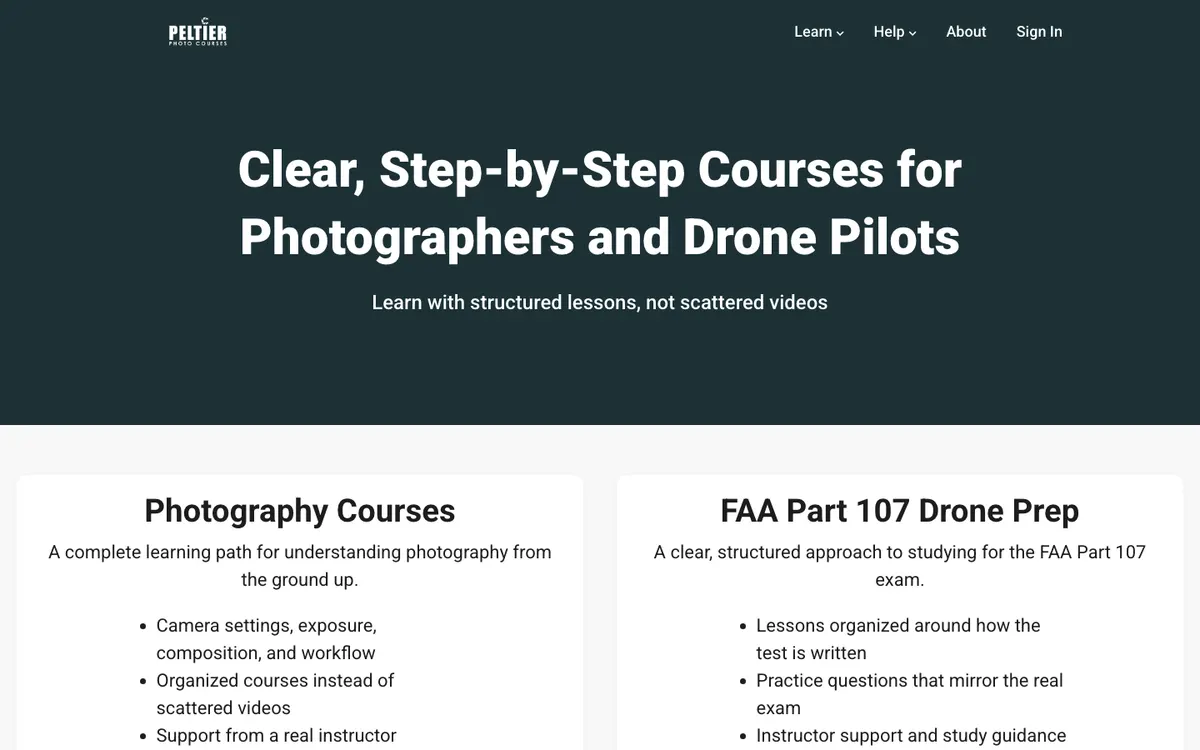
Our verdict8.7/10Peltier Photo Courses is a small, instructor-run school offering photography courses, such as black-and-white and Fujifilm-specific classes, alongside an FAA Part 107 drone exam course.
Courses are self-paced with lifetime access and updates, but they also include assignments and feedback, which is uncommon at this price. Photography courses run from about $59 to $129, the Part 107 course is $149 with a guarantee covering both the test fee and course cost if you fail, and a 335-question practice bank costs $15. The catalog is small and tied to one instructor, so browse previews to see if the style suits you. It is a good fit for hobbyists who want personal feedback.
Best for: Photographers who want instructor-led courses with assignments and feedback, or a Part 107 drone exam course.
At a glance
Peltier Photo Courses is a small, instructor-run school offering photography courses, such as black-and-white and Fujifilm-specific classes, alongside an FAA Part 107 drone exam course. Courses are self-paced with lifetime access and updates, but they also include assignments and feedback, which is uncommon at this price. Photography courses run from about $59 to $129, the Part 107 course is $149 with a guarantee covering both the test fee and course cost if you fail, and a 335-question practice bank costs $15. The catalog is small and tied to one instructor, so browse previews to see if the style suits you.
Pros & cons
- Instructor-led courses with assignments and feedback
- Lifetime access and updates
- Affordable courses from $59
- Part 107 course with pass-or-refund guarantee
- Smaller catalog than large platforms
- Single-instructor brand
What you’ll learn
Peltier’s photography catalog includes a free Exposure Triangle course, a creative-fundamentals course, and Fujifilm-specific instruction. The creative course covers seeing light, composition, color, and black-and-white work, while the Fujifilm course addresses using that camera system. These are different learning objectives, so choose the subject that matches the current obstacle in your photography.
The school emphasizes assignments, quizzes, and feedback in addition to lessons. That can connect an explanation with photographs you actually make rather than leave learning at the demonstration stage. Ask how feedback is submitted and what response is included in the selected course, because the general catalog does not establish identical review arrangements for every product.
Format, schedule and time commitment
Photography courses are self-paced and include lifetime access and updates. That gives you a chance to return to a camera technique or creative concept after trying it in the field. The separate practice-test bank has only two months of access, so check the product type rather than applying the lifetime promise to every purchase.
The practice-test bank is a separate product with two months of access, so the broad lifetime wording should not be applied to every item in the store. For photography learning, reserve time to make images between lessons and return with specific questions. Viewing a demonstration and successfully using the technique in unfamiliar light or a different setting are separate stages of practice.
Accreditation and what the credential is worth
Peltier’s photography courses are presented as skill development, without an accredited academic or professional photography credential established in the offer. Assess their value through the instruction, assignments, and photographs you make. The feedback component may matter more to that goal than the presence of a completion award.
The separate Part 107 course prepares for an exam but does not issue the FAA remote pilot certificate. Keep that aviation route distinct from photography lessons and verify official eligibility and certification steps independently. Any completion document attached to a particular product should not be presented as an external license or proof of client-ready expertise across every photographic subject.
Price, payment plans and refunds
Photography courses range from about $59 to $129. The FAA Part 107 course costs $149, while a separate practice bank is $15. The aviation course carries a pass-or-refund guarantee covering the test fee and course cost; that promise belongs to the Part 107 purchase.
The catalog lists Creative Photography Fundamentals at $59 and Fujifilm Photography Fundamentals at $129. The Part 107 course is a separate $149 purchase, while its practice bank is listed at $15 with limited access. The lowest catalog price therefore does not represent a complete photography course or the full aviation-preparation package.
The Part 107 pass-or-refund promise refers to that specific course and includes stated test-fee and course-cost coverage. It should not be assumed to define refunds for photography courses. Ask about the selected product’s access and cancellation terms, and inspect the free introductory material before deciding whether the instructor’s explanations suit you.
Part 107 course: pass-or-refund guarantee covering test fee and course cost.
No public discount was listed on the official site when we checked. We never publish unverified coupon codes.
Who it’s best for — and who should skip it
Hobbyists who want assignments and personal feedback have a clear reason to consider Peltier’s smaller school. A developing photographer can follow a defined sequence, try the ideas, and return with their own images. The Fujifilm course is especially relevant when using that camera system confidently matters more than exploring a large genre library.
Skip it if the main goal is a large multi-instructor subscription covering many specialties at once. The smaller catalog may not contain the advanced genre or software topic you need. A drone candidate should also select the dedicated Part 107 product rather than assume a photography course includes examination preparation because both appear on the same site.
Pros and cons in detail
- Assignments with feedback: Instructor-led courses connect explanations to practical work.
- Continuing course access: Lifetime access and updates support later reference.
- Accessible starting prices: Photography courses begin at $59.
- A separate aviation route: The Part 107 course includes its advertised pass-or-refund protection.
- Fewer subjects: The catalog is smaller than large membership platforms.
- One teaching identity: The school relies on a single instructor, making previews especially useful.
Assignments and instructor feedback are the main reasons to consider a smaller school. A defined course can also reduce the distraction of choosing among hundreds of unrelated tutorials, while one-time photography purchases provide a different commitment from ongoing library access. The free exposure course offers an inspectable starting point.
The limitations are catalog breadth and reliance on one teaching identity. That is not evidence of poor quality, but it makes previewing the instructor particularly important. Lifetime course access also should not be generalized to the time-limited practice bank. Evaluate the exact product’s feedback, content, and terms rather than treat every catalog item as the same package.
How it compares
The School of Photography Membership offers a broader library of genre courses, assignments, critiques, and more than 100 hours of webinar replays. Monthly access is $22 or GBP 16; annual access is $155 or GBP 115, roughly $13 per month when billed yearly. Recurring membership may suit several planned subjects better than one focused purchase. Compare the models in the side-by-side comparison.
KelbyOne Membership combines photography and Adobe instruction with a new course every week. Its displayed prices are $19.99 monthly instead of $24.99, or $199 annually instead of $249, an approximate $16.58 monthly equivalent. That brings greater catalog variety, but community interaction should not be assumed identical to Peltier’s assignment feedback. See the side-by-side comparison.
A single Peltier course and an annual library membership should be compared according to the subjects you will actually study. One camera-specific course can be sufficient for a clear problem, while a membership becomes more attractive when several genres or editing skills are planned.
Look closely at what each provider means by feedback. Community discussion, a critique event, and individual assignment assessment offer different forms of help. Ask who would respond to your photographs and how often; the usefulness of that interaction may outweigh the number of courses available.
Continue exploring in the Photography category. Our review methodology explains how curriculum, credibility, value, flexibility, and support inform the assessment of Peltier’s smaller, feedback-oriented school.
Peltier Photo Courses vs alternatives
How Peltier Photo Courses stacks up against other photography programs we reviewed, on the facts published by each provider.
Swipe sideways to compare all 4 programs →
| Criterion | This review | |||
|---|---|---|---|---|
| Our score | 8.7/10 | 8.8/10 | 8.8/10 | 8.1/10 |
| Price | $15 – $149 | $19.99 – $199 | $22 – $155 | — |
| Format | Self-paced | Subscription | Subscription | Subscription |
| Duration | Self-paced with lifetime access and updates (practice bank: 2 months). | Membership; a new course every week. | Membership; 100+ hours of recorded webinars plus courses. | Self-paced. |
| Best for | Photographers who want instructor-led courses with assignments and feedback, or a Part… | Photographers who want ongoing Lightroom, Photoshop and photography training from… | Hobbyist photographers who want a broad library of genre courses and recorded webinars at… | Photographers who want structured Lightroom and Photoshop editing lessons plus… |
| Read more | You are here | KelbyOne reviewHead-to-head → | The School of Photography reviewHead-to-head → | Lightroom & Photoshop Tutorials (LRPS) review |


“—” means the information was not published or not yet checked. See all 5 photography programs.
How to enroll
Begin with the free Exposure Triangle course or inspect the catalog listing that matches the camera or skill being studied. Open the selected course and verify its price, lessons, assignments, and feedback arrangements before enrollment.
For the Part 107 route, distinguish the complete course from the separate practice bank and confirm the relevant guarantee. For photography, obtain the product-specific refund and access terms. Plan time to complete assignments with your own images so the course’s practical component is actually used.
Peltier photography and Part 107 course information, with membership comparisons, consulted October 5, 2026: source 1, source 2, source 3.
Score breakdown
Focused photography and Part 107 courses with assignments.
FAA-certified instructor; small independent school.
Courses from $59 with lifetime access.
Self-paced.
Assignments with instructor feedback.
Weighted average of five criteria. Read our methodology.
Key facts
FAQ
Do Peltier courses include feedback?
Yes, the site describes instructor-led courses with assignments and feedback.
What is the Part 107 guarantee?
If you do not pass, the instructor refunds the test fee and course cost.
Head-to-head comparisons
Sources
Information checked on October 5, 2026. Prices and offers can change; confirm on the official site.